
Condé Pink Diamond
History of the Condé Pink Diamond
The Condé Pink Diamond, also known as the Grand Condé or Condé Diamond, is one of Europe's celebrated historic colored diamonds.
Weighing approximately 9.01 carats, the pear-shaped diamond is distinguished by its rare natural pink color and its centuries-long association with the Princes of Condé and the Château de Chantilly in France.
Its unusual color, aristocratic provenance, historic importance and dramatic twentieth-century theft have helped make the Grand Condé one of the best-known historic pink diamonds in the world.
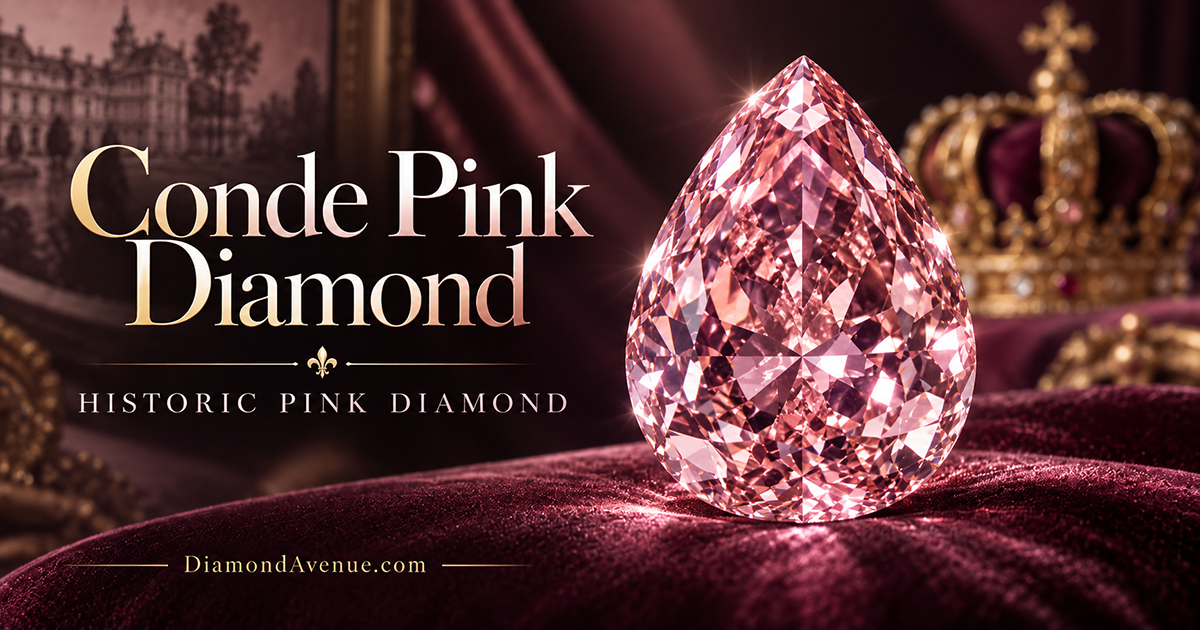
The Grand Condé at a Glance
Name: Condé Pink Diamond / Grand Condé / Condé Diamond
Weight: Approximately 9.01 carats
Shape: Pear-shaped
Color: Natural pink with a slightly orangey hue
Dimensions: Approximately 20.2 mm × 14.2 mm × 4.8 mm
Historic Association: Princes of Condé
Present Collection: Musée Condé, Château de Chantilly, France
Louis II de Bourbon, Prince of Condé
The diamond takes its name from Louis II de Bourbon, Prince of Condé, who lived from 1621 to 1686 and became one of the most celebrated French military commanders of the seventeenth century.
Known to history as Le Grand Condé, he gained fame while still a young man through important military victories during the Thirty Years' War.
His victory over Spanish forces at the Battle of Rocroi in 1643 established his reputation as one of the leading commanders of his generation.
The historic pink diamond became so closely associated with the prince and his descendants that it eventually came to share his famous title: Le Grand Condé.
The Grand Condé

Louis II de Bourbon became known as Le Grand Condé because of his military achievements and his prominent role in French history.
The diamond bearing his name remains one of the most enduring objects associated with the House of Condé.
How Did the Prince of Condé Acquire the Diamond?
The earliest history of the Condé Pink Diamond is surrounded by tradition, and some details repeated over the centuries cannot be documented with certainty.
One traditional account maintains that the diamond was presented to Louis II de Bourbon by the French monarchy in recognition of his military service. King Louis XIII is sometimes credited with presenting the diamond around the time of the Prince's victory at Rocroi in 1643, while other accounts associate the gift with King Louis XIV.
Museum records are more cautious. The diamond is described as having apparently belonged to Louis II de Bourbon-Condé, and tradition holds that it may once have decorated the pommel of his cane.
What is more securely established is that the diamond was preserved by the Condé family and is documented within the collections of the Princes of Condé by at least the eighteenth century.
An Extraordinary Natural Pink Color
The most recognizable characteristic of the Grand Condé is its unusual natural pink coloration.
The diamond has been described as pink with a slightly orangey hue, giving it a distinctive appearance among historic colored diamonds.
In many natural pink diamonds, the color is associated with microscopic deformation within the diamond's crystal lattice.
These structural changes affect the way certain wavelengths of visible light are absorbed as light passes through the stone, producing the pink color seen by the human eye.
Why Pink Diamonds Are So Unusual
Naturally colored pink diamonds are among the more unusual varieties found in nature.
Their desirability is influenced by the strength and evenness of their color, carat weight, clarity, cut and provenance.
In historic diamonds such as the Grand Condé, however, significance extends beyond gemological qualities alone.
Its connection with one of France's most important aristocratic families makes the diamond both a rare gemstone and an important historic artifact.
Possible Indian and Golconda Origin
The Condé Pink Diamond has long been associated with India, which during the seventeenth century was the world's principal known source of important diamonds.
Many exceptional diamonds that reached European royal and aristocratic collections during this period came from mining regions historically associated with Golconda.
The Kollur Mine, located in what is now Andhra Pradesh, was among the most important diamond-producing sites in southern India.
A number of celebrated historic diamonds have been linked with this region, although the precise mine from which the Condé Pink Diamond originated has not been conclusively established.
Jean-Baptiste Tavernier
The name of Jean-Baptiste Tavernier frequently appears in the history of seventeenth-century diamonds.
Tavernier was a French merchant, traveler and gem dealer who made several journeys through Persia and India.
His travels made him one of Europe's most important sources of information about the great diamonds and gemstones of Asia.
A Possible Route to France
Tavernier acquired and traded important gemstones and eventually sold a substantial collection of diamonds to King Louis XIV of France.
For this reason, some historical accounts have suggested that Tavernier may have played a role in bringing the Condé Pink Diamond to France.
A direct connection between Tavernier and this particular diamond has not been conclusively proven.
His career nevertheless illustrates the international trade routes by which important Indian diamonds reached European royal courts.
Preserved by the House of Condé
The diamond remained associated with the House of Condé for generations.
The Princes of Condé were a cadet branch of the House of Bourbon and occupied an important position in French aristocratic, military and political life.
Their collections eventually became closely associated with the Château de Chantilly, one of France's most important historic estates.
Henri d'Orléans, Duke of Aumale
The Château de Chantilly and its collections eventually passed to Henri d'Orléans, Duke of Aumale, son of King Louis-Philippe of France.
A passionate collector, the Duke assembled and preserved an extraordinary collection of paintings, manuscripts, decorative arts and historic objects at Chantilly.
The Grand Condé became part of this remarkable collection of objects associated with French history.
From a Princely Collection to the Musée Condé
In the late nineteenth century, the Duke of Aumale arranged for the Château de Chantilly and its collections to pass to the Institut de France.
The collections preserved at Chantilly became known as the Musée Condé.
The museum preserves paintings, manuscripts, decorative arts and historic treasures accumulated by generations of collectors.
The Condé Pink Diamond remains among the museum's most distinctive historic objects.
The Great Theft of 1926
One of the most dramatic events in the history of the Grand Condé occurred in October 1926.
Thieves broke into the Château de Chantilly and stole the famous pink diamond along with other valuable objects from the museum's collection.
The disappearance of such a recognizable historic jewel attracted considerable attention.
Selling the diamond intact presented the thieves with an obvious problem. Its unusual color, shape and well-known history made it extremely difficult to dispose of without attracting suspicion.
A Diamond Hidden in an Apple
The recovery of the Grand Condé became almost as memorable as the robbery itself.
During the investigation, the famous diamond was discovered concealed inside an apple.
This unusual hiding place became one of the most memorable details associated with the history of the gemstone.
Recovery of the Grand Condé
Fortunately, the diamond was recovered and returned to the Château de Chantilly.
Its recovery ensured that one of the most important objects associated with the Princes of Condé remained preserved within its historic collection.
The theft and recovery added another remarkable chapter to a history already spanning several centuries.
Rare Pink Color
Its natural pink coloration and subtle orangey hue make the Grand Condé visually distinctive among historic diamonds.
Royal and Aristocratic Provenance
Its centuries-long association with the Princes of Condé gives the stone historical importance far beyond its size alone.
Extraordinary History
Centuries of preservation, French aristocratic history, a sensational theft and an unusual recovery have made the diamond especially memorable.
Modern Study of a Historic Diamond
The Grand Condé continues to attract the attention of historians, gemologists and jewelry scholars.
Modern gemological analysis can reveal information about the diamond's structure, natural color, cutting history and physical characteristics.
Historical research can also help distinguish documented provenance from the traditions and legends that accumulated around the diamond over several centuries.
This combination of historical research and modern gemology continues to improve our understanding of one of France's most celebrated historic diamonds.
The Legacy of the Condé Pink Diamond
The fame of the Condé Pink Diamond cannot be attributed to a single characteristic.
Its 9.01-carat weight is notable, its natural pink color is unusual, and its association with one of France's most important princely families gives it exceptional historical provenance.
Equally important is the remarkable continuity of its story. The diamond survived political upheaval, changes in ownership and one of the most memorable museum robberies of the twentieth century.
Today, the Grand Condé is more than a rare gemstone. It is a surviving link between the historic Indian diamond trade, the French aristocracy, the collections of Chantilly and the modern scientific study of naturally colored diamonds.