
Facts About Fancy Green Diamonds
Fancy Green Diamonds
Natural fancy green diamonds are among the rarest and most fascinating colored diamonds in the world. Their colors can range from delicate mint and yellowish green to vivid grass green, forest green and deep green.
Unlike many other fancy-color diamonds whose colors result primarily from trace elements or deformation of the crystal lattice, the green color in many natural diamonds develops after the diamond has formed through exposure to naturally occurring radiation within the earth.
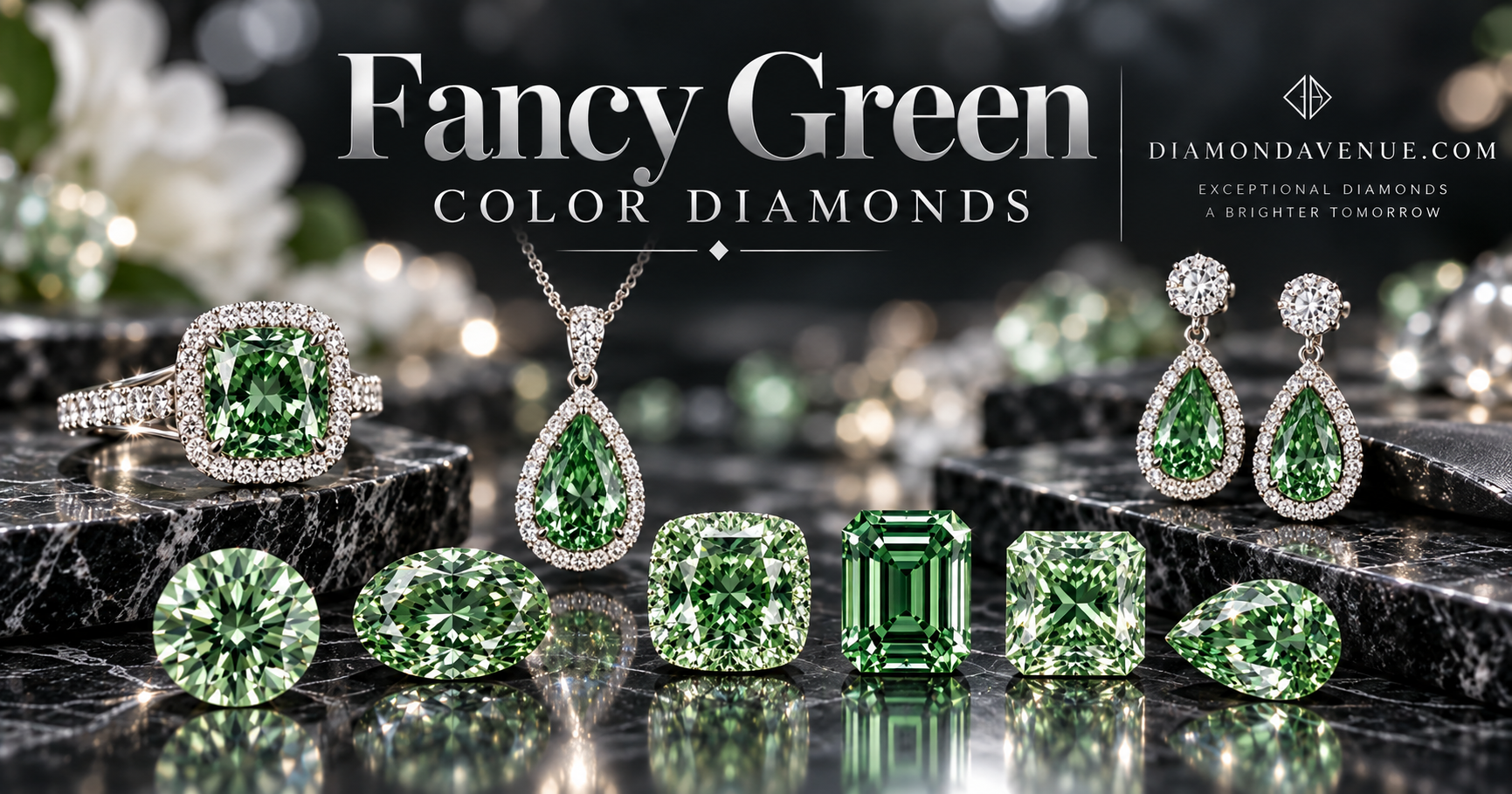
Fancy Green Diamonds
Natural green diamonds can display an extraordinary range of colors, from pale green to intensely saturated green, sometimes accompanied by yellow, brown, gray, blue or other modifying hues.
What Are Fancy Green Diamonds?
Fancy green diamonds are natural diamonds whose dominant visible body color is green and whose color is sufficiently strong to fall within the fancy-color diamond grading system.
Natural green diamonds are exceptionally uncommon. Strongly saturated examples are particularly rare, and stones displaying an attractive green color without significant modifying hues can be among the most desirable colored diamonds.
Green diamonds have been recovered from several diamond-producing regions of the world, including Africa, South America, India, Australia and Russia. However, the color itself is not associated with one particular mine or geographic region.
Why Are Green Diamonds So Rare?
A diamond must first form naturally deep within the earth and then encounter the unusual geological conditions capable of altering its crystal lattice in a way that produces visible green coloration.
In many cases, radiation affects only the outermost surface of the rough diamond. Much of this shallow green coloration may be removed when the diamond is cut and polished.
Diamonds in which attractive green color penetrates deeply enough to remain visible throughout a finished gemstone are therefore considerably less common.
What Causes a Diamond to Become Green?
The most familiar cause of natural green color in diamonds is exposure to naturally occurring radiation while the diamond remains buried in the earth.
Radiation can originate from radioactive minerals or fluids within the surrounding geological environment. Energetic particles can strike the diamond and displace carbon atoms from their normal positions within the crystal lattice.
These displaced carbon atoms leave behind vacant positions known as lattice vacancies. One important radiation-related defect is known as the GR1 center, or General Radiation 1 defect.
GR1 defects absorb certain wavelengths of visible light. Because portions of the red region of the spectrum are absorbed, the remaining visible light can give the diamond a green or blue-green appearance.
Natural Radiation and the Diamond Crystal
Natural radiation does not ordinarily make a diamond radioactive. Instead, radiation changes portions of the diamond's atomic structure.
Different forms of radiation penetrate diamond to different depths. Some produce extremely shallow damage near the surface, while more penetrating radiation can affect deeper portions of the crystal.
This helps explain why rough green diamonds frequently display patches or areas of green radiation staining on their natural surfaces.
Green Radiation Stains
Rough diamonds exposed to natural radiation may develop green spots, patches or broader areas of green coloration on their surfaces.
Gemologists commonly refer to these features as radiation stains or, when more broadly distributed, as a green radiation skin.
These stains can provide important evidence that a diamond experienced natural radiation during its geological history.
Because some surface stains are extremely shallow, much of the original coloration may disappear during cutting and polishing.
Not All Green Diamonds Get Their Color the Same Way
Natural radiation damage is the best-known cause of green color in diamonds, but it is not the only possible cause.
Gemological research has identified several mechanisms capable of producing or contributing to green coloration.
- Radiation-related GR1 lattice defects
- H3 defects
- Hydrogen-related defects
- Nickel-related defects
A single diamond may contain more than one color-producing mechanism, making the scientific identification of natural green color especially challenging.
Heat Can Alter Radiation Damage
Diamonds can remain within the earth for enormous periods of geological time after exposure to radiation.
During that period they may also experience elevated temperatures. This natural heating, sometimes called geological annealing, can alter radiation-related defects within the crystal lattice.
The final color of a natural green diamond can therefore represent a complex combination of radiation exposure, crystal defects and subsequent geological heating.
Green Color Can Change
Certain radiation-damaged areas of diamond are sensitive to heat.
Some green radiation stains can change toward olive or brown shades when exposed to sufficiently high temperatures.
Brown radiation stains found on some natural diamonds may therefore represent areas that originally experienced radiation-related green coloration and were later altered by heat.
Secondary Colors and Modifying Hues
Natural green diamonds frequently contain additional colors that modify the dominant green appearance. These secondary hues can significantly affect both appearance and rarity.
Yellow-Green
Yellow is a common modifying color in green diamonds and can produce appearances ranging from fresh lime green to deeper olive or grassy tones.
Brown or Gray-Green
Brown and gray modifiers can produce more subdued green colors. These diamonds may appear olive, mossy, smoky or muted depending upon the strength of the modifying hue.
Blue-Green
Green diamonds containing a noticeable blue component can display striking teal, aqua or blue-green appearances. Attractive naturally colored examples can be exceptionally uncommon.
Pure Green Diamonds
Green diamonds displaying little or no obvious secondary color are exceptionally rare.
When a natural diamond combines a predominantly green hue with strong saturation, attractive tone and even color distribution, it can become a highly desirable collector gemstone.
As with other fancy-color diamonds, increasing purity and intensity of an already rare color can have a major effect on market value.
Color Distribution
The distribution of green color throughout a diamond is particularly important.
Some rough diamonds possess only localized green surface stains, while others contain deeper zones of green coloration.
An unusually even and deeply penetrating body color can distinguish an exceptional green diamond from one whose coloration is concentrated mainly near the surface.
Fancy Green Diamond Color Grading
Fancy-color diamonds are evaluated according to characteristics that include hue, tone and saturation.
- Hue — the dominant color and any modifying colors visible in the diamond.
- Tone — how light or dark the color appears.
- Saturation — the strength or intensity of the color.
Depending upon the color appearance, fancy-color terminology can include:
- Fancy Light
- Fancy
- Fancy Intense
- Fancy Vivid
- Fancy Deep
- Fancy Dark
The exact grade depends upon the combined hue, tone and saturation of the individual diamond.
Natural or Treated Green?
One of the most important issues involving green diamonds is determining whether their color developed naturally within the earth or was produced through artificial treatment.
Diamonds can be irradiated artificially to create green coloration that may resemble naturally irradiated material.
Because natural and laboratory-induced radiation can produce some of the same types of crystal defects, distinguishing between them can be difficult.
Laboratory Testing Is Important
Valuable green diamonds should be examined by a respected independent gemological laboratory.
Gemologists may use microscopy, ultraviolet-visible spectroscopy, infrared spectroscopy, photoluminescence and other advanced techniques when evaluating the origin of a diamond's color.
Even with sophisticated instruments, determining whether green color is natural can sometimes be more complicated than determining the origin of color in many other fancy-color diamonds.
The Famous Dresden Green Diamond
One of the world's most famous natural green diamonds is the approximately 41-carat Dresden Green Diamond.
The Dresden Green is particularly important because its green coloration extends throughout much of the gemstone rather than being confined primarily to shallow surface radiation stains.
The diamond also has a documented history extending back centuries, long before artificial irradiation of diamonds became possible.
Its combination of size, natural green body color, historical importance and exceptional rarity has made the Dresden Green one of the best-known fancy-color diamonds in the world.
Cut and Green Color
The cutter of a fancy green diamond must consider both the value of the rough diamond and the distribution of its color.
Because some rough green diamonds possess only shallow radiation-related coloration, excessive removal of material during cutting can reduce or eliminate desirable green areas.
The final shape and proportions may therefore be selected partly to preserve or enhance the visible face-up color.
Preserving Natural Green Skin
In some cases, cutters intentionally preserve small portions of a rough diamond's natural green radiation staining near the girdle or pavilion.
When properly positioned, these areas may contribute visible green color when the diamond is viewed face-up.
Preserved natural surfaces can also provide gemologists with valuable evidence concerning the diamond's geological exposure to radiation.
What Determines the Value of a Fancy Green Diamond?
Because natural green diamonds are so rare, individual stones can vary enormously in value. Important factors include natural color origin, color intensity, color purity, carat weight, color distribution, cut and clarity.
Natural Color Origin
Confirmation that the green color is naturally occurring is critical for valuable collector diamonds.
Color Intensity
Strong, attractive green saturation can greatly affect desirability, particularly when the color remains vivid without becoming excessively dark.
Color Purity
Predominantly green diamonds without substantial brown, gray or yellow modifiers are exceptionally uncommon and can command significant premiums.
Carat Weight
Large naturally colored green diamonds are extremely difficult to find, making size an important rarity factor.
Color Distribution
Attractive, evenly distributed green body color is generally more desirable than patchy or localized coloration.
Clarity and Cut
Clarity and cut remain important, but with rare fancy-color diamonds, exceptional natural color can outweigh minor clarity characteristics.
Fancy Green Diamonds in Jewelry
Green diamonds can create some of the most distinctive jewelry designs found among fancy-color diamonds.
Their colors can complement:
- Platinum
- White gold
- Yellow gold
- Rose gold
- Colorless diamond halos
- Yellow diamond accents
- Pink diamond accents
Engagement Rings and Collector Jewelry
A natural fancy green diamond can provide a rare and unusual centerpiece for an engagement ring or important piece of collector jewelry.
Pale green diamonds may produce a subtle and elegant appearance, while stronger green diamonds can provide dramatic color contrast.
Because of their rarity and the difficulty of verifying natural color origin, independent laboratory certification is especially important for significant green diamond purchases.
Buying a Fancy Green Diamond
Buyers considering an important natural green diamond should examine more than the stone's commercial color description.
Important considerations include:
- Obtain a grading report from a recognized independent gemological laboratory.
- Confirm whether the diamond is natural or laboratory-grown.
- Confirm whether the green color is natural or the result of treatment.
- Review the exact laboratory color grade and modifying hues.
- Examine the diamond under neutral lighting.
- Look at the strength and distribution of its face-up green color.
- Consider whether brown, yellow, gray or blue modifiers enhance or reduce the appearance you prefer.
- Compare certified stones with similar color, size and origin rather than relying solely on generalized price-per-carat figures.
Fancy Green Diamond Quick Facts
- Gem: Natural diamond
- Primary color: Green
- Rarity: Among the rarest natural fancy-color diamonds
- Best-known color mechanism: Natural radiation damage to the diamond crystal lattice
- Important radiation-related defect: GR1 lattice vacancy
- Other possible color mechanisms: H3, hydrogen-related and nickel-related defects
- Possible modifying colors: Yellow, brown, gray and blue
- Important value factors: Natural color origin, hue, tone, saturation, color distribution, modifiers, carat weight, cut and clarity
- Famous example: Dresden Green Diamond
- Laboratory identification: Strongly recommended because distinguishing natural from treated green color can be particularly difficult
The Exceptional Rarity of Natural Green Diamonds
Fancy green diamonds represent one of nature's most unusual combinations of geology, radiation and crystal structure.
A diamond may spend millions or even billions of years beneath the earth before encountering the particular geological environment capable of producing green coloration. Even then, the resulting color may penetrate only a tiny distance beneath the surface.
For a diamond to retain attractive natural green color after cutting and polishing is therefore an uncommon occurrence. For that color to be strong, evenly distributed and predominantly green is rarer still.
These unusual circumstances help explain why exceptional natural fancy green diamonds, such as the Dresden Green, occupy a special place among the world's most important colored gemstones.