
Facts About Fancy White Diamonds
Fancy White Diamonds
Natural Fancy White diamonds are unusual colored diamonds distinguished by a cloudy, milky or opalescent white appearance rather than the transparent, colorless appearance associated with traditional D-to-Z diamonds.
Their appearance is produced primarily by extremely small inclusions and structural features within the diamond that scatter light as it passes through the stone.
Fancy White diamonds are encountered infrequently and occupy a distinctive category within the world of natural fancy-color diamonds.
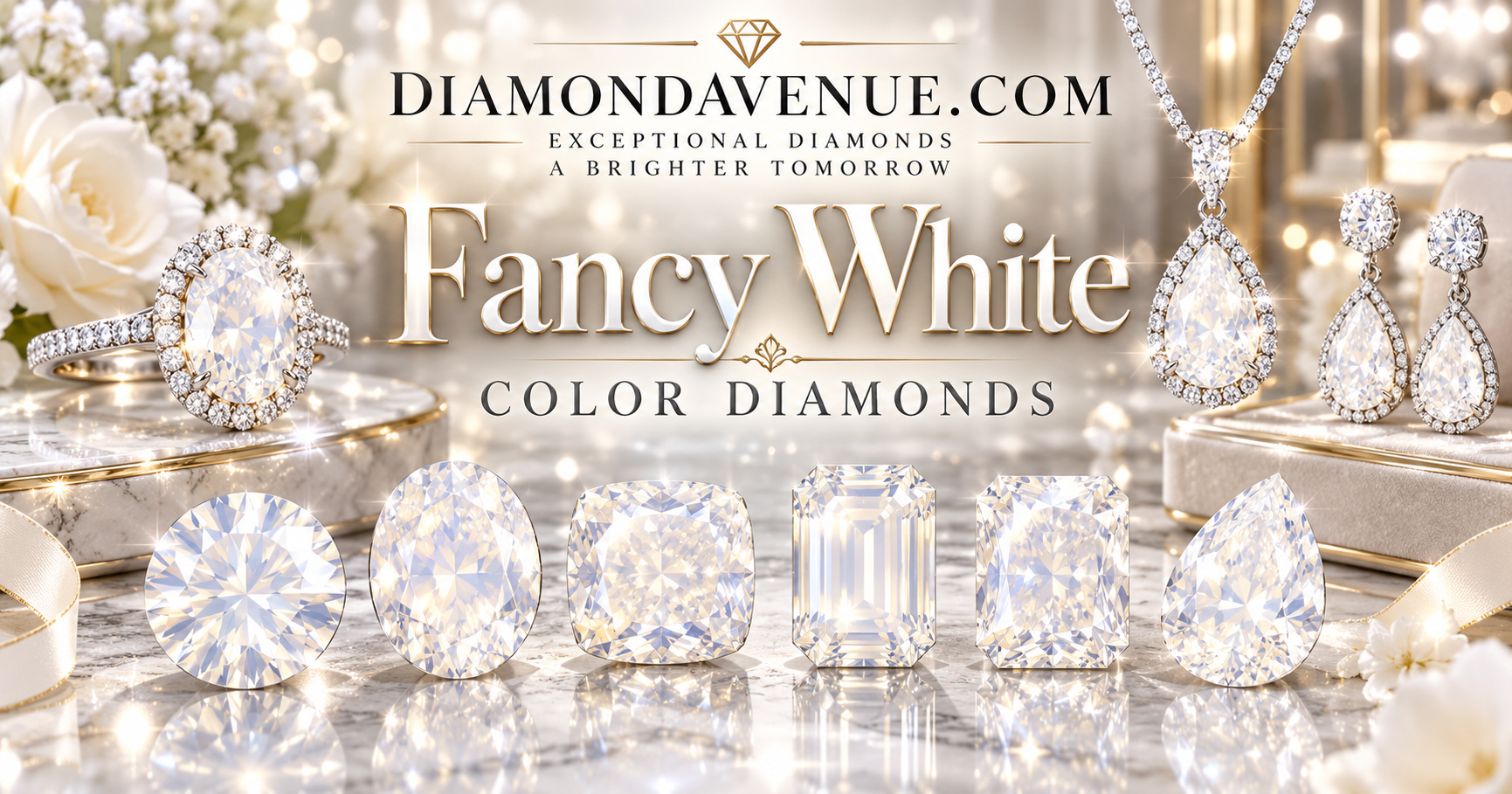
Fancy White Diamonds
Fancy White diamonds can display appearances ranging from softly translucent and milky to strongly cloudy or nearly opaque. Some examples can also produce subtle flashes of spectral color that give them an opalescent appearance.
What Are Fancy White Diamonds?
Fancy White diamonds are natural diamonds whose internal structure and inclusions scatter enough light to produce a distinctly whitish appearance.
They should not be confused with ordinary colorless diamonds. A D-color diamond, for example, is valued for its lack of visible body color and generally high transparency.
A Fancy White diamond, by contrast, possesses an actual whitish, cloudy or milky face-up appearance created by internal light scattering.
White Is Different From Colorless
The terms "white diamond" and "colorless diamond" are sometimes used interchangeably in the jewelry trade, but gemologically they can refer to very different appearances.
Colorless diamonds are generally graded within the GIA D-to-Z system and are valued in part for transparency and absence of noticeable color.
Fancy White diamonds fall outside that appearance because their transparency is substantially affected by microscopic internal features.
What Causes the White Appearance?
The white appearance of most Fancy White diamonds is not caused by a conventional color-producing trace element such as nitrogen or boron.
Instead, extremely small inclusions and structural features inside the diamond scatter visible light in many directions.
When enough of these tiny features are present, the diamond can appear hazy, cloudy, milky or luminous white when viewed face-up.
Modern gemological research has associated this appearance with nano-inclusions and structural features such as dislocation loops within the diamond crystal.
Transparency Is an Important Factor
Fancy White diamonds vary substantially in transparency.
Some stones remain partly transparent, while others are translucent or strongly opaque-looking. The amount and distribution of internal scattering features strongly influence the final appearance.
This variation in transparency is often more visually important than differences in color saturation.
The Fancy White Boundary
GIA distinguishes Fancy White diamonds from diamonds that can still be graded normally on the D-to-Z color scale.
When transparency is sufficiently reduced that the grader cannot readily observe the pavilion facets through the table under standard grading conditions, the diamond may fall outside normal D-to-Z grading and be described as Fancy White.
This helps separate true Fancy White diamonds from ordinary colorless diamonds that simply contain visible inclusions.
Milky and Cloudy Diamonds
Fancy White diamonds are often described with terms such as milky, cloudy, snowy or frosted.
These descriptions refer to the way internal light scattering affects the diamond's transparency and face-up appearance.
The effect can range from a soft luminous haze to a much denser white appearance.
Opalescent Appearance
Some Fancy White diamonds are described as opalescent because they can show faint flashes of spectral color when viewed face-up.
This can create an appearance reminiscent of white opal, although diamond and opal are completely different gemstones.
The effect in Fancy White diamond is produced by internal light scattering and dispersion rather than by the same internal structure that creates play-of-color in precious opal.
Fancy White Diamonds and Type IaB
Gemological studies have found that a large majority of Fancy White diamonds are classified as Type IaB.
Type IaB diamonds contain nitrogen atoms that have aggregated into groups known as B centers. Research on Fancy White diamonds has also found comparatively strong hydrogen-related features in many examples.
However, hydrogen itself should not be described as the direct cause of the white color in every Fancy White diamond.
Current research indicates that the cloudy white appearance is primarily associated with nano-inclusions and structural scattering features within the diamond.
Some Fancy White Diamonds Have a Superdeep Origin
Research into Type IaB Fancy White diamonds has provided evidence that many formed at unusually great depths within the earth.
These diamonds may originate in the mantle transition zone or even the lower mantle, considerably deeper than most diamonds formed within the shallower lithospheric mantle.
The higher pressures and temperatures associated with these environments may help explain the unusual nitrogen aggregation and structural features found in many Fancy White diamonds.
How Fancy White Diamonds Are Graded
Fancy White diamonds differ from most other fancy-color diamonds because their appearance varies more strongly with transparency than with conventional color saturation.
Unlike yellow, pink or blue diamonds, Fancy White diamonds are not normally divided into categories such as Fancy Light, Fancy Intense or Fancy Vivid.
The color designation is simply: Fancy White.
This places Fancy White diamonds in a specialized grading category similar in some respects to Fancy Black diamonds.
Secondary Colors and Modifying Hues
Although some Fancy White diamonds appear predominantly neutral white, others may display subtle modifying colors.
Bluish White
Some Fancy White diamonds can display a cool bluish cast that produces an icy or silvery-white appearance.
Grayish White
Gray modifiers can produce a softer, smoky or silvery white appearance.
Yellowish White
A subtle yellow component can give the diamond a warmer cream or ivory-like appearance.
Brownish White
Brown modifiers can create warmer off-white, beige or cream-like tones.
Trade Names for White Diamond Appearances
Jewelry sellers sometimes use descriptive terms for cloudy or whitish diamonds, including:
- Milky
- Cloudy
- Opalescent
- Pearl
- Ivory
- Cream
- Snow
- Sugar
- Salt-and-pepper
These are descriptive or marketing terms rather than standardized GIA Fancy White color grades.
Some of these commercial descriptions may also be applied to included diamonds that would not necessarily qualify as Fancy White under laboratory grading standards.
Fancy White vs. Salt-and-Pepper Diamonds
Fancy White diamonds should not automatically be equated with so-called salt-and-pepper diamonds.
Salt-and-pepper is an informal trade term usually applied to diamonds containing numerous visible dark and light inclusions.
A true Fancy White diamond receives its overall whitish appearance from extensive microscopic light-scattering features rather than simply from an assortment of large visible inclusions.
Fancy White vs. Colorless Diamond
A high-quality colorless diamond is prized for transparency and the absence of noticeable body color.
A Fancy White diamond is prized for exactly the opposite visual characteristic: an intentional milky, cloudy or opalescent white body appearance.
Both are natural diamonds, but their appearance, grading and market characteristics are very different.
How Rare Are Fancy White Diamonds?
Natural Fancy White diamonds are encountered relatively infrequently.
GIA has reported receiving far fewer Fancy White and Fancy Black diamonds for grading than the better-known fancy-color categories such as yellow or brown.
Their rarity, however, should not automatically be equated with higher value than every pink, blue or other fancy-color diamond.
Market value depends on the complete combination of rarity, size, transparency, appearance, cut, clarity characteristics and buyer demand.
What Determines the Value of a Fancy White Diamond?
Fancy White diamonds differ from highly saturated colored diamonds because intensity of color is not the primary consideration.
Important value factors include:
Appearance
An attractive, evenly distributed white or opalescent appearance can contribute substantially to desirability.
Transparency
The degree of transparency or translucency influences the overall character of a Fancy White diamond.
Carat Weight
Large attractive natural Fancy White diamonds are difficult to find and can be substantially rarer than smaller examples.
Cut
Cut influences apparent size, overall shape, light return and the distribution of the diamond's cloudy or luminous appearance.
Surface Condition
Chips, fractures or durability concerns can affect desirability, particularly in heavily included or less transparent diamonds.
Overall Beauty
Because Fancy White diamonds can vary greatly in appearance, visual appeal becomes especially important when comparing individual stones.
Fancy White Diamonds in Jewelry
The soft luminous appearance of Fancy White diamonds can produce distinctive contemporary jewelry designs.
Their neutral white coloration can complement:
- Platinum
- White gold
- Yellow gold
- Rose gold
- Colorless diamond accents
- Fancy-color diamond accents
- Colored gemstones
A Different Kind of Diamond Appearance
Fancy White diamonds are generally chosen for their unusual body appearance rather than the brilliant transparency normally associated with conventional diamonds.
This can make them especially appealing in jewelry intended to have an unconventional, soft or ethereal appearance.
Individual stones should be examined carefully because Fancy White diamonds can differ substantially in transparency and overall visual character.
Laboratory Identification
Important Fancy White diamonds should be examined by a respected independent gemological laboratory.
The laboratory can determine whether the stone is a natural diamond and evaluate whether its appearance falls within the Fancy White category.
GIA has reported that natural Fancy White diamonds are unusual enough that they are not routinely encountered in large numbers.
Laboratory documentation is therefore particularly useful when a diamond is represented as a rare natural Fancy White.
Buying a Fancy White Diamond
Buyers considering a Fancy White diamond should evaluate the stone differently from a conventional colorless diamond.
Important considerations include:
- Obtain an independent gemological laboratory report for important stones.
- Confirm that the stone is a natural diamond.
- Confirm that the laboratory identifies the color as Fancy White.
- Examine the degree of transparency or translucency.
- Look for an attractive and relatively even white appearance.
- Examine the diamond under several different lighting conditions.
- Consider whether any blue, gray, yellow or brown cast enhances or detracts from the appearance you prefer.
- Inspect the stone for fractures, chips or other durability concerns.
- Compare individual stones visually rather than relying solely on carat weight or commercial descriptions.
Fancy White Diamond Quick Facts
- Gem: Natural diamond
- Color designation: Fancy White
- Appearance: Milky, cloudy, translucent, luminous or opalescent white
- Primary appearance mechanism: Light scattering from nano-inclusions and structural features within the diamond
- Transparency: Can range from partially transparent to translucent or nearly opaque
- Common diamond type: Type IaB
- Possible modifying appearances: Bluish, grayish, yellowish or brownish white
- Fancy-color intensity: Generally designated simply Fancy White rather than Fancy Light, Intense or Vivid
- Difference from colorless diamonds: Fancy White diamonds possess an actual cloudy or milky white appearance rather than transparency and absence of color
- Major value factors: Overall appearance, transparency, uniformity, carat weight, cut, durability and rarity
- Laboratory identification: Recommended for significant Fancy White diamonds
The Unusual Beauty of Fancy White Diamonds
Fancy White diamonds represent one of the most unusual categories within the natural colored diamond family.
Instead of deriving their appearance primarily from conventional color-producing impurities, their characteristic milky white appearance is created largely by microscopic and nanoscopic internal features that scatter visible light.
The result can range from a softly luminous translucent diamond to a strongly cloudy or opalescent gemstone with subtle flashes of color.
Their rarity, unusual geological origin and distinctive appearance make natural Fancy White diamonds a fascinating and very different member of the fancy-color diamond family.
