
DiamondAvenue.com - Facts About Enhanced Natural Diamonds
Enhanced Natural Diamonds
An enhanced natural diamond is a natural diamond that has been altered after mining and cutting through one or more treatments designed to improve its color, clarity or overall appearance.
Enhancement does not change the fact that the stone originated as a natural diamond. However, the treatment history is an important part of the diamond's identity and can affect durability, care requirements, resale considerations and market value.
Some treatments are intended primarily to improve clarity, while others are used to change or improve color.
Diamond Enhancement Processes
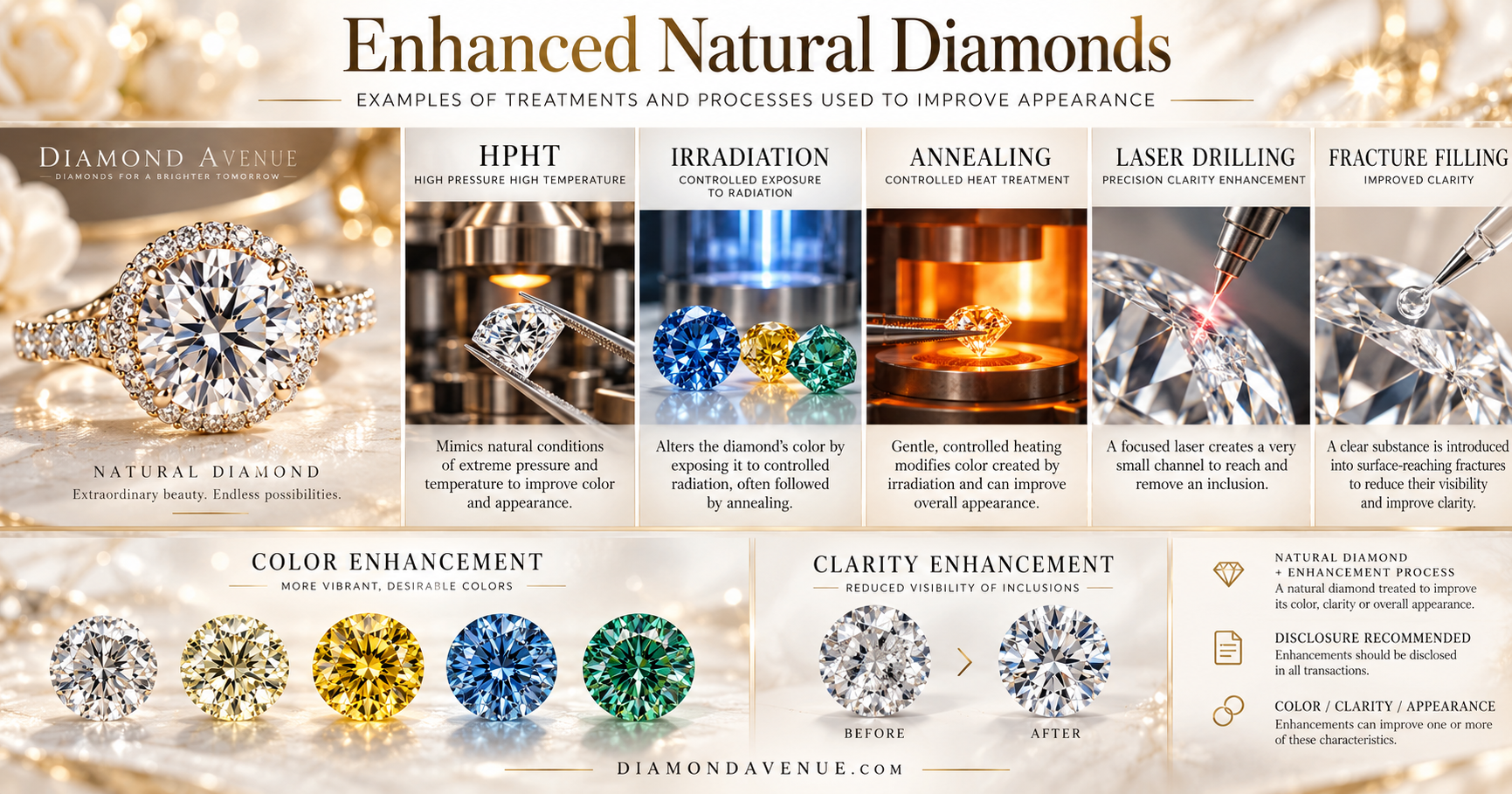
Natural diamonds may undergo several different treatment processes. Some alter color, some reduce the visibility of inclusions, and some are used in combination.
What Does "Enhanced" Mean?
Enhancement refers to a treatment performed after a diamond has formed naturally.
The goal is usually to make a particular characteristic less noticeable or more desirable.
Enhancement may be used to:
- Reduce the visibility of certain inclusions
- Reduce the appearance of dark internal features
- Improve apparent clarity
- Change or intensify color
- Reduce unwanted brown or yellow coloration
Natural Does Not Mean Untreated
A diamond can be both natural and treated.
The word natural describes the diamond's geological origin. It does not necessarily mean that the stone has remained completely unchanged after mining.
This distinction is important when comparing:
- Natural untreated diamonds
- Natural treated diamonds
- Lab-grown untreated diamonds
- Lab-grown treated diamonds
Clarity Enhancement
Clarity enhancement is designed to make certain internal or surface-reaching features less noticeable.
Common clarity-related treatments include:
- Laser drilling
- Fracture filling
These treatments do not necessarily remove all inclusions. Instead, they may reduce the visual impact of specific clarity characteristics.
Laser Drilling
Laser drilling is a clarity-enhancement process in which a very small laser-created channel is made from the surface of the diamond to an internal inclusion.
The channel may allow a dark inclusion to be removed, bleached or made less visible.
Laser-drilled channels may sometimes be visible under magnification as thin, straight or slightly irregular lines extending from the surface toward an inclusion.
Laser drilling generally creates a permanent physical alteration to the diamond because the microscopic channel remains in the stone.
Detecting Laser Drilling
Under magnification, a trained gemologist may look for:
- Very thin drill channels
- Small openings at the diamond's surface
- Channels leading to previously dark inclusions
- Evidence of internal bleaching
Detection may require professional magnification and gemological examination.
Fracture Filling
Fracture filling is used on certain surface-reaching fractures.
A transparent filling material is introduced into the fracture in order to reduce the contrast between the fracture and the surrounding diamond.
This can make the fracture substantially less noticeable to the unaided eye.
The treatment does not remove the fracture. Instead, it improves its appearance by reducing its visibility.
Durability of Fracture Filling
Fracture filling requires special care because the filling material may be affected by excessive heat, harsh chemicals or certain jewelry repair procedures.
A jeweler should be informed that a diamond has been fracture-filled before performing:
- Soldering
- Resizing
- Retipping
- Steam cleaning
- Ultrasonic cleaning
Care requirements can depend upon the specific treatment and filling material used.
Detecting a Fracture-Filled Diamond
Fracture filling can be difficult for an untrained buyer to recognize.
Possible indications under magnification and certain lighting conditions may include:
- Colored flashes from filled fractures
- Flow-like patterns
- Small trapped bubbles
- Differences in appearance when viewed from different angles
- Surface-reaching fracture patterns
Professional gemological testing is preferable to visual inspection alone.
Color Enhancement
Color-enhancement treatments are used to alter the apparent body color of some natural diamonds.
Depending upon the original diamond and the treatment used, the process may:
- Reduce brown coloration
- Reduce yellow coloration
- Produce or intensify yellow
- Produce green or blue-green hues
- Produce pink or reddish tones
- Create other fancy-color appearances
HPHT Treatment
HPHT stands for High Pressure High Temperature.
The treatment subjects a diamond to conditions of very high pressure and temperature in order to alter defects within the crystal structure.
Depending upon the diamond, HPHT treatment can modify color substantially.
It may be used to improve the appearance of some brownish diamonds or to create particular fancy-color results.
HPHT and Diamond Identification
HPHT treatment can produce permanent changes in the diamond's crystal structure and color.
Because these changes may not be obvious to the unaided eye, advanced laboratory testing may be needed to identify HPHT treatment conclusively.
A grading or identification report should be reviewed carefully for treatment information.
Irradiation
Irradiation exposes a diamond to controlled high-energy particles or radiation in order to alter defects within the crystal lattice.
This can produce significant color changes.
Irradiated diamonds may display colors including:
- Green
- Blue-green
- Yellow
- Orange
- Pink or reddish tones after additional treatment
Annealing
Annealing is controlled heating that may be performed after irradiation.
Heating allows some crystal defects to rearrange, potentially changing the final color produced by the irradiation process.
Irradiation and annealing are therefore often discussed together when describing certain color-treated diamonds.
Diamond Enhancement Treatment Summary
| Treatment | Primary Purpose | General Result |
|---|---|---|
| Laser Drilling | Clarity enhancement | Creates a microscopic channel to reach and reduce the visibility of certain inclusions. |
| Fracture Filling | Clarity enhancement | Introduces transparent filling material into surface-reaching fractures to reduce their visibility. |
| HPHT | Color modification | Uses high pressure and high temperature to alter crystal defects and modify color. |
| Irradiation | Color modification | Uses controlled radiation to create changes in the crystal lattice that alter color. |
| Annealing | Color modification | Controlled heating changes defects within the crystal and is often used following irradiation. |
Are Diamond Enhancements Permanent?
The answer depends upon the treatment.
Some color treatments can create highly stable changes under normal wearing conditions.
Other treatments, particularly fracture filling, may require greater care because the filling material can potentially be altered or damaged.
Consumers should therefore understand exactly which treatment has been performed rather than assuming all enhanced diamonds require the same care.
Jewelry Repair and Cleaning
Before repair or professional cleaning, tell the jeweler if a diamond has undergone enhancement.
This is especially important for fracture-filled stones, since some procedures involving heat, chemicals or aggressive cleaning may affect the treatment.
Keep any grading report, treatment documentation and purchase records with the diamond.
How Enhancement Can Affect Value
A treated natural diamond should not automatically be valued in the same manner as a comparable untreated natural diamond.
Market value can depend on:
- The treatment performed
- Whether the treatment is permanent or requires special care
- Original color and clarity
- Resulting appearance
- Carat weight
- Cut quality
- Laboratory documentation
- Market demand
Enhanced diamonds can sometimes provide a particular appearance at a different price point than comparable untreated diamonds, but treatment status should be considered when making comparisons.
Treatment Disclosure Is Important
Significant diamond treatments should be clearly disclosed when the stone is represented or sold.
Organizations and laboratories such as CIBJO, the Gemological Institute of America (GIA) and other gemological authorities emphasize accurate identification and disclosure of treatments.
Disclosure allows a buyer to distinguish between:
- Natural untreated diamonds
- Natural treated diamonds
- Lab-grown diamonds
- Lab-grown treated diamonds
Treatment information can affect purchasing decisions, care requirements, insurance, appraisal and future resale.
The Importance of a Gemological Laboratory Report
For a significant diamond purchase, an independent gemological laboratory report can provide important information regarding the stone's identity and treatment status.
Depending upon the diamond and laboratory service, a report may identify:
- Natural or laboratory-grown origin
- Carat weight
- Color
- Clarity
- Cut or proportions
- Fluorescence
- Detectable treatments
Buying an Enhanced Natural Diamond
Before purchasing an enhanced natural diamond, consider asking:
- What treatment was performed?
- Was the treatment used for color or clarity?
- Is the treatment considered stable under normal wear?
- Does the diamond require special cleaning or repair procedures?
- Is the treatment disclosed in writing?
- Is there an independent laboratory report?
- How does the price compare with a similar untreated diamond?
Enhanced Natural Diamond
An enhanced natural diamond:
- Formed naturally within the Earth
- Was mined as a natural diamond
- Was subsequently treated to change its appearance
Lab-Grown Diamond
A lab-grown diamond:
- Was created in a controlled technological environment
- Has the basic crystal structure and chemical composition of diamond
- May itself be untreated or subsequently treated
Enhancement and origin are therefore two separate issues.
Enhanced Natural Diamond Quick Reference
Laser Drilling: Primarily used to reduce the visibility of certain inclusions.
Fracture Filling: Fills surface-reaching fractures to make them less noticeable.
HPHT: Uses extreme pressure and temperature to alter color.
Irradiation: Alters color by changing defects within the crystal structure.
Annealing: Uses controlled heating and is frequently associated with color treatment following irradiation.
Explore More Diamond Information
Diamond Types | The Four Cs | Carat Weight | Color | Clarity | Cut