
DiamondAvenue.com

DiamondAvenue.com - Diamond Facts


Information and facts on everything Diamond


Diamond Facts Overview

Explore the essential facts about diamonds, including their formation, physical properties, quality factors, shapes, types, treatments, grading and care.

Understanding Diamonds

Diamond is a crystalline form of carbon and one of nature's most remarkable minerals. Its exceptional hardness, optical properties and rarity have made it important both as a gemstone and as an industrial material.

Gem-quality diamonds are evaluated according to a combination of measurable characteristics. The best known are the Four Cs: Carat Weight, Color, Clarity and Cut, but many other factors can influence a diamond's appearance, rarity and value.

Diamond shape, fluorescence, origin, treatments, proportions, grading laboratory and whether a diamond is natural or laboratory-grown can all be important considerations.
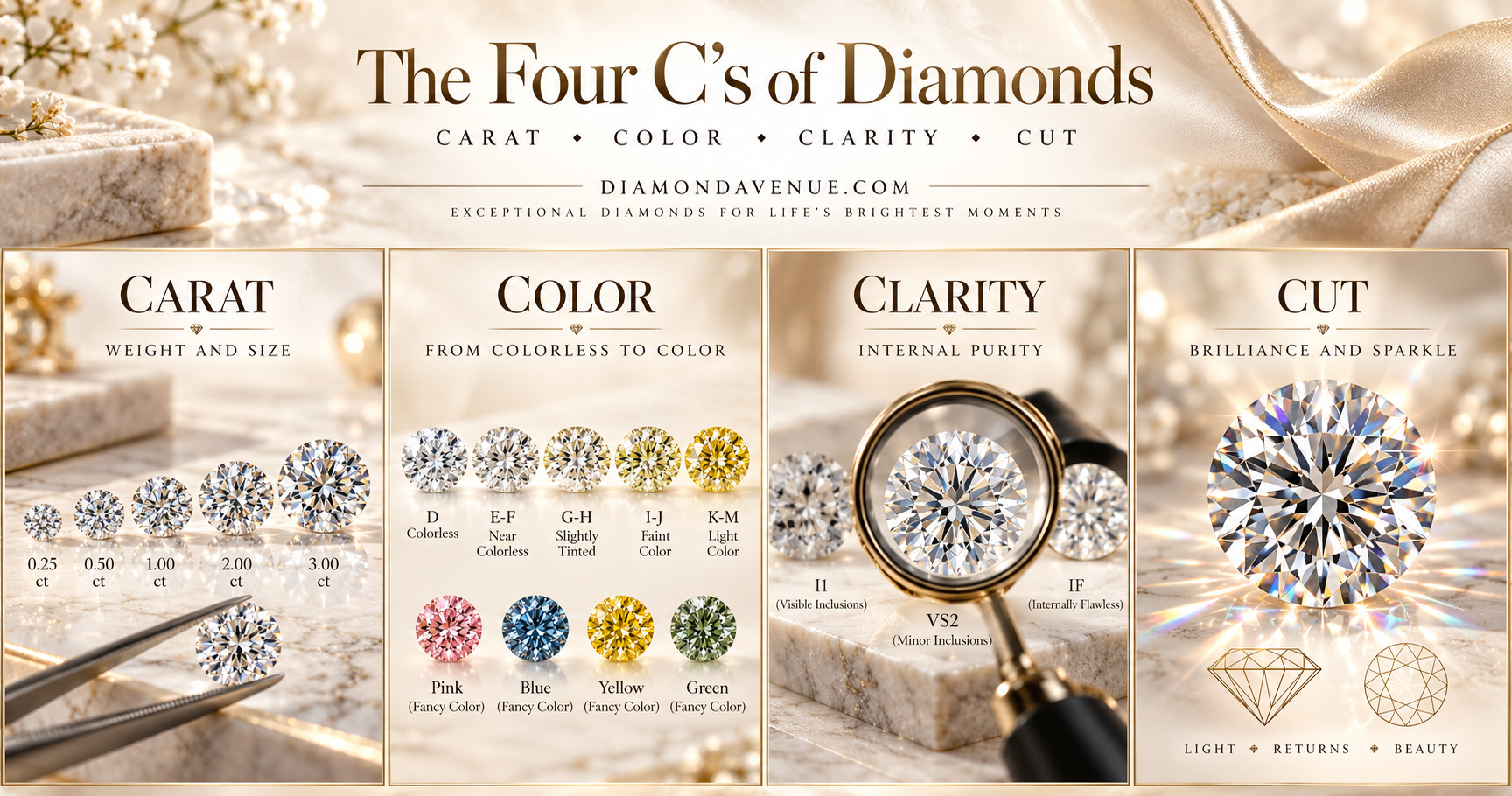
The Essential Characteristics of Diamonds

Diamond facts montage illustrating carat, color, clarity and cut

The Four Cs provide the foundation for evaluating gem-quality diamonds, while additional characteristics such as shape, fluorescence, treatments and origin provide a more complete picture of an individual stone.

What Is a Diamond?

A diamond consists primarily of carbon atoms bonded together in a strong three-dimensional crystal structure.

This atomic arrangement gives diamond its exceptional hardness and many of the physical characteristics that distinguish it from other gemstones.

Diamonds can be transparent, translucent or opaque and may occur in a wide variety of colors.

Learn more about Diamond Properties

How Natural Diamonds Form

Most natural diamonds formed deep within the Earth under conditions of high pressure and temperature.

Geological processes later transported some diamonds toward the surface, where they became associated with diamond-bearing rocks or secondary deposits such as river gravels.

Natural diamonds may remain embedded in rock or be recovered as loose rough crystals before cutting and polishing.

Learn more about How Diamonds Form

The Four Cs of Diamond Quality

The Four Cs are the best-known system for describing important characteristics of gem-quality diamonds.

They are: Carat Weight, Color, Clarity and Cut.

No single C determines overall quality. Each should be considered together with the others.

Learn more about the Four Cs

Carat Weight

Carat measures a diamond's weight.

One metric carat equals 200 milligrams and is divided into 100 points.

Carat weight does not necessarily equal visible size, because proportions and shape affect how large a diamond appears.

Diamond Carat Weight

Color

Traditional white diamonds are evaluated according to the amount of body color they display.

Colorless diamonds occupy one end of the grading scale, while increasing yellow or brown tint appears farther along the scale.

Strongly colored diamonds may instead be classified as fancy-color diamonds.

Diamond Color

Clarity

Clarity describes internal features known as inclusions and external characteristics known as blemishes.

Their size, number, position, nature and visibility influence the clarity grade.

Many inclusions cannot be seen without magnification.

Diamond Clarity

Cut

Cut describes how effectively a polished diamond's proportions, facets, symmetry and polish interact with light.

Cut strongly influences brightness, fire and scintillation.

Cut should not be confused with diamond shape.

Diamond Cut

Diamond Shapes

Shape describes the outline of a diamond when viewed from above.

Popular shapes include:

  • Round Brilliant
  • Princess
  • Oval
  • Cushion
  • Emerald
  • Radiant
  • Pear
  • Marquise
  • Heart
  • Asscher

Explore Diamond Shapes

Diamond Types

The term "diamond type" can have more than one meaning.

In scientific gemology, diamonds may be classified as Type Ia, Ib, IIa or IIb according to impurities and defects in the crystal structure.

In broader consumer terminology, diamond types may also refer to categories such as natural, lab-grown, rough, fancy-color, treated and industrial diamonds.

Explore Diamond Types

Natural Diamonds

Natural diamonds formed through geological processes within the Earth.

They can occur in many colors, clarity grades, sizes, shapes and scientific diamond types.

Natural origin is separate from whether a diamond has subsequently received a treatment.

Learn more about Natural Diamonds

Lab-Grown Diamonds

Lab-grown diamonds are produced in controlled technological environments rather than formed naturally within the Earth.

They possess the basic crystal structure and chemical composition of diamond and can be produced using processes such as HPHT and CVD.

Learn more about Lab-Grown Diamonds

Rough Diamonds

Rough diamonds are diamonds in their natural, unpolished state.

They may occur as octahedral, cubic, irregular or fragmented crystals and can vary greatly in size, transparency, color and quality.

Diamond cutters examine the rough crystal to determine how it can best be fashioned into one or more polished diamonds.

Explore Rough Diamonds

Enhanced Natural Diamonds

Some natural diamonds are treated after mining to alter their color, clarity or appearance.

Treatments may include HPHT, irradiation, annealing, laser drilling and fracture filling.

Treatment status is an important characteristic and should be disclosed when applicable.

Enhanced Natural Diamonds

Diamond Fluorescence

Some diamonds emit visible light when exposed to ultraviolet radiation.

This phenomenon is called fluorescence.

Blue is a common fluorescence color, although other colors can occur.

Fluorescence strength may be noted on a laboratory grading report.

Learn more about Diamond Fluorescence

Diamond Grading Reports

Independent gemological laboratories evaluate diamonds and issue reports describing characteristics such as carat weight, color, clarity, proportions, polish, symmetry and fluorescence.

A grading report provides an independent description of the examined diamond and can help buyers compare stones more accurately.

Learn more about Diamond Grading

Diamond Simulants

A diamond simulant resembles a diamond but is made from a different material.

Examples include cubic zirconia and moissanite.

Simulants should not be confused with lab-grown diamonds. A lab-grown diamond is diamond, while a simulant is another material that resembles diamond.

Learn about Diamond Simulants

Caring for Diamonds

Although diamond is extremely hard, diamond jewelry can still be damaged.

Settings can loosen, exposed edges can chip, and oils or residue can reduce apparent brilliance.

Proper cleaning, separate storage and periodic professional inspection can help protect diamond jewelry.

Diamond Care

Fancy Color Diamonds

Diamonds can naturally occur in colors including yellow, pink, blue, green, orange, red, purple, brown and gray.

The causes of color differ and may involve nitrogen, boron, crystal deformation, radiation-related defects or other features of the crystal structure.

Explore Fancy Color Diamonds

Famous Diamonds

Some diamonds are famous because of exceptional size, unusual color, rarity, provenance or historical importance.

Well-known examples include the Hope Diamond, Koh-i-Noor, Cullinan, Tiffany Diamond, Golden Jubilee and many others.

Explore Famous Diamonds

Diamond Hardness

Diamond ranks 10 on the Mohs scale and is exceptionally resistant to scratching.

Hardness does not mean that a diamond is impossible to damage. Diamonds can chip or fracture if struck forcefully in certain directions.

Industrial Uses of Diamond

Diamond's hardness and other physical properties make it valuable for applications beyond jewelry.

Natural and synthetic industrial diamonds are used in cutting, grinding, drilling, polishing and precision manufacturing.

Learn more about Industrial Diamonds

From Rough Diamond to Polished Gem

Diamond cutting transforms rough material into a finished gemstone.

Modern cutters use scanning, computer modeling, precision measurement and laser technology to examine a rough diamond and plan the finished stones.

The cutter must balance several objectives, including beauty, light performance, clarity considerations, shape and retention of carat weight.

Diamond Cut   |   Diamond Shapes   |   Diamond Cutting

Back to Top