
DiamondAvenue.com is the place to learn about Lab Created Diamonds
Lab-Grown Diamonds
Laboratory-grown diamonds, sometimes called lab-created or laboratory-created diamonds, are real diamonds produced under controlled conditions rather than formed naturally deep within the Earth.
They have essentially the same chemical composition, crystal structure, hardness and optical properties as natural diamonds, but their origin and growth history are different.
What Is a Lab-Grown Diamond?
A lab-grown diamond is a diamond crystal produced through a technological process that recreates important conditions involved in diamond formation.
Like natural diamond, laboratory-grown diamond is composed primarily of carbon atoms arranged in a diamond crystal structure.
As a result, laboratory-grown diamonds possess the fundamental properties that make diamond unique, including exceptional hardness, brilliance and a high refractive index.
Lab-Grown Does Not Mean Simulant
Laboratory-grown diamonds should not be confused with diamond simulants.
Materials such as cubic zirconia and moissanite may resemble diamond, but they have different chemical compositions, crystal structures and physical properties.
A lab-grown diamond is diamond material. A simulant merely imitates the appearance of diamond.
Natural Diamonds vs. Lab-Grown Diamonds
The principal difference between a natural diamond and a laboratory-grown diamond is how and where the diamond formed.
Natural diamonds formed deep within the Earth under extreme pressure and temperature, generally over geological periods of time. They were later carried toward the Earth's surface through volcanic processes and eventually recovered through mining.
Laboratory-grown diamonds are produced in specialized equipment where technicians create controlled conditions that allow carbon atoms to crystallize into diamond.
The finished materials can be extremely similar in appearance. Determining whether a diamond is natural or laboratory-grown may therefore require specialized gemological testing.
How Lab-Grown Diamonds Are Made
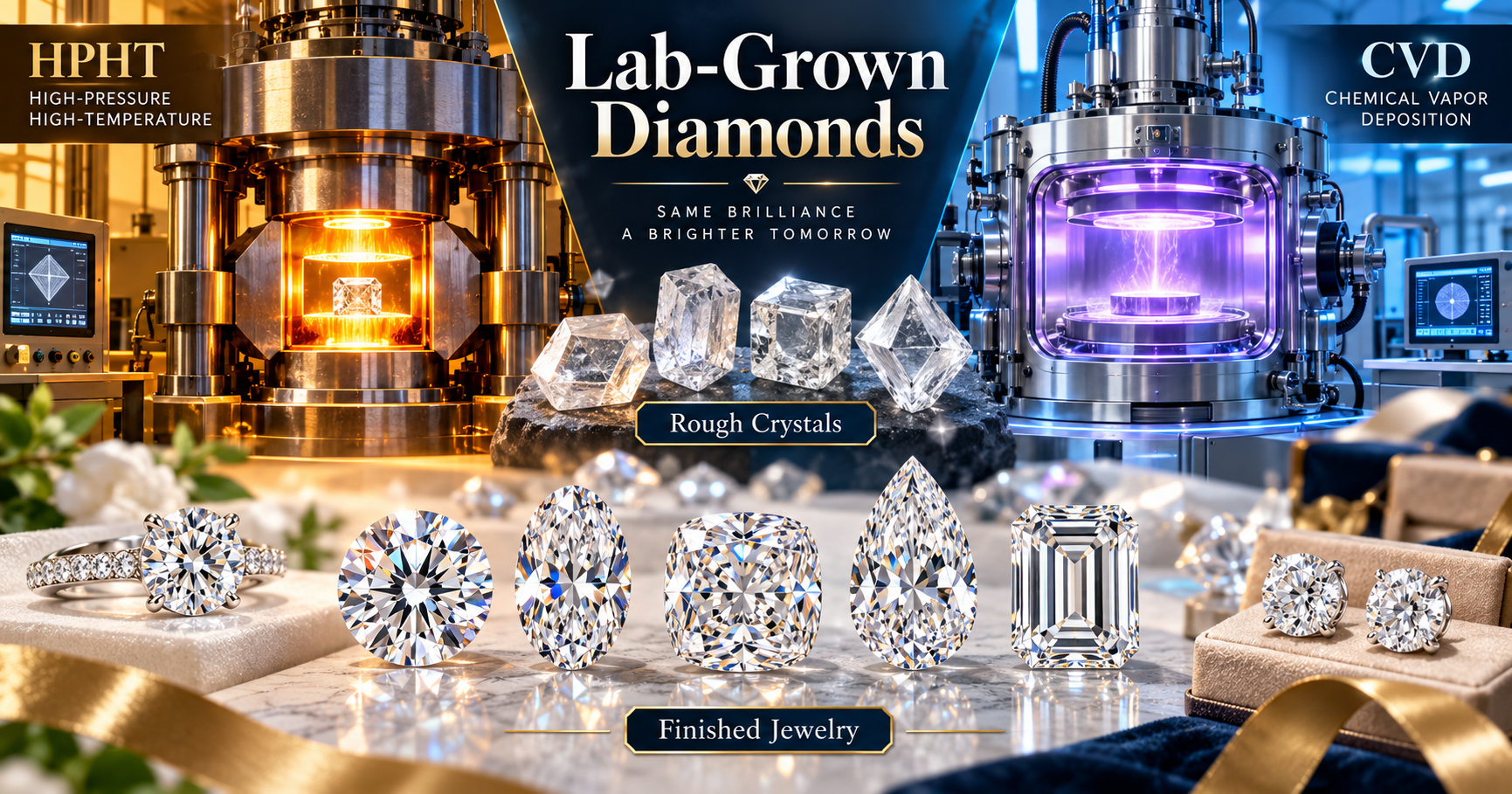
Two principal technologies are used commercially to grow gem-quality diamonds: HPHT and CVD.
HPHT Diamonds
HPHT stands for High Pressure High Temperature.
The process uses extremely high pressure and elevated temperature to create an environment in which carbon can crystallize as diamond.
A small diamond seed is typically placed in a growth cell along with a carbon source and a metallic catalyst or flux.
Under the proper conditions, carbon dissolves and then crystallizes around the seed, gradually producing a larger diamond crystal.
HPHT Growth Characteristics
HPHT-grown diamonds may contain growth features that differ from those typically found in natural diamonds.
Depending on the particular growth process, these may include metallic inclusions, distinctive fluorescence patterns or characteristic internal growth structures.
These features can provide trained gemologists with clues concerning laboratory origin.
CVD Diamonds
CVD stands for Chemical Vapor Deposition.
In the CVD process, thin diamond seed plates are placed inside a chamber containing carbon-bearing gases.
Energy is introduced into the chamber to create a plasma. Carbon-containing molecules are broken apart, allowing carbon atoms to settle onto the diamond seed.
Layer by layer, the carbon atoms build upon the seed and form additional diamond crystal.
CVD Growth Characteristics
CVD-grown diamonds can also display identifying characteristics associated with their growth environment.
Gemological laboratories may observe particular fluorescence patterns, strain patterns, growth banding or other microscopic features.
Sophisticated laboratory instruments can analyze these characteristics and distinguish CVD-grown material from natural diamond.
HPHT vs. CVD
HPHT and CVD use very different technologies, but both processes can produce gem-quality diamonds.
HPHT creates diamond using extremely high pressure and temperature, while CVD grows diamond by depositing carbon from a gas or plasma onto a diamond seed.
Neither production method automatically determines whether a finished diamond will be more attractive than another.
Finished appearance depends on numerous factors, including the individual crystal, cutting, polishing, color, clarity and proportions.
Physical Properties
Natural and laboratory-grown diamonds share the basic physical characteristics associated with diamond.
Both rank approximately 10 on the Mohs hardness scale, making diamond the hardest naturally occurring mineral and an exceptionally durable material.
Both types can be fashioned into the same familiar diamond shapes and cutting styles.
Optical Properties
Laboratory-grown diamonds can display the same brilliance, fire and scintillation associated with natural diamonds.
To the unaided eye, a well-cut laboratory-grown diamond may be visually indistinguishable from a comparable natural diamond.
Visual appearance alone should therefore not be relied upon to establish a diamond's origin.
Can You Tell a Lab-Grown Diamond by Looking at It?
In many cases, the answer is no.
Laboratory-grown diamonds can look virtually identical to natural diamonds when viewed with the naked eye.
Even traditional gemological observations may not always be sufficient to determine origin. Professional gemological laboratories use advanced instrumentation to examine fluorescence, growth structures, spectroscopy and other identifying characteristics.
When origin is important, buyers should rely on documentation from a recognized gemological laboratory rather than appearance alone.
Color
Laboratory-grown diamonds are available in colorless and near-colorless ranges as well as various fancy colors.
Growth conditions and post-growth treatment can influence the final color of some laboratory-grown diamonds.
Clarity
Just like natural diamonds, laboratory-grown diamonds may contain internal and external characteristics.
Some inclusions and growth features can provide useful information to gemologists concerning the method by which the diamond was produced.
Cut
Lab-grown diamonds can be cut into essentially the same shapes and styles as natural diamonds.
Popular shapes include round brilliant, oval, cushion, emerald, pear, princess, radiant, marquise and heart.
Cutting quality remains especially important because it strongly influences brilliance, fire and the overall visual appeal of the finished stone.
Carat Weight
Carat is a measurement of diamond weight.
One carat equals 0.20 grams.
Laboratory technology has advanced substantially, allowing producers to manufacture gem-quality diamonds in a wide range of carat weights.
GIA Laboratory-Grown Diamond Quality Assessment
The Gemological Institute of America has evaluated laboratory-grown diamonds for many years.
Beginning October 1, 2025, GIA introduced a revised quality assessment system for eligible colorless-to-near-colorless laboratory-grown diamonds.
Instead of using the same descriptive nomenclature traditionally applied to natural diamonds, eligible laboratory-grown diamonds are classified by GIA as:
Premium
or
Standard
The overall assessment considers factors including color, clarity, polish, symmetry and, where applicable, cut quality.
GIA Premium
Under the current GIA system, a laboratory-grown diamond must meet the required Premium criteria across the applicable quality categories to receive the Premium classification.
Among the criteria are very high clarity, D color, Excellent polish and Excellent symmetry.
Round brilliant diamonds must also meet the required Excellent cut criteria.
GIA Standard
Laboratory-grown diamonds meeting GIA's broader qualifying criteria may receive a Standard classification.
The Standard category accommodates qualifying stones within specified ranges of color, clarity, polish, symmetry and cut.
Stones that do not meet GIA's minimum Standard requirements do not receive the Laboratory-Grown Diamond Quality Assessment.
Laboratory Identification and Laser Inscription
Identification and disclosure are important because natural and laboratory-grown diamonds can be very difficult to distinguish visually.
Under GIA's current laboratory-grown diamond assessment program, qualifying stones are laser inscribed on the girdle with the term "Laboratory-Grown" and the associated GIA quality assessment number.
This provides an additional permanent means of identifying the stone and connecting it with its laboratory documentation.
Post-Growth Treatments
Some laboratory-grown diamonds undergo treatments after the initial growth process.
These treatments may be used to alter or improve certain appearance characteristics, particularly color.
A reputable gemological laboratory may be able to determine both the laboratory growth method and whether evidence of post-growth treatment is present.
Price and Value
Laboratory-grown and natural diamonds participate in different markets and may have significantly different pricing.
Buyers should compare diamonds based on the characteristics important to them rather than assuming that two diamonds of similar visual appearance necessarily have the same market value.
Market prices can change over time, so current pricing should be checked when making a purchase.
Resale Considerations
Buyers should also consider potential resale value separately from initial purchase price.
Natural and laboratory-grown diamonds have different supply structures and secondary-market conditions.
Anyone purchasing a diamond partly for long-term value should investigate current resale conditions and obtain independent professional advice when appropriate.
Buying a Lab-Grown Diamond
When shopping for a laboratory-grown diamond, consider more than carat weight alone.
- Confirm that the stone is clearly disclosed as laboratory-grown.
- Review documentation from a recognized gemological laboratory.
- Examine the diamond's cut and proportions.
- Consider its color and clarity.
- Confirm whether the stone was produced by HPHT or CVD, when that information is available.
- Check for disclosure of any post-growth treatments.
- Verify any laboratory report or assessment number when possible.
- Compare current prices among similar stones.
- Understand that purchase price and future resale value are separate considerations.
Lab-Grown Diamonds vs. Diamond Simulants
This distinction is especially important:
Lab-Grown Diamond
Diamond material created in a controlled laboratory
environment.
Natural Diamond
Diamond material formed through natural geological
processes within the Earth.
Cubic Zirconia
A manufactured diamond simulant composed primarily
of zirconium dioxide. It may resemble diamond but is
not diamond.
Moissanite
A gemstone composed of silicon carbide. Gem-quality
synthetic moissanite may resemble diamond but has
different physical and optical properties.
Natural Diamond
Formed naturally within the Earth.
Material:
Diamond
Lab-Grown Diamond
Grown in a controlled manufacturing environment.
Material:
Diamond
Diamond Simulant
Made from another material that resembles diamond.
Material:
Not Diamond
Lab-Grown Diamond Terminology
Consumers may encounter several terms when researching these diamonds.
Common descriptions include:
- Lab-Grown Diamond
- Laboratory-Grown Diamond
- Lab-Created Diamond
- Laboratory-Created Diamond
These terms generally describe diamonds produced through technological growth processes rather than natural geological formation.
They should not be confused with the terms simulated diamond or diamond simulant, which refer to materials that imitate diamond but are not actually diamond.
Lab-Grown Diamonds: Key Points
- Lab-grown diamonds are real diamond material.
- They are not the same as cubic zirconia or moissanite.
- The two principal commercial growth methods are HPHT and CVD.
- Natural and laboratory-grown diamonds can be extremely difficult to distinguish by appearance alone.
- Specialized gemological equipment can identify growth characteristics associated with laboratory-grown diamonds.
- Some lab-grown diamonds undergo post-growth treatments.
- Independent laboratory documentation is useful for confirming identity and quality.
- Natural and laboratory-grown diamonds should be compared as distinct products with different origins and market considerations.
Understanding Lab-Grown Diamonds
Laboratory-grown diamond technology has progressed rapidly, making gem-quality diamonds available in a growing variety of sizes, shapes and qualities.
The important distinction is not whether the material is diamond — laboratory-grown diamonds are diamond — but rather how the diamond originated.
Natural diamonds are products of geological processes within the Earth. Laboratory-grown diamonds are products of controlled technological growth using processes such as HPHT and CVD.
Understanding this distinction, reviewing reliable laboratory documentation and comparing quality, price and personal preferences can help consumers make a more informed diamond purchase.