
Facts About Fancy Pink Diamonds
Fancy Pink Diamonds
Natural fancy pink diamonds are among the rarest, most recognizable and most desirable colored diamonds in the world. Their colors can range from delicate blush and rose tones to richly saturated pink, purplish pink and vivid pink.
Unlike yellow diamonds, whose color is generally associated with nitrogen, or blue diamonds, whose color can be associated with boron, the color in most natural pink diamonds is linked to structural changes within the diamond crystal itself.
Fancy Pink Diamonds
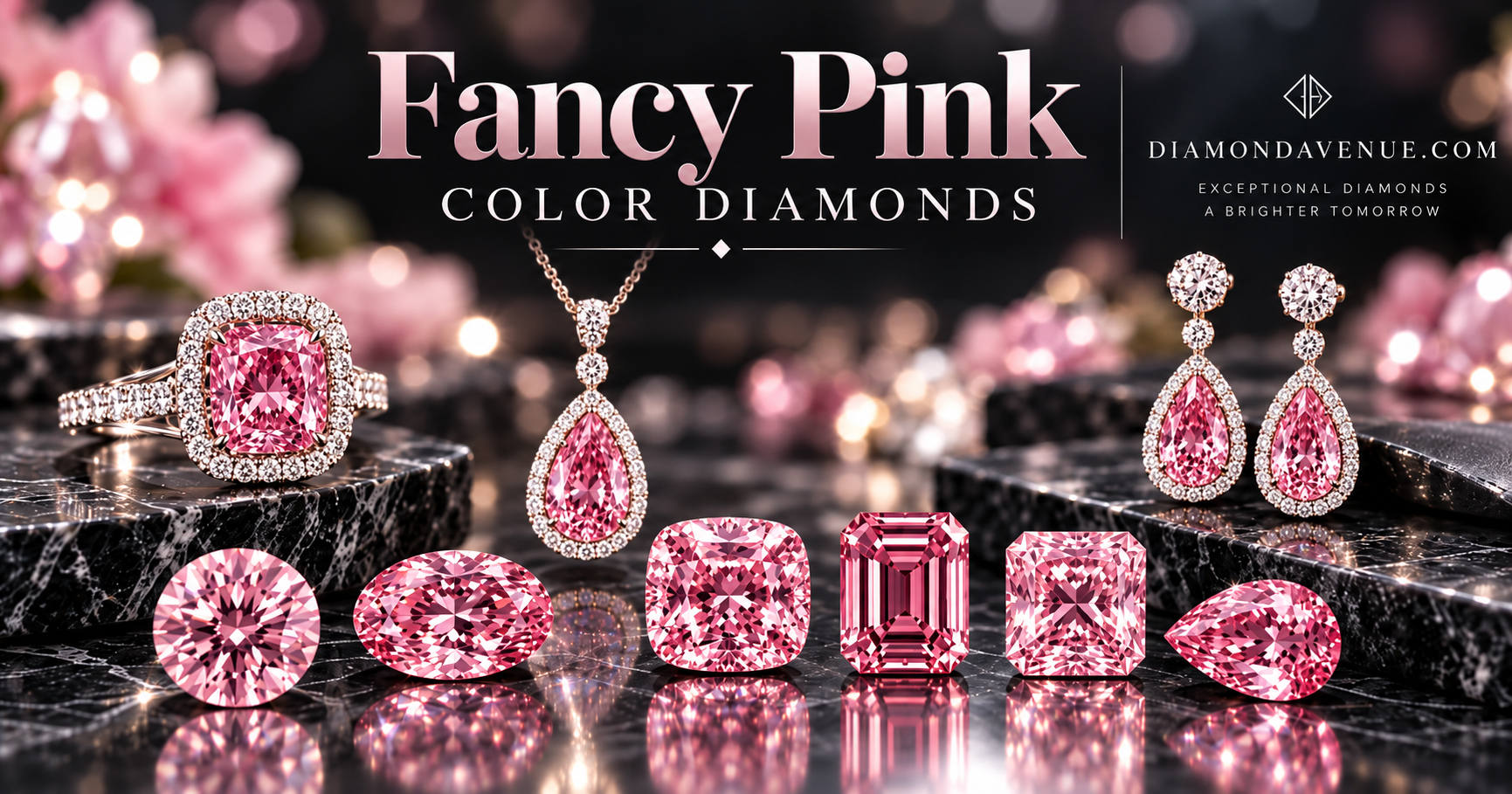
Natural pink diamonds can display a broad range of appearances, from very pale pink to intensely saturated Fancy Vivid colors. Secondary hues such as purple, orange and brown can create additional varieties of pink coloration.
What Are Fancy Pink Diamonds?
Fancy pink diamonds are natural diamonds that exhibit pink as their dominant visible color. They belong to the broader category of fancy-color diamonds, which are evaluated according to the presence and strength of color rather than the absence of color used in the traditional D-to-Z diamond grading scale.
Natural diamonds displaying a noticeable pink color are extremely uncommon. Strongly saturated pink diamonds are rarer still, which helps explain why exceptional examples have become important collector gemstones.
Why Are Pink Diamonds So Rare?
The unusual geological conditions required to produce natural pink coloration occur in only a very small proportion of diamonds.
The diamond must experience sufficient stress within the earth to alter portions of its crystal structure without destroying the stone.
Even among diamonds that develop pink coloration, strongly saturated and evenly distributed color is uncommon. Large natural diamonds combining attractive pink color with good transparency are particularly rare.
What Causes the Pink Color?
For many years, the exact cause of pink coloration in natural diamonds was difficult to explain. Modern gemological research has shown that the vast majority of natural pink diamonds owe their color to distortion within the diamond crystal.
This distortion is associated with a process known as plastic deformation. During the diamond's long geological history, enormous forces within the earth can place the crystal under intense stress.
Under the appropriate conditions, microscopic layers within the diamond crystal can shift slightly relative to one another without causing the diamond to fracture.
These structural changes create defects that selectively absorb portions of visible light. The remaining light reaching the observer can produce the diamond's characteristic pink color.
Pink Graining
In many natural pink diamonds, the color is concentrated along narrow parallel areas within the crystal.
Gemologists may refer to these features as pink graining, colored graining, lamellae, glide planes or slip planes.
These colored areas can sometimes be observed under magnification and provide valuable information about the internal structure of the diamond.
Plastic Deformation
Plastic deformation does not mean that the diamond becomes soft. Diamond remains an extremely hard crystalline material.
The term refers to permanent microscopic changes within the crystal lattice caused by geological stress.
Depending upon the nature and degree of deformation, the resulting diamond may develop pink, brown or related color characteristics.
Where Are Pink Diamonds Found?
Natural pink diamonds have been recovered from diamond-producing regions in several parts of the world, including Australia, Africa, Russia, Canada and Brazil.
Historically, however, one source dominated the modern market for natural pink diamonds: Australia's Argyle Diamond Mine in the East Kimberley region of Western Australia.
During its operating life, the Argyle mine became famous throughout the gem and jewelry industry for producing the overwhelming majority of the world's supply of rare pink diamonds, as well as red and violet diamonds.
The Argyle Diamond Mine
The Argyle Diamond Mine began production in the 1980s and operated for approximately 37 years. Although the mine produced enormous quantities of diamonds, only a tiny fraction possessed the exceptional pink, red or violet colors for which Argyle became internationally famous.
Mining at Argyle officially ceased on November 3, 2020.
As a result, Argyle pink diamonds now represent a finite historical production rather than an ongoing mine supply.
The Argyle Pink Diamonds Tender
For decades, some of the finest pink, red, violet and blue diamonds recovered from Argyle were presented through the prestigious Argyle Pink Diamonds Tender.
The annual invitation-only tender presented a carefully selected collection of the mine's rarest colored diamonds to specialist buyers, collectors and luxury jewelry houses.
The final Argyle Pink Diamonds Tender was held following the mine's closure, using diamonds recovered during its final year of production.
How Fancy Pink Diamonds Are Color Graded
Fancy-color diamonds are evaluated differently from colorless and near-colorless diamonds. Three important aspects of color are considered:
- Hue — the dominant visible color and any modifying colors present in the diamond.
- Tone — the relative lightness or darkness of the color.
- Saturation — the strength or intensity of the color.
Depending upon the appearance of the individual diamond, color terminology can include:
- Faint
- Very Light
- Light
- Fancy Light
- Fancy
- Fancy Intense
- Fancy Vivid
- Fancy Deep
- Fancy Dark
Not every hue occurs naturally in every possible grade. The final description is determined by the combined effect of hue, tone and saturation.
Secondary Colors and Modifying Hues
Many natural pink diamonds contain additional colors that modify their overall appearance. These secondary hues are included in the color description on a laboratory grading report.
Purplish Pink
Purple is one of the best-known modifiers found with pink diamonds. Attractive purplish pink diamonds can display colors ranging from soft lavender-pink to richly saturated magenta-like appearances.
Orangy Pink
Orange modifiers can give a pink diamond a warmer appearance. Depending upon the relative strength of the colors, the laboratory description may use terminology such as orangy pink.
Brownish Pink
Brown is another modifier frequently encountered in natural pink diamonds. Brownish pink diamonds may range from warm rose and blush tones to deeper earthy pink colors.
Modifier or Dominant Color?
The order of words in a laboratory color description is important.
In a description such as Fancy Intense Purplish Pink, pink is the dominant color and purple is the modifying hue.
A diamond described as pinkish purple, however, would have purple as the dominant color.
Pure Pink
A diamond graded simply as pink, without an additional hue modifier, is often described in the trade as an unmodified or pure pink diamond.
Attractive unmodified pink diamonds can be especially desirable because the visible color is dominated by pink rather than another hue.
However, beauty and value depend upon the entire appearance of the individual diamond, not solely on whether a modifier is present.
Does Stronger Pink Color Mean Greater Value?
Color is generally the most important value factor in a fancy-color diamond.
All else being equal, a stronger and more attractive pink color will often be more desirable than a pale example. Fancy Intense and Fancy Vivid pink diamonds can therefore command substantial premiums.
Color grade alone, however, does not determine value. Hue, color distribution, modifying colors, carat weight, clarity, cut, provenance and overall visual appeal can all significantly affect the price of an individual diamond.
Color
Hue, tone, saturation and the evenness of color distribution are central considerations when evaluating a pink diamond.
Carat Weight
Large natural pink diamonds are exceptionally rare. As size increases, the rarity of a strongly colored natural pink diamond can increase dramatically.
Natural Color Origin
Confirmation that the pink color is naturally occurring rather than treated is essential for valuable natural fancy-color diamonds.
Color Distribution
Even and attractive face-up color is generally preferable to distracting zones of stronger and weaker coloration.
Clarity
Clarity remains important, but minor inclusions may have less influence on value when a diamond possesses exceptionally rare and attractive color.
Cut
Fancy-color diamonds are often cut to strengthen the visible face-up color while also preserving as much valuable rough weight as practical.
Cut Can Enhance Pink Color
Cutting a fancy-color diamond involves different priorities from cutting a traditional colorless diamond.
A cutter may select proportions that concentrate color within the diamond and improve the intensity visible when the gemstone is viewed face-up.
Because natural pink rough is exceptionally valuable, retaining carat weight can also be an important consideration.
Popular Shapes
Natural pink diamonds can be found in many shapes, including:
- Round
- Oval
- Cushion
- Radiant
- Pear
- Heart
- Emerald
- Marquise
Fancy shapes can sometimes help concentrate visible color more effectively than a traditional round brilliant design.
Natural Pink, Treated Pink and Lab-Grown Pink Diamonds
A pink appearance by itself does not prove that a diamond possesses naturally occurring pink color.
Diamond treatments can alter color, and laboratory-grown diamonds can also be manufactured or treated to produce pink coloration.
Natural pink diamonds, treated natural diamonds and laboratory-grown pink diamonds are different categories and should be represented accurately to the buyer.
For any significant natural pink diamond purchase, an independent gemological laboratory report identifying the diamond and determining the origin of its color is strongly recommended.
Famous Pink Diamonds
The extraordinary rarity of large natural pink diamonds has made a number of individual stones famous throughout the world.
The Graff Pink
The Graff Pink is one of the world's best-known pink diamonds and is celebrated for its large size, strong natural pink color and exceptional provenance.
The Pink Star
The Pink Star is a large Fancy Vivid pink diamond that became internationally famous after achieving a record-setting auction price.
The Williamson Pink Star
The Williamson Pink Star is another exceptional Fancy Vivid pink diamond whose rarity and highly saturated color attracted international attention.
Pink Diamonds in Jewelry
Pink diamonds can create striking contrasts with both white and colored metals.
Popular combinations include:
- Platinum
- White gold
- Rose gold
- Yellow gold
- Colorless diamond halos
- Pink diamond halos
- Contrasting fancy-color diamond accents
Pink Diamond Engagement Rings
Their rarity, durability and romantic coloration have made natural pink diamonds highly desirable center stones for engagement rings and important jewelry.
A pale pink diamond can provide subtle color, while an intense or vivid pink center stone can create a dramatic contrast when surrounded by colorless diamonds.
Rose gold settings may strengthen the visual impression of pink, while platinum and white gold can provide greater color contrast.
Buying a Fancy Pink Diamond
Buyers considering a natural fancy pink diamond should evaluate the entire gemstone rather than relying solely upon carat weight or a commercial color description.
Important considerations include:
- Obtain an independent grading report from a respected gemological laboratory.
- Confirm that the diamond is natural rather than laboratory-grown.
- Confirm whether the pink color is natural or treated.
- Review the complete laboratory color description.
- Examine any secondary hues or modifiers.
- Compare color intensity and color distribution.
- Examine the diamond under neutral and consistent lighting.
- Consider clarity characteristics that might affect beauty, transparency or durability.
- Compare diamonds with similar laboratory grades, size and color origin.
Fancy Pink Diamond Quick Facts
- Gem: Natural diamond
- Primary color: Pink
- Rarity: Among the rarest natural fancy-color diamonds
- Primary color mechanism: Structural distortion associated with plastic deformation in the great majority of natural pink diamonds
- Possible modifying colors: Purple, orange and brown
- Historic major source: Argyle Diamond Mine, Western Australia
- Argyle mine closure: November 3, 2020
- Important grading factors: Hue, tone and saturation
- Major value factors: Natural color origin, color strength, color purity, distribution, carat weight, cut, clarity and provenance
- Famous examples: Graff Pink, Pink Star and Williamson Pink Star
- Laboratory grading: Strongly recommended for important natural pink diamonds
The Extraordinary Appeal of Natural Pink Diamonds
Natural fancy pink diamonds represent one of the most unusual results of the tremendous geological forces that act upon diamonds deep within the earth.
Their color is not usually created by a simple trace impurity. Instead, the pink appearance of most natural examples results from microscopic structural changes produced as the diamond crystal experiences extraordinary stress.
Combine this unusual origin with the scarcity of strongly colored stones, the limited number of significant historical sources and the closure of the Argyle mine, and it becomes clear why exceptional natural pink diamonds occupy a distinctive place among the world's rarest and most celebrated gemstones.