
Diamond Carat
Diamond Characteristics: Carat (Weight)
Diamond Carat Weight
The Four Cs of Diamond Quality: Carat • Clarity • Color • Cut
Carat weight is the standard measurement used to describe how much a diamond weighs. Although carat weight strongly influences rarity and price, it is only one of the Four Cs used to evaluate a diamond.
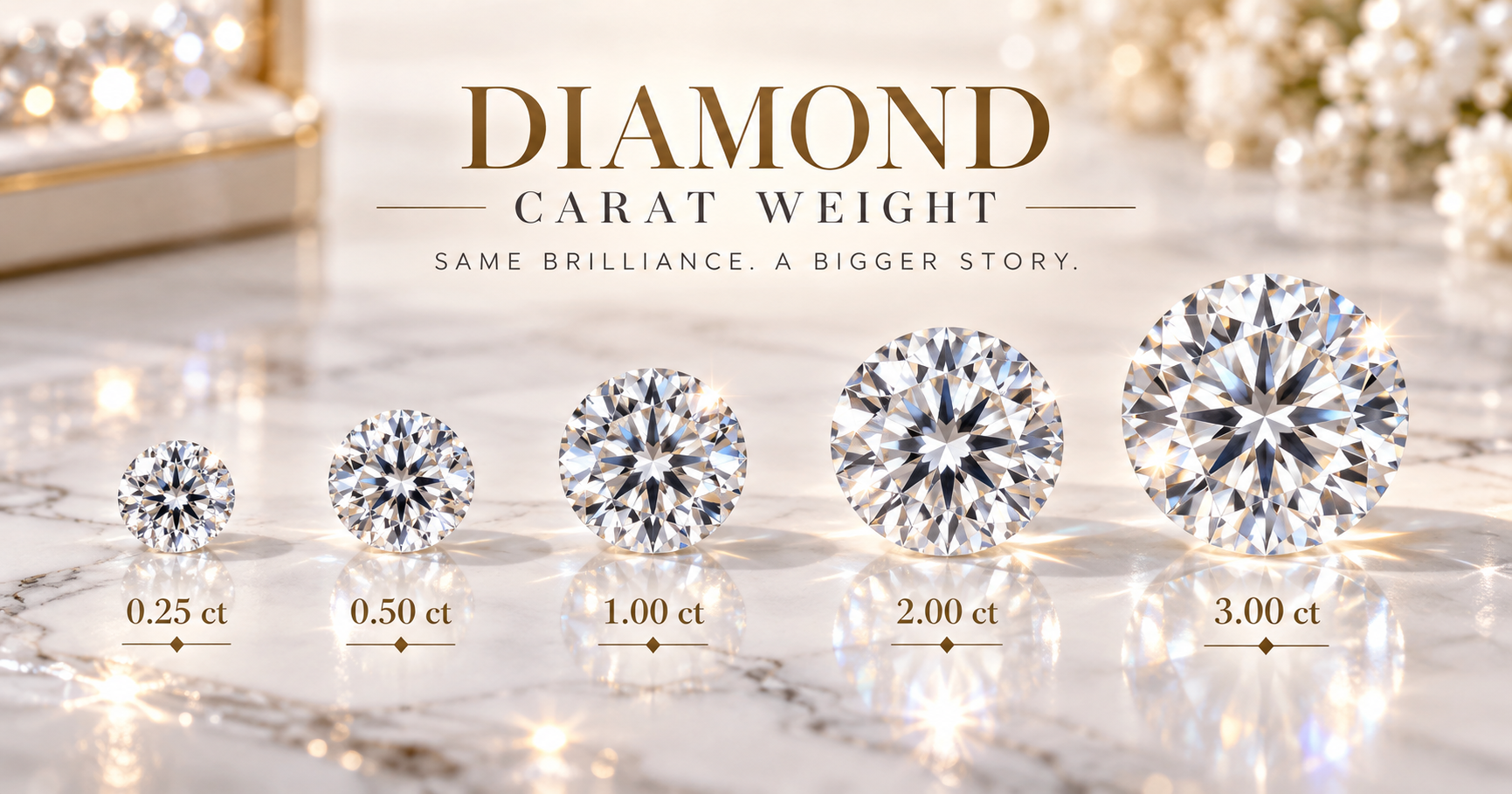
Diamond Carat Weight
Carat measures a diamond's weight, not its physical diameter or visible size.
What Is a Diamond Carat?
A carat, abbreviated ct, is the international unit of weight used for diamonds and most other gemstones.
One metric carat is exactly:
1 carat = 200 milligrams = 0.20 gram
The carat is divided into 100 smaller units called points. This allows diamonds weighing less than one carat to be described very precisely.
For example, a diamond weighing 0.25 carat may be described as a 25-point diamond, while a diamond weighing 0.75 carat may be called a 75-point diamond.
Where Did the Word "Carat" Come From?
The word carat has historical roots in the use of carob seeds by early gemstone traders.
Small carob seeds were used as counterweights on balance scales when precious stones were traded. Over time, different regional carat standards developed.
To eliminate variations in gemstone weighing, the metric carat was eventually standardized internationally at exactly 200 milligrams.
Modern diamonds are now weighed using extremely precise electronic scales rather than seeds or mechanical counterweights.
Understanding Carats and Points
Think of a carat as being similar to a dollar divided into 100 cents. One carat contains 100 points.
0.25 Carat
25 Points
One-quarter carat.
0.50 Carat
50 Points
One-half carat.
0.75 Carat
75 Points
Three-quarter carat.
1.00 Carat
100 Points
One full carat.
Carat Weight Is Not the Same as Diamond Size
One of the most important facts to understand when shopping for a diamond is that carat measures weight, not diameter.
Two diamonds can weigh exactly 1.00 carat yet appear different in size when viewed from above.
A diamond's visible dimensions are influenced by several factors, including:
- Diamond shape
- Table size
- Total depth
- Crown height
- Pavilion depth
- Girdle thickness
- Overall cut proportions
Why Two 1-Carat Diamonds Can Look Different
A well-proportioned round brilliant diamond weighing approximately one carat commonly has a diameter in the neighborhood of 6.4 to 6.5 millimeters, although actual measurements vary from stone to stone.
Another one-carat diamond may carry more of its weight in its depth, pavilion or girdle. Because some of that weight is hidden below the diamond's face-up surface, the stone may appear smaller when viewed from above.
This is why a buyer should consider both carat weight and measurements when comparing diamonds.
A heavier diamond is not automatically a larger-looking or more beautiful diamond.
Carat Weight and Diamond Cut Work Together
The relationship between carat weight and cut is especially important. A diamond cutter must decide how to transform a piece of rough diamond into a finished gemstone while balancing beauty, proportions and retained weight.
If too much weight is retained in the pavilion or girdle, a diamond may achieve a higher carat weight but appear smaller from the top. Poor proportions may also affect the diamond's ability to return light effectively.
A well-cut diamond can therefore provide a more attractive combination of apparent size, brightness, fire and scintillation than a heavier diamond with less favorable proportions.
For this reason, carat weight should always be considered together with the fourth C: Diamond Cut .
How Carat Weight Affects Diamond Value
All other quality factors being comparable, larger diamonds generally command higher prices because larger gem-quality diamonds are less common than smaller ones.
However, diamond prices do not simply increase in a straight line as weight increases.
A two-carat diamond of comparable quality will ordinarily cost substantially more than twice the price of a one-carat diamond because larger diamonds are progressively rarer.
Carat weight alone never determines the complete value of a diamond. The other Four Cs - cut, color and clarity - can cause two diamonds of identical weight to have substantially different values.
"Magic" Carat Weights
Certain popular carat weights are particularly desirable in the diamond market. These are sometimes called "magic sizes" or "magic weights."
Common examples include:
- 0.50 carat
- 0.75 carat
- 1.00 carat
- 1.50 carats
- 2.00 carats
- 3.00 carats
Prices per carat may increase as diamonds cross certain popular weight thresholds.
For example, the visual difference between a 0.99-carat diamond and a 1.00-carat diamond may be extremely difficult to detect with the unaided eye, yet the one-carat stone may command a higher price.
Price Per Carat
Diamond pricing is frequently discussed in terms of price per carat.
The total price of a diamond can be viewed generally as:
Carat Weight × Price Per Carat = Diamond Price
However, the price-per-carat figure itself varies according to the individual diamond's combination of cut, color, clarity, shape, grading characteristics and market demand.
Consequently, two diamonds weighing exactly the same amount can have very different selling prices.
Buying Just Below a Popular Weight
Buyers looking for value sometimes compare a diamond at a major carat threshold with one weighing slightly less.
For example:
0.95 ct vs. 1.00 ct
Depending upon their proportions, the difference in visible diameter may be very small, while the difference in price can sometimes be more noticeable.
The best comparison should consider actual measurements, cut quality, color, clarity and overall appearance rather than carat weight alone.
Diamond Shape Also Influences Apparent Size
Diamonds with the same carat weight can look different not only because of their proportions, but also because of their shape.
Round brilliant, oval, pear, marquise, emerald, cushion, princess and other diamond shapes distribute their weight differently.
Some elongated shapes, such as oval, pear and marquise diamonds, may present a relatively large face-up area for their weight. Other shapes may concentrate more weight below the girdle.
Therefore, comparing diamonds by carat weight alone does not necessarily reveal which diamond will look largest when worn.
Carat
Carat = Gemstone Weight
Carat, abbreviated ct, measures the weight of diamonds and other gemstones.
Example: 1.25 ct diamond.
Karat
Karat = Gold Purity
In the United States, karat, abbreviated K or Kt, refers to the purity or fineness of gold.
Example: 14K or 18K gold.
Diamond Carat Weight Buying Tips
- Do not shop by carat weight alone. Compare cut, color and clarity as well.
- Check the actual measurements. Millimeter dimensions can help indicate how large the diamond will appear face-up.
- Pay close attention to cut. A well-cut diamond may appear more brilliant and visually impressive than a heavier but poorly proportioned diamond.
- Compare diamonds just below major weight thresholds. A diamond slightly below 1.00, 1.50 or 2.00 carats may offer a similar visual appearance at a different price.
- Compare diamonds of the same shape. Different shapes distribute carat weight differently.
- Review an independent grading report. A grading report provides the diamond's measured carat weight together with other important quality characteristics.
Diamond Carat Weight Quick Reference
1.00 carat = 100 points = 0.20 gram
0.75 carat = 75 points
0.50 carat = 50 points
0.25 carat = 25 points
Remember: carat describes weight, not necessarily how large the diamond will look.