All Brands
Browse diamond bracelets from featured brands and online merchants.

All Brands
Browse diamond bracelets from featured brands and online merchants.
For Men
Browse diamond bracelet styles and designs for men.
For Women
Explore diamond bracelets for women in a variety of styles and designs.
Allurez
Browse diamond bracelet selections from Allurez.
Amazon Collection
Explore diamond bracelets from the Amazon Collection.
Dazzling Rock
Browse diamond bracelet selections from Dazzling Rock.
BARZEL
Explore diamond bracelet styles from BARZEL.
Jewels by Lux
Browse diamond bracelets from Jewels by Lux.
Belacqua
Browse Belacqua diamond bracelet selections.
Houston Diamond District
Explore diamond bracelets from Houston Diamond District.
Kendra Scott
Browse diamond bracelets from Kendra Scott.
Palm Beach Jewelry
Explore diamond bracelet selections from Palm Beach Jewelry.
Pavoi
Browse diamond bracelets from Pavoi.
SWEETV
Explore diamond bracelet styles from SWEETV.
TUHE
Browse TUHE diamond bracelet selections.
Yadoca
Explore diamond bracelets from Yadoca.
Affiliate Disclosure: DiamondAvenue.com may earn a commission from qualifying purchases made through affiliate links at no additional cost to you.
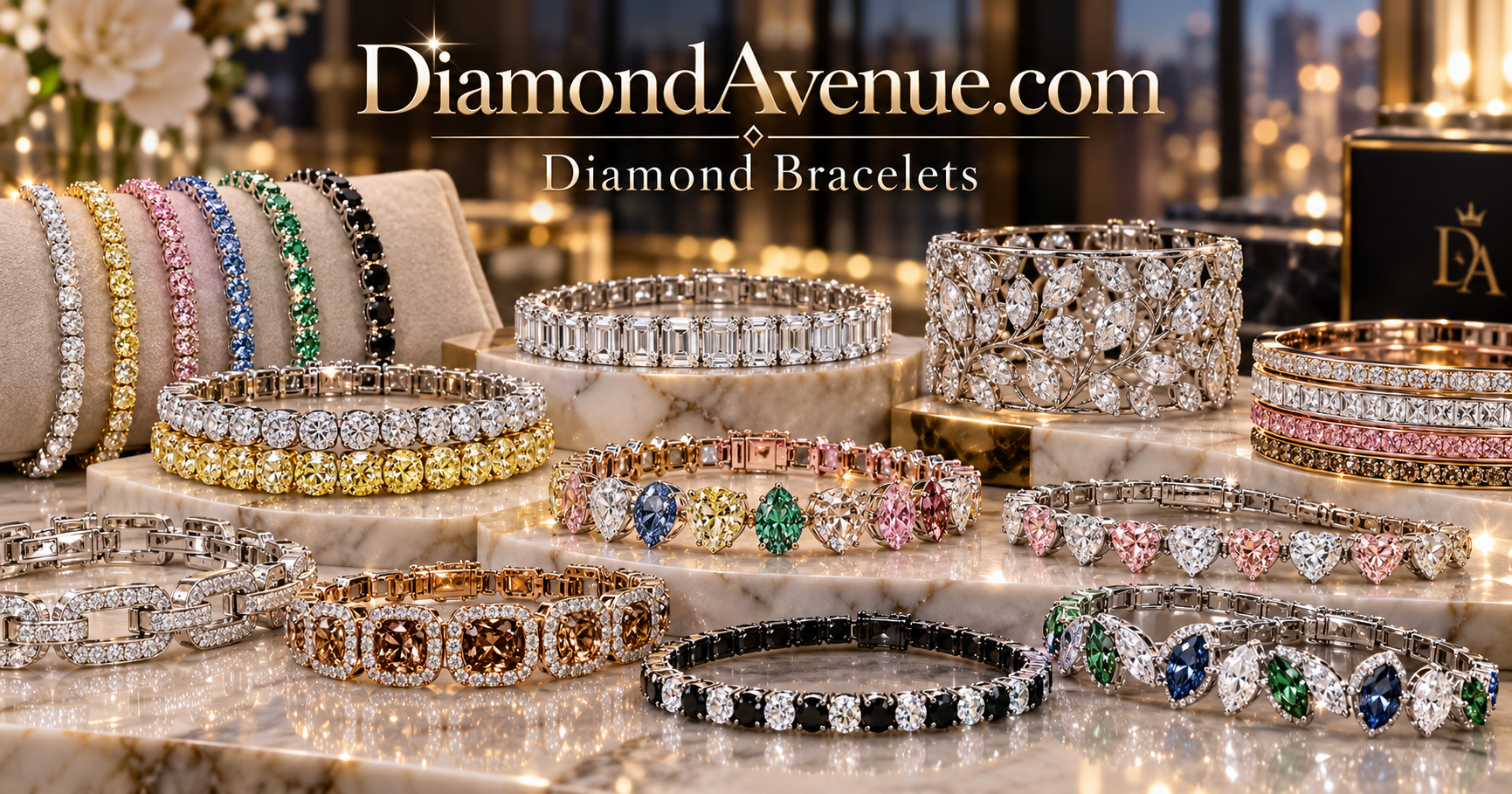
Diamond bracelets combine the brilliance of diamonds with one of the most versatile forms of jewelry. They range from classic tennis bracelets and elegant diamond bangles to bold men's styles and delicate designs intended for everyday wear.
When comparing diamond bracelets, consider not only appearance and price, but also diamond quality, metal type, bracelet construction, length, fit and the security of the clasp. Understanding these features can help you select a bracelet that is attractive, comfortable and appropriate for the way it will be worn.
A diamond tennis bracelet is typically made from a continuous or nearly continuous row of individually set diamonds joined by flexible links. The design is valued for its clean, symmetrical appearance and the way it allows the diamonds to follow the natural curve of the wrist.
Tennis bracelets are commonly made with round brilliant-cut diamonds, although other diamond shapes may also be used. The diamonds may be secured with prongs, bezels or other settings depending on the design.
Because a tennis bracelet contains many diamonds, its overall appearance depends heavily on how well the stones match in size, color, clarity and brilliance. Consistency across the bracelet can be just as important visually as the grade of any single diamond.
Diamond bangles have a more rigid structure than traditional link bracelets. They may be completely circular or use a hinged design that opens to make the bracelet easier to put on and remove.
Diamonds may cover the entire circumference of the bangle or appear only across the upper portion. Some designs use a single row of diamonds, while others incorporate multiple rows, pavé settings or decorative patterns.
Diamond bangles can be worn alone for a clean, elegant appearance or stacked with other diamond, gemstone or plain-metal bracelets to create a layered look.
Women's diamond bracelets are available in a wide range of styles, from fine and delicate pieces to wide statement bracelets containing multiple rows of diamonds.
Popular designs include tennis bracelets, diamond bangles, chain bracelets with diamond stations, pavé bracelets and bracelets combining diamonds with colored gemstones.
For everyday wear, many buyers prefer a lower-profile setting that is less likely to catch on clothing. For formal or occasional wear, larger diamonds and more elaborate settings may provide greater visual impact.
Men's diamond bracelets often feature broader links, heavier metal construction and stronger geometric styling than many traditional women's bracelet designs.
Common styles include diamond link bracelets, curb and Cuban link designs, tennis bracelets, ID-style bracelets and bracelets that combine diamonds with black, white or colored metal finishes.
When selecting a men's diamond bracelet, comfort and proportion are especially important. The width of the bracelet, total weight, clasp design and wrist size should all be considered in addition to the diamond content.
The metal used in a diamond bracelet affects its appearance, durability, weight and price. Common choices include white gold, yellow gold, rose gold and platinum.
White Gold: White gold provides a bright appearance that blends naturally with colorless diamonds. Many white-gold jewelry pieces are rhodium plated to produce an especially white and reflective finish.
Yellow Gold: Yellow gold provides a warm, traditional appearance and can create an attractive contrast with white diamonds.
Rose Gold: Rose gold has a warm pinkish tone and can produce a softer or more contemporary appearance.
Platinum: Platinum is naturally white, dense and highly durable. It is often used in fine jewelry where strength and long-term wear are important considerations.
The same Four C's used to evaluate loose diamonds—carat weight, color, clarity and cut—also influence the appearance and value of the diamonds used in bracelets.
In a bracelet containing many smaller diamonds, overall matching is especially important. Diamonds that are noticeably different in color, brightness or size can make the bracelet appear uneven.
Cut: Cut influences a diamond's brilliance and sparkle. Well-cut diamonds generally reflect light more effectively and can make a bracelet appear brighter.
Color: Diamond color becomes particularly noticeable when many diamonds are positioned next to one another. A well-matched row generally produces a more uniform appearance.
Clarity: Clarity refers to internal inclusions and external blemishes. Because many bracelet diamonds are relatively small, extremely high clarity grades may not always produce a visible difference without magnification.
Carat Weight: Diamond bracelets are frequently advertised using total carat weight, meaning the combined weight of all the diamonds in the bracelet. Buyers should determine whether a stated weight refers to one diamond or to the combined weight of all diamonds.
Bracelet length affects both comfort and appearance. A bracelet that is too tight may be uncomfortable, while one that is too loose may rotate excessively or be more likely to catch on surrounding objects.
Measure the wrist at the point where the bracelet will normally rest. Additional room can then be added according to the desired fit and the thickness of the bracelet.
Wider or heavier bracelets may require slightly more room than delicate bracelets in order to move comfortably on the wrist.
A diamond bracelet should move naturally on the wrist without being loose enough to slip over the hand.
The clasp is particularly important because a diamond bracelet can represent a substantial investment. Box clasps, lobster clasps and other secure fastening mechanisms are commonly used.
Many fine tennis bracelets include an additional safety latch or safety catch. This secondary feature can help keep the bracelet attached if the primary clasp accidentally opens.
Before purchasing a diamond bracelet, compare the complete piece rather than focusing only on total carat weight. Two bracelets with similar total diamond weight can look very different depending on diamond quality, metal weight, stone size, setting style and craftsmanship.
Check whether the stated carat weight represents the total weight of all diamonds in the bracelet. Also review the stated diamond color and clarity ranges, metal purity, bracelet dimensions and clasp construction.
Look carefully at the setting and construction. Diamonds should be securely mounted, links should move smoothly and the clasp should close firmly.
Review the seller's return policy, warranty, repair provisions and shipping or insurance policies before ordering.
For higher-value diamond bracelets, buyers may also wish to determine whether diamond grading information, documentation or an independent appraisal is available.
Most importantly, choose a bracelet that combines attractive diamonds with secure construction, comfortable fit and a style appropriate for the person who will wear it.
Understanding the characteristics of diamonds can make it easier to compare diamond bracelets and other jewelry. DiamondAvenue.com provides additional information about diamond carat weight, color, clarity, cut and the Four C's.
Diamond Carat Weight | Diamond Color | Diamond Clarity | Diamond Cut | The Four C's