All Brands
Browse a broad selection of diamond earrings, diamond studs and classic earring styles.

Browse a broad selection of diamond earrings, diamond studs and classic earring styles.
Explore diamond earrings and classic jewelry styles available through the Amazon Essentials.
Browse diamond earrings and jewelry selections from Belacqua.
Browse diamond earrings and jewelry selections from Gem Stone King.
Explore diamond earrings and jewelry from the DazzlingRock Collection.
Explore diamond earrings and classic diamond jewelry styles from Diamond Wish.
Browse diamond earrings and jewelry selections available from GUILDED.
Explore diamond earrings and fine jewelry selections from Jewels by Lux.
Explore diamond earrings and jewelry selections available from MAX + STONE.
Browse diamond earrings and fine jewelry selections from Sonia Jewels.
Explore diamond earrings and fine jewelry selections from Santuzza.
Affiliate Disclosure: DiamondAvenue.com may earn a commission from qualifying purchases made through affiliate links at no additional cost to you.
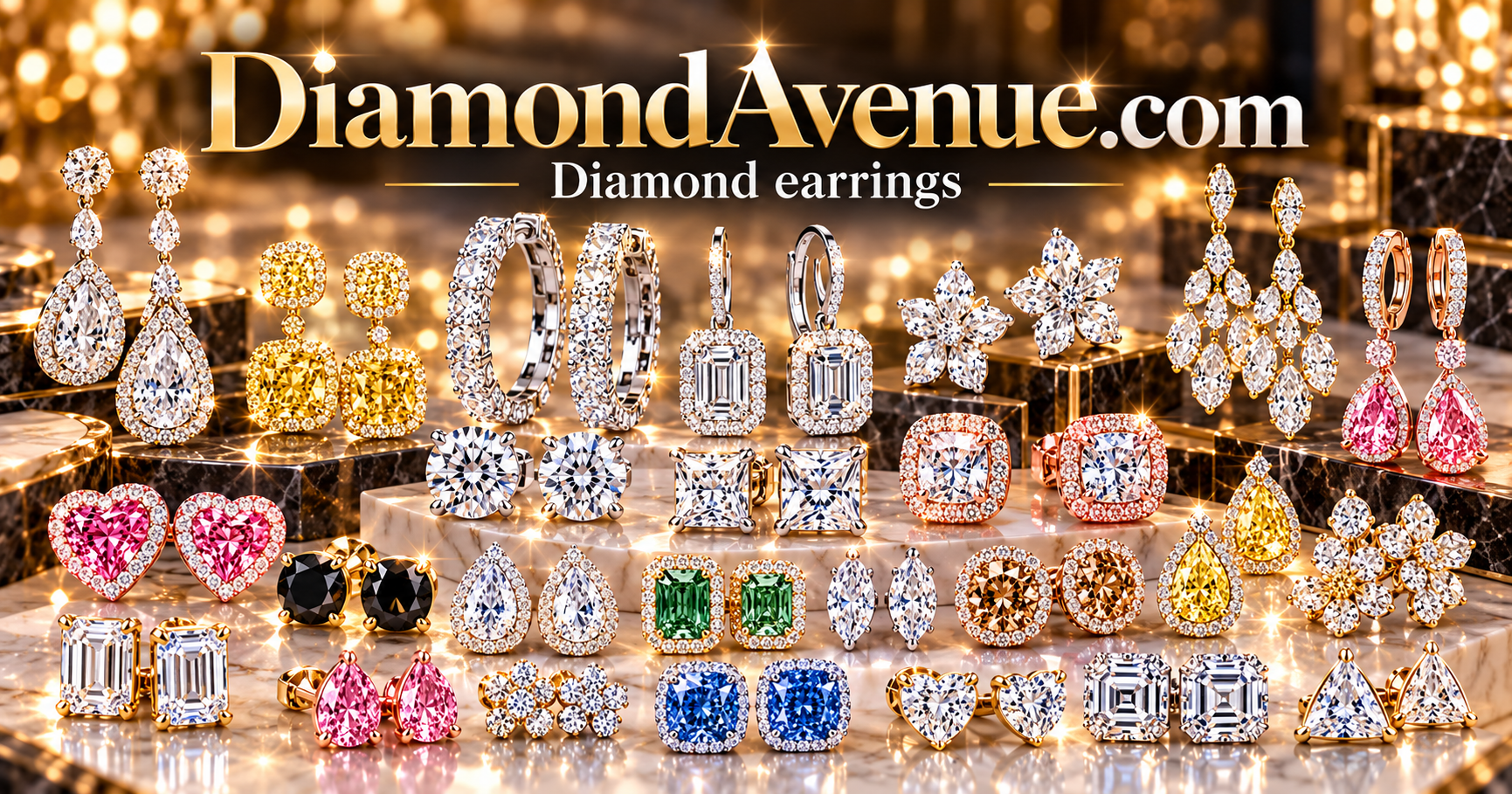
Diamond earrings are among the most versatile pieces of diamond jewelry. They can be worn every day, reserved for special occasions or given as gifts for birthdays, anniversaries, weddings and other important events.
Choosing a good pair of diamond earrings involves more than simply looking at total carat weight. Diamond cut, color, clarity, shape and matching are important, but the earring style, setting, precious metal, backing, size, comfort and overall workmanship also affect how the earrings look and how practical they are to wear.
The best choice depends on the wearer's personal style, how frequently the earrings will be worn and the balance between diamond size, quality, durability and budget.
Diamond earrings are available in many different designs. The appropriate style depends on the wearer's taste, lifestyle and the occasions for which the earrings will normally be worn.
Diamond studs are one of the most traditional and versatile diamond earring styles. A single diamond is normally mounted on each ear, allowing the diamonds themselves to become the main visual focus.
Stud earrings can range from small, understated diamonds appropriate for everyday wear to much larger diamonds that create a more dramatic appearance.
Diamond hoop earrings feature diamonds set along part or all of a circular or semi-circular earring.
Small hoops can provide subtle everyday sparkle, while larger hoops or designs containing multiple rows of diamonds can create a more prominent appearance.
Drop and dangle earrings suspend diamonds below the earlobe and may incorporate several diamonds, decorative metalwork or additional gemstones.
Their movement can attract attention and create additional sparkle, making these styles particularly popular for formal and special-occasion jewelry.
Diamonds used in earrings are evaluated using the same basic characteristics applied to other diamonds: Cut, Color, Clarity and Carat Weight. These characteristics are commonly known as the Four C's.
With earrings, however, there is another important consideration: the two earrings should work together as a matched pair.
The diamonds do not necessarily need to have identical grading specifications, but they should look similar enough in size, color, brilliance and overall appearance that one earring does not appear noticeably different from the other.
The best value often comes from balancing all four characteristics instead of attempting to obtain the highest grade in every category.
Cut has a major influence on how brightly a diamond sparkles. A well-cut diamond can reflect light effectively and may appear more lively than a poorly proportioned diamond of similar weight.
Because earrings are often viewed from a greater distance than rings, brilliance can be particularly important to their overall visual impact.
For diamond studs, well-cut diamonds can create strong sparkle even when the individual stones are relatively modest in size.
A pair of diamond earrings should have a reasonably consistent level of brilliance.
If one diamond is noticeably brighter or better cut than the other, the mismatch may be visible when the earrings are worn.
Matching overall appearance is often more important than requiring the grading specifications of the two diamonds to be absolutely identical.
Diamonds within the normal color range are graded according to how much yellow or brown body color they contain. Diamonds closer to colorless generally receive higher color grades.
Because earrings are normally viewed at some distance from the eyes, very small differences between neighboring color grades may be difficult to notice when the earrings are actually being worn.
The two diamonds should, however, appear reasonably similar in color so that one does not look noticeably warmer or more colorless than the other.
Clarity describes inclusions inside a diamond and blemishes on its surface.
Very high clarity grades can substantially increase price, although the differences may not be visible without magnification.
For many earrings, particularly smaller studs, a diamond that appears clean to the unaided eye may provide a good balance between appearance and price without requiring an exceptionally high clarity grade.
One of the most important things to understand when shopping for diamond earrings is the meaning of total carat weight.
Diamond earrings are often advertised according to the combined weight of all diamonds in the pair.
For example, a pair of one-carat-total-weight diamond stud earrings may contain approximately one-half carat of diamonds in each earring rather than a one-carat diamond in each ear.
Always determine whether an advertised carat weight refers to each individual diamond or to the combined weight of the entire pair.
Carat measures diamond weight rather than the visible diameter of the diamond.
Two diamonds with the same carat weight can have slightly different face-up dimensions depending on their shape and proportions.
When comparing diamond studs, actual millimeter measurements can help provide a better understanding of how large the diamonds will appear on the ear.
Unlike a ring or pendant containing a single center diamond, diamond earrings are normally worn as a pair. The diamonds should therefore complement one another visually.
When evaluating a pair of diamond stud earrings, compare the diamonds for:
A well-matched pair of moderately graded diamonds may produce a more pleasing appearance than two higher-grade diamonds that look noticeably different from one another.
Round brilliant diamonds are the traditional choice for diamond stud earrings, but many other shapes can create distinctive and attractive designs.
Round brilliant diamonds are popular because of their symmetrical appearance and strong potential for brilliance. They work well in nearly every style of diamond earring.
Princess-cut diamonds provide a square appearance with brilliant-style faceting, while cushion cuts combine softened corners with a more rounded or pillow-like outline.
Oval, pear, emerald, marquise and other diamond shapes can create more distinctive earrings and may complement particular personal styles.
For any matched pair, the outlines and proportions of the two diamonds should appear reasonably consistent.
The setting holds the diamonds securely and also affects how much of each diamond remains visible.
Prong settings use small metal supports to hold a diamond. They expose much of the diamond and can allow light to reach the stone from several directions.
Check that the prongs are even, smooth and securely holding the diamonds.
A bezel setting surrounds all or part of a diamond's edge with metal.
This creates a smooth appearance and provides additional protection around the diamond, which can make bezel-set earrings practical for frequent wear.
A halo surrounds a center diamond with smaller diamonds. This adds sparkle and can make the overall earring appear larger without requiring a substantially larger center diamond.
The earring backing is an important part of security, particularly when the earrings contain valuable diamonds. A beautiful diamond earring provides little value if the backing comes loose and the earring is lost.
Push backs, sometimes called friction backs, slide onto the post and are among the most common earring fasteners.
They are convenient and easy to use, but the fit should remain sufficiently tight to hold the earring securely.
Screw-back earrings use threaded posts and backs that screw into place.
They take slightly longer to put on and remove but may provide additional security for valuable diamond studs.
Hoop and drop earrings may use hinged posts, lever backs, latch backs or other fastening systems.
Whatever style is used, make certain the mechanism closes securely and is comfortable on the ear.
Diamond earrings are commonly made from platinum, white gold, yellow gold or rose gold. The metal affects the appearance, durability, weight, maintenance requirements and price of the earrings.
Platinum is naturally white, dense and durable. Its white appearance complements colorless diamonds and does not depend on rhodium plating for its basic color.
White gold provides a bright white-metal appearance that works particularly well with diamonds.
Many white-gold earrings receive rhodium plating to produce an especially bright white finish.
Yellow gold provides the traditional warm appearance associated with fine gold jewelry and creates an attractive contrast with white diamonds.
Rose gold has a warm pink or reddish color created by the metals alloyed with gold and can give diamond earrings a distinctive appearance.
Fourteen-karat gold contains approximately 58.5 percent pure gold, with the balance consisting of alloying metals.
It is widely used for earrings because it combines gold content with good durability for regular wear.
Eighteen-karat gold contains 75 percent pure gold. It has a higher gold content than 14K gold and may have a richer appearance, particularly in yellow and rose gold.
The choice between 14K and 18K gold involves balancing gold content, durability, appearance and price.
Earrings should be comfortable enough for the amount of time they are expected to be worn.
Small diamond studs are usually light and suitable for long periods of wear. Larger earrings may place more weight on the earlobe.
A pair intended for everyday use should balance visual impact with comfort.
As diamond studs become larger and heavier, the size and design of the earring back become increasingly important.
A larger backing can provide more support behind the earlobe and may help prevent a heavy stud from tilting downward.
Check how the earrings sit when worn rather than judging their appearance only when displayed in a box.
Natural diamonds formed within the earth over geological time before being mined, cut and polished for jewelry.
When purchasing natural diamond earrings, review the seller's disclosure about the diamonds and any grading information supplied with the pair.
Lab-created diamonds are diamonds grown under controlled laboratory conditions. They have essentially the same crystal structure and chemical composition as natural diamonds but have a different origin.
The seller should clearly identify whether the earrings contain natural or laboratory-created diamonds.
Diamond simulants such as cubic zirconia and moissanite may resemble diamonds but are different materials with different physical, chemical and optical properties.
A laboratory-created diamond is a diamond with a laboratory origin. A diamond simulant is not a diamond.
Read product descriptions carefully so that you know whether you are buying natural diamonds, lab-created diamonds or diamond simulants.
Larger individual diamonds may be accompanied by independent laboratory grading reports describing characteristics such as carat weight, color, clarity, measurements and other identifying information.
Smaller diamonds used in earrings are not always individually graded because obtaining separate reports for numerous small stones may not be practical.
For higher-value diamond studs, ask what grading or documentation is provided and whether the individual diamonds have laboratory reports.
A grading report describes the characteristics of a diamond.
An appraisal generally assigns a monetary value to the finished jewelry for a particular purpose, such as insurance.
The two documents serve different purposes and should not be confused.
Diamond earrings do not have to contain traditional colorless diamonds. Natural diamonds can occur in yellow, pink, blue, brown and other colors.
Fancy-color diamonds can be used as center stones or combined with white diamonds to create contrasting designs.
Matching can be especially important when two fancy-color diamonds are being used as a pair.
Differences in hue, tone and color intensity may be more noticeable than small differences in traditional colorless diamond grades.
For everyday earrings, comfort, security and durability may be as important as diamond size.
Stud earrings, small hoops and lower-profile settings are popular choices because they are relatively easy to wear with many types of clothing and other jewelry.
For formal occasions, larger diamonds, elaborate drops, multiple rows of diamonds and more dramatic designs can provide greater visual impact.
A special-occasion pair may emphasize appearance and movement more heavily than earrings intended to be worn throughout the day.
Diamond earrings are available across a wide range of prices. The amount spent should reflect the buyer's financial circumstances, the intended use of the earrings and which diamond characteristics matter most.
For example, a buyer may prefer larger diamonds with moderate color and clarity grades rather than smaller diamonds with extremely high grades that provide little additional visible benefit when worn on the ears.
The goal should be to find a well-matched pair with good visual appeal, secure construction and a price appropriate for the buyer's budget.
Before buying diamond earrings online, review the description carefully.
Look for the total carat weight, number of diamonds, diamond shape, color and clarity information, precious metal, dimensions and type of earring back or closure.
Consider the seller's reputation and make sure important product information is clearly disclosed.
For higher-value earrings, determine what grading reports, appraisals, warranties or other documentation accompany the jewelry.
Earrings can look different when worn than they appear in photographs, so review the return policy before purchasing.
Determine the length of the return period and whether there are restrictions involving worn, customized or special-order earrings.
Skin oils, cosmetics, hair products and other residue can accumulate on earrings and reduce the apparent brilliance of the diamonds.
Regular appropriate cleaning can help maintain their sparkle.
Follow care recommendations appropriate for the diamonds, precious metal and any other gemstones used in the earrings.
Periodically inspect prongs, settings, posts, hinges and earring backs for wear or looseness.
A loose prong can allow a diamond to fall out, while a worn or loose backing can result in the loss of the entire earring.
Higher-value earrings can also be inspected periodically by a qualified jeweler.
Higher-value diamond earrings may warrant insurance against risks such as theft, loss or accidental damage.
Coverage may be available through homeowners or renters insurance, a scheduled jewelry endorsement or specialized jewelry insurance.
Keep sales receipts, grading reports, photographs and appraisals in a safe place in case documentation is needed later.
Before selecting a pair of diamond earrings, consider the following:
Diamond earrings should be evaluated as complete pieces of jewelry rather than simply by their advertised carat weight.
The quality and matching of the diamonds, their visible size, the precious metal, settings, earring backs, comfort, workmanship and overall design all contribute to how attractive and practical the earrings will be.
A well-matched pair of attractive diamonds mounted securely in a comfortable, well-made setting can provide greater satisfaction than earrings chosen primarily because they have a larger total carat-weight number.
The Four C's | Carat Weight | Clarity | Color | Cut | Diamond Shape
Lab-Created Diamonds | Diamond Simulants | Fancy Colored Diamonds | Diamond Care