
Diamond Shape
DiamondAvenue.com is the place to learn about "Shape" which is a component of Cut" one of the four Diamond Characteristics
Diamond Shapes and Their Relationship to Cut
Understanding Round, Princess, Cushion, Emerald, Oval, Pear, Marquise, Heart, Radiant, Asscher and Other Diamond Shapes
A diamond's shape describes its overall outline when viewed from above, while its cut describes how the stone's facets, proportions, symmetry and polish work together to interact with light.
Shape and cut are closely related, but they are not the same thing. Two diamonds may have the same shape while differing greatly in cut quality, brilliance, proportions and overall visual appeal.
Popular Diamond Shapes
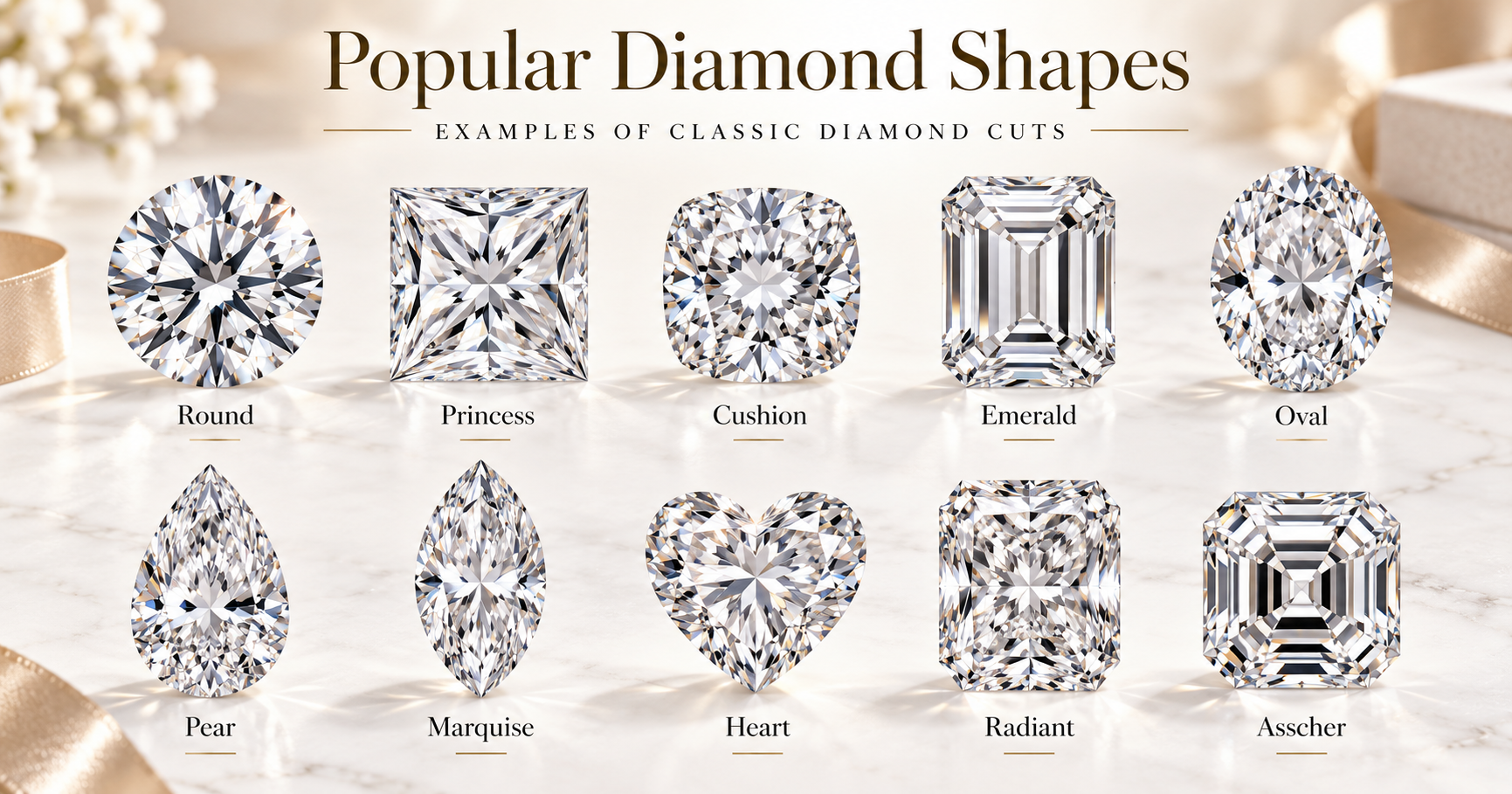
Diamonds are fashioned into many different shapes, each creating its own combination of brilliance, proportions, style and visual character.
From Rough Diamond to Polished Gem
A natural diamond begins as a rough crystal rather than as the polished gemstone seen in finished jewelry.
Before cutting begins, the cutter studies the rough diamond and evaluates its shape, internal characteristics, crystal structure and potential yield.
The goal is to determine how the rough can be transformed into one or more polished diamonds while balancing:
- Beauty
- Brilliance
- Carat-weight retention
- Clarity considerations
- Proportions
- Market demand
Shape Is Different from Cut Quality
The terms shape and cut are sometimes used interchangeably, but they describe different characteristics.
Shape refers primarily to the outline of a diamond, such as round, oval, pear, emerald or princess.
Cut quality describes how effectively the diamond's proportions, facet arrangement, symmetry and polish work together to reflect and return light.
A diamond may therefore have an attractive shape yet still be poorly proportioned, while another diamond of the same shape may display exceptional brilliance and balance.
Round Brilliant and Fancy-Shaped Diamonds
The round brilliant is the best-known modern diamond shape and was developed through generations of experimentation with proportions and light performance.
The influential work of Marcel Tolkowsky in the early twentieth century helped establish mathematical principles for round brilliant proportions. Modern round brilliants have continued to evolve since that time.
Diamonds with shapes other than round brilliant are generally referred to as fancy-shaped diamonds.
Fancy shapes include princess, oval, cushion, emerald, pear, marquise, heart, radiant, Asscher and many other variations.
Fancy shapes are not necessarily lower quality than round diamonds. They simply use different outlines, facet arrangements and proportion systems to create different visual effects.
Round Brilliant
The Round Brilliant is the most widely recognized diamond shape and is specifically designed to maximize light return.
A traditional modern round brilliant generally contains 57 or 58 facets, depending upon whether the culet is counted as a facet.
Its symmetrical circular outline and carefully arranged facets can produce a strong combination of:
- Brightness
- Fire
- Scintillation
The round brilliant is commonly used for engagement rings, earrings, pendants and many other forms of diamond jewelry.
Why Round Diamonds Are Different
Round brilliants have been studied extensively because of their rotational symmetry and their ability to return light efficiently when properly proportioned.
This has led to more established systems for evaluating round brilliant cut quality than exist for many fancy shapes.
Fancy-shaped diamonds require somewhat different evaluation because their ideal appearance depends on shape-specific factors such as:
- Length-to-width ratio
- Symmetry
- Corner shape
- Bow-tie visibility
- Facet pattern
- Face-up proportions
Princess Cut
The Princess Cut typically has a square or slightly rectangular outline with pointed corners and brilliant-style faceting.
Its facet pattern produces considerable sparkle and gives buyers a geometric alternative to the round brilliant.
Because the corners are pointed, protective prong settings are important to help reduce the risk of chipping at vulnerable points.
Cushion Cut
The Cushion Cut combines a square or rectangular outline with rounded corners, giving it a softer appearance than a princess cut.
Cushion diamonds are available in numerous facet patterns and proportions.
Some show broad, chunky flashes of light, while others display a finer, more sparkling appearance.
Cushion cuts may be square or elongated depending upon the desired style.
Oval Cut
The Oval Cut uses brilliant-style faceting in an elongated outline.
Because of its length, an oval diamond can often create the impression of a larger face-up area than a round diamond of similar carat weight.
Oval diamonds are popular in solitaire engagement rings, three-stone designs and halo settings.
When evaluating an oval diamond, buyers should examine symmetry, length-to-width ratio and the visibility of any central bow-tie effect.
Marquise Cut
The Marquise Cut has an elongated outline with pointed ends.
Its long shape can make a diamond appear relatively large for its carat weight and can create an elegant, lengthening effect when worn in a ring.
Good symmetry is particularly important in a marquise. The two ends should align properly and the curves on each side should appear balanced.
Like ovals and pears, marquise diamonds may display varying degrees of bow-tie effect.
Pear Cut
The Pear Cut, sometimes called a teardrop shape, combines characteristics of the round brilliant and marquise.
One end is rounded while the opposite end tapers to a point.
Pear-shaped diamonds are used in engagement rings, pendants, earrings and other jewelry where their graceful elongated outline can be emphasized.
Symmetry is especially important. The point should align visually with the center of the rounded end.
Heart Cut
The Heart Cut is one of the most distinctive fancy shapes and is commonly associated with romance and sentimental jewelry.
A well-proportioned heart shape should display:
- Balanced lobes
- A distinct central cleft
- An evenly positioned point
- Good overall symmetry
Because small heart-shaped diamonds may not show the outline as clearly, the shape is often especially effective in larger sizes.
Emerald Cut
The Emerald Cut has a rectangular outline with cropped corners and long, step-cut facets.
Unlike brilliant cuts, which emphasize sparkle through numerous small reflections, emerald cuts produce broad flashes of light and a distinctive hall-of-mirrors appearance.
Because of its large open table and broad facets, inclusions and body color can sometimes be more visible in an emerald cut.
For this reason, clarity and color may deserve additional consideration when selecting an emerald-cut diamond.
Asscher Cut
The Asscher Cut is a square or near-square step cut with cropped corners.
Its concentric step facets create a distinctive geometric pattern that can appear almost architectural when viewed face-up.
Like the emerald cut, the Asscher emphasizes clarity, symmetry and broad flashes of reflected light rather than the smaller scintillation typical of many brilliant cuts.
Radiant Cut
The Radiant Cut combines a rectangular or square outline with trimmed corners and brilliant-style faceting.
It was developed to combine the geometric outline associated with emerald-type shapes with the lively sparkle of a brilliant cut.
Radiant diamonds may be nearly square or distinctly rectangular depending upon their length-to-width ratio.
Their clipped corners also make the outline less vulnerable than the sharp points of a princess cut.
Baguette Cut
The Baguette Cut is usually a narrow rectangular step-cut diamond.
The name comes from the French word baguette, meaning a small rod or stick, and is also associated with the familiar long, narrow shape of baguette bread.
Baguette diamonds are commonly used as accent stones beside a larger center diamond or arranged in geometric jewelry designs.
Because baguettes have relatively few broad facets, clarity, symmetry and straight facet alignment can strongly influence their appearance.
Brilliant Cuts and Step Cuts
Diamond shapes can also be grouped according to the style of their facet arrangement.
Brilliant-Style Cuts
Brilliant-style cuts use numerous triangular and kite-shaped facets designed to create strong light return, sparkle and fire.
Examples include:
- Round Brilliant
- Oval
- Pear
- Marquise
- Heart
- Many Cushion Cuts
- Radiant Cuts
- Princess Cuts
Step Cuts
Step-cut diamonds use long, generally parallel facets arranged in a series of steps around the stone.
They tend to produce broad flashes of light rather than the rapid scintillation associated with brilliant cuts.
Examples include:
- Emerald Cut
- Asscher Cut
- Baguette Cut
Shape Can Affect Apparent Size
Two diamonds of equal carat weight may appear different in size when viewed from above.
Elongated shapes such as oval, marquise and pear may present a larger-looking face-up outline than some other shapes of similar weight.
However, actual appearance also depends on:
- Depth percentage
- Table percentage
- Girdle thickness
- Overall proportions
- Length-to-width ratio
Length-to-Width Ratio
The length-to-width ratio describes how elongated or square a diamond appears.
It is especially important when evaluating:
- Oval diamonds
- Pear diamonds
- Marquise diamonds
- Emerald cuts
- Radiant cuts
- Cushion cuts
There is no single ratio that is ideal for every buyer. The preferred proportion often depends on personal taste and the jewelry design in which the diamond will be set.
The Bow-Tie Effect in Elongated Diamonds
Oval, pear and marquise diamonds may display a darker bow-shaped area across the center of the stone known as a bow-tie effect.
Some bow-tie appearance is common in elongated brilliant shapes and does not automatically indicate a poorly cut diamond.
The important consideration is its strength. A mild bow-tie may be barely noticeable, while a very dark or prominent bow-tie can distract from the diamond's overall brilliance and visual balance.
Choosing a Diamond Shape
There is no single diamond shape that is best for every buyer. Shape is largely a matter of personal preference, jewelry design and the visual effect desired.
When comparing shapes, consider:
- Overall brilliance and light performance
- Face-up size
- Length-to-width ratio
- Symmetry
- Corner and point protection
- Bow-tie effect where applicable
- Clarity characteristics
- Color visibility
- Setting style
- Personal preference
Diamond Shape Quick Reference
Maximum Sparkle
Round Brilliant
Princess
Radiant
Elegant and Elongated
Oval
Pear
Marquise
Geometric and Classic
Emerald
Asscher
Baguette
Diamond Shape and the Four Cs
Shape is not itself one of the traditional Four Cs, but it has an important relationship with all four.
Carat: Different shapes distribute weight differently, so diamonds of identical carat weight can have different visible dimensions.
Color: Some shapes may reveal body color more readily than others, particularly near points or broad facets.
Clarity: Step cuts such as emerald and Asscher cuts may make inclusions easier to see because of their large, open facets.
Cut: Proper proportions, symmetry and facet arrangement determine how effectively a particular shape interacts with light.