DiamondAvenue.com - Information on Fancy Color Diamonds
Fancy Color Diamonds
Understanding Natural Colored Diamonds, Hue, Tone, Saturation, Rarity and Value
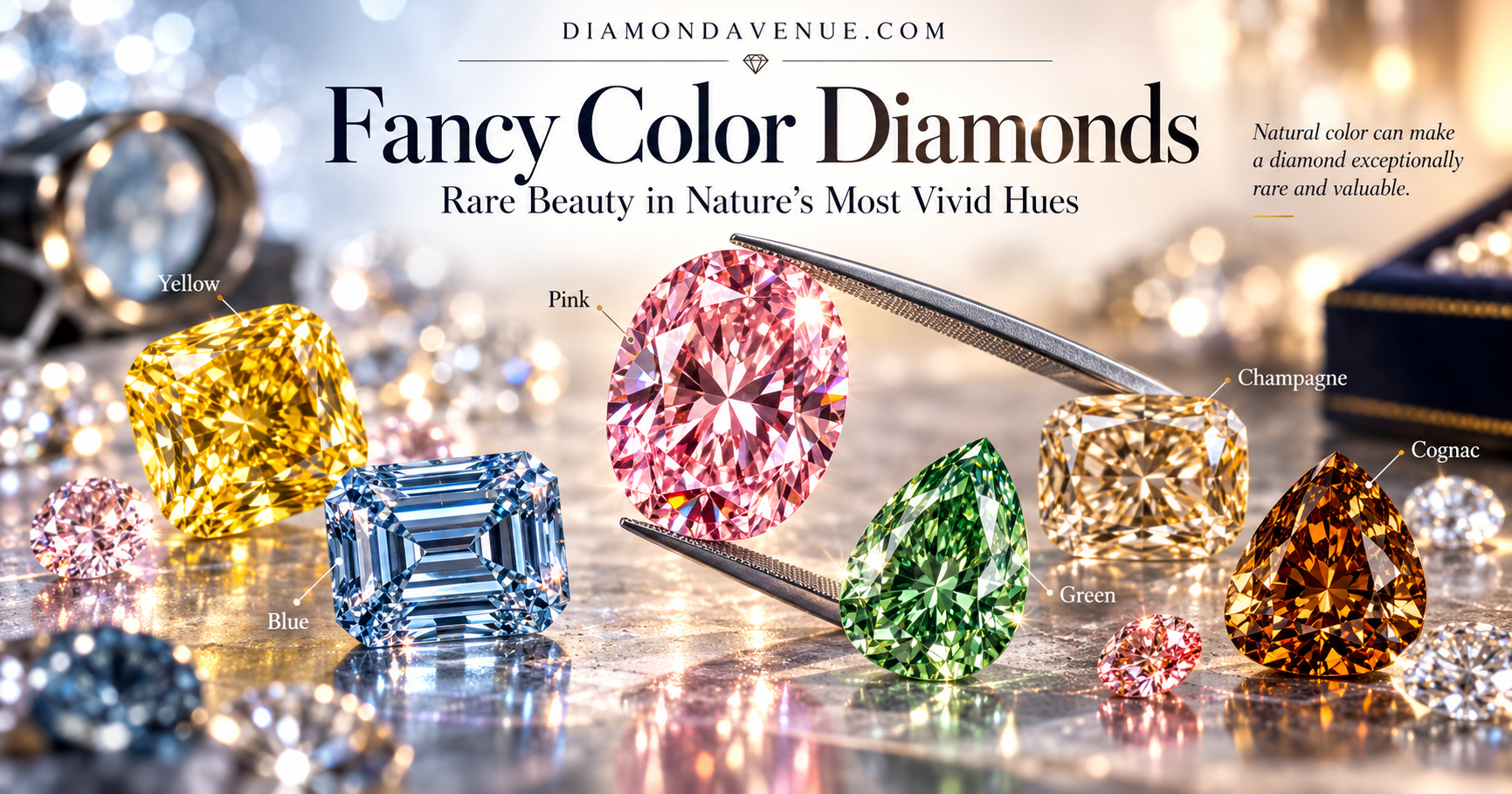
What Are Fancy Color Diamonds?
Most diamonds used in jewelry fall within the traditional D-to-Z color range, where the relative absence of color is generally preferred.
Fancy color diamonds are evaluated differently. Yellow and brown diamonds that display more color than the Z range, as well as diamonds showing other distinct colors such as pink, blue, green or red, are evaluated using a separate colored-diamond grading system.
In fancy color diamonds, stronger and more attractive color can increase rarity and value. Large diamonds with vivid, evenly distributed natural color can be among the most valuable gemstones in the world.
Color Is the Dominant Value Factor
With ordinary D-to-Z diamonds, buyers generally seek less visible body color.
With fancy color diamonds, the opposite is often true. Stronger, purer and more attractive color can make the diamond considerably rarer and more valuable.
A fancy color diamond may have noticeable inclusions and still be highly prized if its face-up color is exceptional. For this reason, color commonly has a greater influence on value than clarity in this category.
Hue
Hue is the basic color of the diamond, such as yellow, pink, blue, green, orange, violet or red.
A diamond may also contain modifying hues, such as orangy pink, greenish yellow or grayish blue.
Tone
Tone describes how light or dark the color appears.
Two diamonds can have similar hue and saturation but look different because one is lighter or darker in tone.
Saturation
Saturation describes the strength or intensity of the color.
More saturated colors often appear richer and more vivid, although the most desirable balance depends upon the hue and tone of the individual diamond.
GIA Fancy Color Grading
GIA evaluates fancy color diamonds by examining hue, tone and saturation under carefully controlled viewing conditions.
Depending upon the color, GIA terminology can include:
Faint | Very Light | Light | Fancy Light | Fancy | Fancy Intense | Fancy Vivid | Fancy Dark | Fancy Deep
Not every grade is used for every hue. For example, yellow diamonds that extend beyond the normal D-to-Z range generally begin in the fancy-color system at Fancy Light.
Yellow Diamond Color Intensity
Yellow diamonds provide an easy example of how increasing saturation can affect the color description.
Fancy Light Yellow

Fancy Yellow

Fancy Intense Yellow

Fancy Vivid Yellow

Rare Fancy Diamond Colors
Natural fancy-color diamonds occur across much of the visible spectrum, but some colors are much rarer than others.
Yellow and brown diamonds are encountered more frequently, while attractive red, pink, blue and green diamonds can be exceptionally rare.
Red Diamonds
Natural red diamonds are among the rarest colored diamonds. Even comparatively small stones with attractive natural red color can be highly prized.
Red diamonds may also display modifying colors such as purplish red or brownish red.
Pink Diamonds
Fine natural pink diamonds are highly sought after for their rarity and beauty.
Pink diamonds can range from delicate pale tones to strongly saturated Fancy Intense and Fancy Vivid colors and may include purple, orange, brown or gray modifiers.
Blue Diamonds
Natural blue diamonds are exceptionally rare.
In many natural blue diamonds, boron incorporated into the crystal structure contributes to the blue coloration.
Blue diamonds may also show gray or green modifying hues.
Green Diamonds
Natural green diamonds are also extremely rare.
Natural radiation in the Earth can alter the crystal structure and produce green coloration. In some diamonds, the green color is concentrated near the surface rather than extending evenly throughout the stone.
Yellow Diamonds
Yellow is one of the most familiar fancy diamond colors.
Nitrogen within the diamond crystal can absorb portions of visible light and create yellow coloration.
Strongly colored yellow diamonds are sometimes marketed in the jewelry trade as "canary" diamonds, although this is a trade term rather than an official GIA grade.
Brown, Champagne and Cognac Diamonds
Brown diamonds occur more commonly than many other fancy colors and can range from pale brown to rich dark brown.
Terms such as champagne and cognac are commonly used as marketing or trade descriptions for attractive brown diamonds.
Black Diamonds
Black diamonds can owe their appearance to numerous dark inclusions, structural features or, in some cases, treatment.
They are increasingly used in contemporary jewelry designs, including pavé and contrasting settings.
Gray Diamonds
Gray diamonds may range from light silvery gray to dark graphite-like tones and can sometimes contain blue, green, violet or brown modifiers.
Fancy White Diamonds
Fancy white diamonds differ from D-color diamonds. Instead of appearing transparent and colorless, they can have a translucent or milky appearance caused by microscopic internal features that scatter light.
What Causes Fancy Diamond Color?
Fancy diamond color can result from trace elements, distortions in the crystal structure, radiation exposure during geological history or combinations of these factors.
Different causes can produce very different colors. Boron, for example, is associated with many natural blue diamonds, while nitrogen contributes to many yellow diamonds.
Pink and red colors are generally associated with structural distortion in the diamond crystal, while natural green coloration can result from exposure to radiation in the Earth.
Fancy Color Diamonds and Clarity
Clarity is still an important quality factor, but it often plays a secondary role to color in fancy-color diamonds.
A diamond with noticeable inclusions may still be very desirable if it displays exceptional face-up color.
However, inclusions that are highly visible or that threaten durability can reduce value.
Fancy Color Diamonds and Cut
Fancy-color diamonds are often cut with a different goal than traditional colorless diamonds.
Instead of maximizing only white-light return, the cutter may choose proportions and facet patterns that intensify or distribute the diamond's body color more attractively.
Radiant, cushion and other modified brilliant styles are frequently used because their facet arrangements can help concentrate face-up color.
Shape Can Influence Color
The outline and faceting pattern of a diamond can influence how strongly its color appears when viewed face-up.
Cushion, radiant, pear and other fancy shapes are frequently used for colored diamonds because they may enhance the visual concentration of color.
Face-Up Color Matters
Fancy-color grading emphasizes the color visible when the diamond is viewed in its normal face-up position.
Cutters therefore balance weight retention, shape, proportions and facet design with the goal of producing an attractive and evenly distributed face-up color.
Carat Weight and Rarity
Large fancy-color diamonds are generally rarer than smaller stones of comparable color quality.
When a rare hue, strong saturation and substantial carat weight occur together, value can increase dramatically.
For especially rare colors, even relatively small diamonds can command significant prices.
Color Distribution
The evenness of the visible color can also affect appearance and desirability.
A diamond with strong, evenly distributed face-up color may be more attractive than a stone with obvious weak areas or uneven zones of color, although some collectors may value unusual natural color patterns.
Natural Color Versus Treated Color
Not every colored diamond acquired its present color naturally.
Diamond color can be altered through treatments including high-pressure high-temperature processing, irradiation, annealing and surface coating.
Naturally colored diamonds and treated-color diamonds can differ substantially in rarity and value, so the origin of color is an important consideration when purchasing a valuable colored diamond.
HPHT Treatment
High-pressure high-temperature treatment can alter the atomic structure of certain diamonds and change or remove their color.
Irradiation and Annealing
Irradiation can create a variety of colors and is sometimes followed by controlled heating, known as annealing, to produce additional color changes.
Surface Coatings
Colored coatings can alter the apparent color of a diamond, but unlike many other treatments, coatings may be less durable and can be damaged or removed.
Why a Laboratory Report Is Important
Fancy-color grading is highly specialized because small differences in hue, tone and saturation can have a major effect on rarity and price.
For a significant fancy-color diamond, an independent gemological laboratory report can identify the color grade and determine whether the color is natural or treated.
The report may also provide information about carat weight, clarity, measurements, polish, symmetry and other important characteristics.
Famous Fancy Color Diamonds
Many of the world's most celebrated diamonds are famous specifically because of their remarkable natural colors.
Examples include the blue Hope Diamond, the Dresden Green, the yellow Tiffany Diamond, the Graff Pink and the Moussaieff Red.
These diamonds demonstrate how extraordinary hue, saturation, size, rarity and history can combine to make a colored diamond internationally famous.
What Determines Fancy Color Diamond Value?
Fancy-color diamond value is influenced by several factors working together.
- Hue and rarity of the color
- Tone
- Saturation and intensity
- Evenness of color distribution
- Natural versus treated origin of color
- Carat weight
- Cut and face-up appearance
- Clarity
- Provenance and historical importance
Fancy Color Diamond Buying Tips
- Give primary attention to the diamond's face-up color.
- Consider hue, tone and saturation together rather than relying only on the intensity name.
- Look for attractive and reasonably even color distribution.
- Remember that clarity may be less important than color unless inclusions affect appearance or durability.
- Evaluate shape and cut for how effectively they enhance the diamond's color.
- Determine whether the color is natural or treatment-created.
- Obtain an independent laboratory report for a significant fancy-color diamond.
- Compare diamonds under similar lighting conditions whenever possible.
Learn More About Diamond Color
Diamond Color Guide | Diamond Clarity | Diamond Cut | Diamond Carat