Allurez
Browse diamond engagement rings and fine jewelry from Allurez through Amazon.

Browse diamond engagement rings and fine jewelry from Allurez through Amazon.
Explore diamond engagement rings available through Angara.
Explore diamond engagement rings from the DazzlingRock Collection.
Browse diamond engagement ring selections from GUILDED.
Browse diamond engagement ring styles from Houston Diamond District.
Browse diamond engagement rings and fine jewelry from Kobelli.
Explore diamond engagement rings and jewelry from MauliJewels.
Explore diamond engagement ring styles from Palm Beach Jewelry.
Browse diamond engagement ring selections from Roy Rose Jewelry.
Browse diamond engagement ring selections from THELANDA.
Affiliate Disclosure: DiamondAvenue.com may earn a commission from qualifying purchases made through affiliate links at no additional cost to you.
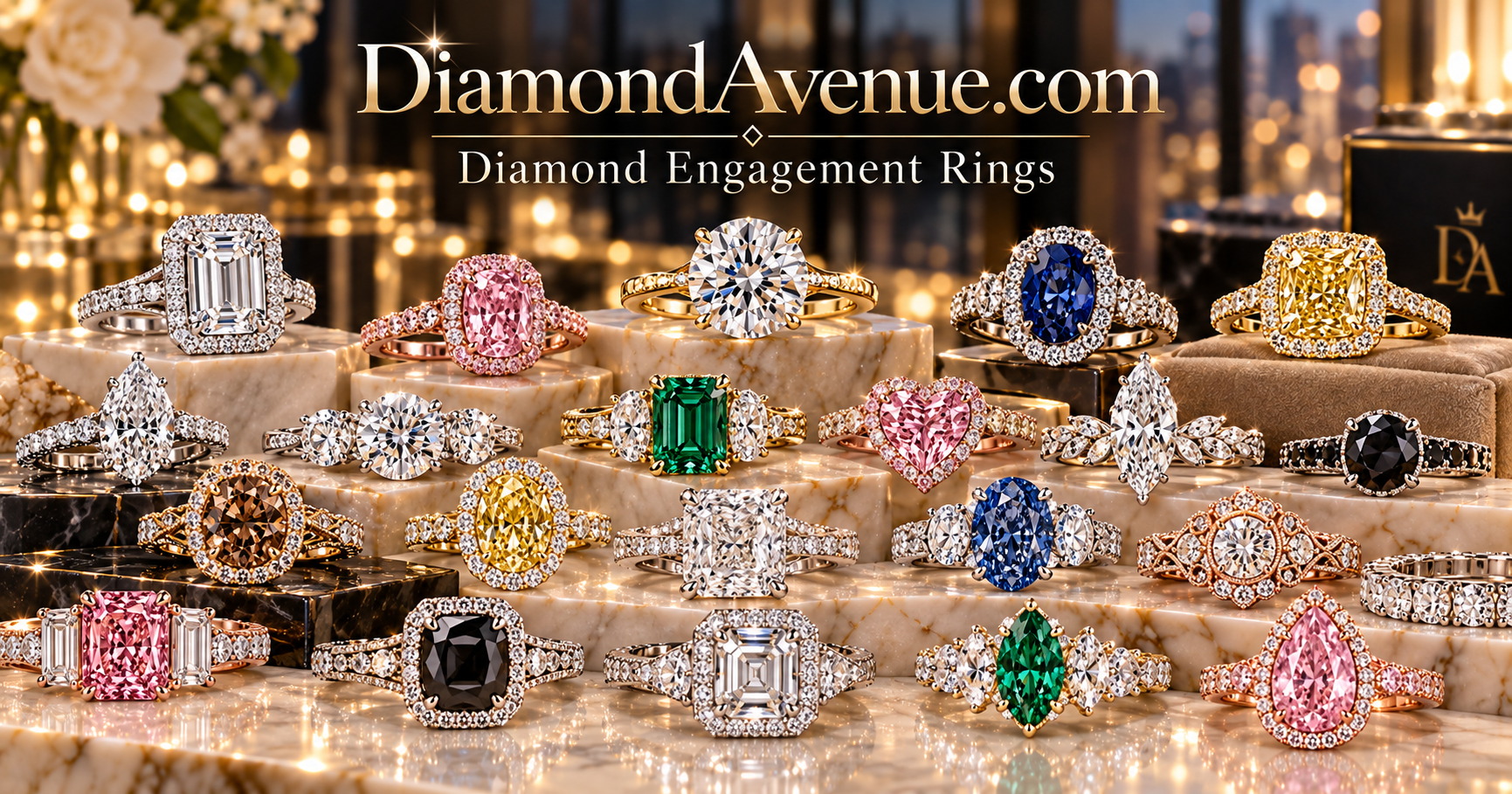
A diamond engagement ring is one of the most personal pieces of jewelry a person may ever purchase. Unlike jewelry worn only on special occasions, an engagement ring is often worn every day for many years, so beauty, durability, comfort and personal style all deserve careful consideration.
The center diamond may receive most of the attention, but the appearance and quality of an engagement ring depend on much more than carat weight. Diamond cut, color, clarity and shape, along with the setting, precious metal, accent diamonds, craftsmanship and proportions of the ring, all contribute to the finished piece.
A good buying strategy is to understand these individual elements and then select the combination that offers the appearance, quality and value that matter most to the wearer.
Before comparing diamond grades, consider the style of jewelry the person normally wears.
Some people prefer a classic solitaire with very little decoration, while others prefer pavé diamonds, halos, side stones, three-stone designs, vintage-inspired rings or more contemporary settings.
Existing jewelry can provide useful clues about preferred metals, diamond shapes and design styles.
Because an engagement ring is normally worn frequently, personal preference should be one of the most important factors in the decision.
Lifestyle can influence which engagement-ring design is most practical.
Someone who frequently works with their hands may prefer a lower-profile setting or a design that provides more protection around the center diamond.
Tall settings and delicate prongs can create an elegant appearance, but they may be more likely to catch on clothing, gloves or other objects.
The ring should complement the wearer's lifestyle as well as personal taste.
In many engagement rings, the center diamond is the focal point of the design and often represents a substantial portion of the ring's cost.
Center diamonds are commonly evaluated using the Four C's: Cut, Color, Clarity and Carat Weight. These characteristics provide a useful framework for comparing diamonds.
However, no individual grade tells the complete story. Two diamonds with similar grading information can look noticeably different when viewed in person.
Whenever possible, consider the diamond's overall visual appearance rather than choosing solely according to a grading report.
The Four C's describe four important characteristics of a diamond:
Cut has a major influence on a diamond's brilliance, fire and sparkle.
A well-cut diamond is proportioned and finished in a way that allows light to enter, interact with the facets and return effectively to the viewer.
A poorly proportioned diamond may appear darker or less lively even when it has high color and clarity grades.
For this reason, cut quality deserves particularly close attention when selecting an engagement diamond.
Diamond grading information is valuable, but the final decision should still consider what the diamond actually looks like.
A beautifully cut diamond of moderate color and clarity may appear more attractive than a diamond with higher color and clarity grades but poorer proportions.
Consider the complete combination of characteristics rather than trying to maximize every grade independently.
The traditional diamond color scale evaluates how much yellow or brown body color is present in diamonds within the normal color range.
Diamonds closer to colorless generally receive higher grades and may command higher prices.
Differences between neighboring color grades can sometimes be subtle. Diamond shape, size and the color of the surrounding metal can also influence how noticeable body color appears.
A slightly warmer diamond may look especially attractive in yellow or rose gold, while white metals can emphasize a more colorless appearance.
Clarity describes naturally occurring internal features known as inclusions and external features known as blemishes.
Higher clarity grades generally contain fewer or less noticeable clarity characteristics.
Extremely high clarity grades can command significant premiums even when the difference is difficult to see without magnification.
Many buyers therefore look for a diamond that appears clean to the unaided eye rather than automatically selecting the highest clarity grade available.
Carat is a measurement of diamond weight. One carat equals 200 milligrams.
Carat weight is not the same thing as visible size. Two diamonds with identical carat weights may have different dimensions depending on their shape and proportions.
A diamond carrying more of its weight in its depth may appear smaller from the top than another diamond of the same weight.
When comparing diamonds, look at the actual millimeter dimensions as well as the carat weight.
This helps explain why two diamonds of equal weight can have different face-up appearances.
Certain elongated shapes, including oval, pear and marquise diamonds, may also appear larger from the top than some other shapes of similar weight.
Diamond shape refers to the outline of the diamond as viewed from above. Shape strongly influences the overall personality and appearance of the engagement ring.
There is no single best diamond shape. The appropriate choice depends primarily on personal preference.
The round brilliant is one of the most traditional engagement-ring choices and is designed to emphasize brilliance and light return.
It works with almost every engagement-ring setting, from simple solitaires to elaborate halos.
Oval, pear and marquise diamonds have elongated shapes that can produce an elegant appearance on the finger.
Their elongated outlines may also create a larger visual impression for a given carat weight.
Princess cuts offer a square or rectangular appearance. Cushion cuts have softer rounded corners. Radiant cuts combine angular outlines with brilliant-style faceting.
Emerald-cut diamonds use broad step-cut facets that produce a distinctive hall-of-mirrors appearance.
The setting secures the diamond and establishes much of the ring's overall style. The same center diamond can look dramatically different depending on how it is set.
A solitaire engagement ring places emphasis on a single center diamond.
Its simple design can showcase the center stone and usually coordinates easily with many wedding bands.
Pavé settings use numerous small diamonds placed closely together along portions of the ring.
This creates additional sparkle without requiring large accent diamonds.
Side-stone engagement rings place additional diamonds or gemstones beside the center diamond.
These stones can increase the visual width and brilliance of the ring.
Three-stone engagement rings normally feature a prominent center diamond accompanied by two significant side stones.
This design provides a broader diamond presentation while keeping the center stone as the visual focal point.
A halo setting surrounds the center diamond with a row of smaller diamonds.
The additional diamonds increase sparkle and can make the center portion of the ring appear substantially larger.
Halos may be round, square, cushion-shaped or designed to follow the outline of the center diamond.
A high setting can make a center diamond more prominent and may allow a wedding band to fit more closely beneath the engagement ring.
A lower-profile setting can provide a smoother appearance and may be less likely to catch on clothing or other objects.
Consider appearance, comfort and lifestyle when choosing the setting height.
Prongs are small metal supports used to hold a diamond securely in place.
Four-prong and six-prong settings are common for round center diamonds. Fewer prongs can expose more of the diamond, while additional prongs provide more points of contact around the stone.
Prongs should be smooth, properly positioned and securely holding the diamond.
A bezel setting surrounds all or part of the diamond's edge with metal.
This provides additional protection around the stone and creates a smooth appearance.
Bezel and other protective settings can be particularly useful for someone who has an active lifestyle or works frequently with their hands.
The ring metal affects appearance, durability, maintenance, weight and price. It can also influence how the center diamond's color appears.
Platinum is naturally white, dense and durable. Its white color works particularly well with diamonds and does not depend on rhodium plating for its basic color.
White gold provides a bright white-metal appearance and is commonly used for engagement rings.
Many white-gold rings are rhodium plated to achieve an especially bright white finish.
Yellow gold provides the traditional warm appearance associated with fine gold jewelry.
It can create an attractive contrast with a colorless or near-colorless diamond.
Rose gold has a pink or reddish appearance created by the metals alloyed with gold.
It can provide a warm and distinctive alternative to yellow or white metals.
Fourteen-karat gold contains approximately 58.5 percent pure gold, with the balance consisting of other metals.
Because of its higher proportion of alloying metals, 14K gold is generally harder than higher-karat gold and is widely used for jewelry intended for regular wear.
Eighteen-karat gold contains 75 percent pure gold.
It has a higher gold content than 14K gold and can have a richer appearance, particularly in yellow and rose gold alloys.
The choice between 14K and 18K gold involves balancing gold content, durability, appearance and price.
Natural diamonds formed deep within the earth over geological time and were later brought closer to the surface through geological processes before being mined.
They are then cut and polished for use in jewelry.
When purchasing a natural diamond, review the seller's disclosure and any independent grading report supplied with the stone.
Lab-created diamonds are grown under controlled laboratory conditions.
They have essentially the same crystal structure and chemical composition as natural diamonds but have a different origin.
Sellers should clearly disclose whether an engagement ring contains a natural or laboratory-created diamond.
Materials such as cubic zirconia and moissanite may look similar to diamonds, but they are different materials with different chemical and physical properties.
A laboratory-created diamond is a diamond with a laboratory origin. A diamond simulant only imitates the appearance of a diamond.
Read product descriptions carefully so that you understand exactly what material is being purchased.
The smaller diamonds used in halos, pavé settings and side-stone designs contribute substantially to the overall appearance of the ring.
Accent diamonds should be securely set and should appear reasonably consistent in brightness and color.
Examine the complete ring rather than concentrating only on the center diamond.
Side diamonds should complement the center diamond.
Notice whether the stones appear reasonably uniform and whether their color and brilliance harmonize with the center stone.
Good matching can make the entire engagement ring look more balanced and refined.
Important center diamonds are commonly accompanied by an independent laboratory grading report.
Depending on the laboratory and report, the document may describe the diamond's carat weight, measurements, color, clarity, proportions, finish and other identifying characteristics.
A grading report provides independently documented information that can make it easier to compare diamonds.
Verify that the report number and identifying information correspond to the diamond being purchased.
A diamond grading report describes characteristics of the diamond.
An appraisal generally assigns a monetary value to a piece of jewelry for a particular purpose, such as insurance.
An appraisal value should not automatically be interpreted as the ring's actual retail or resale value.
An attractive engagement ring should appear balanced. Consider the relationship between the center diamond, band width, setting height, accent diamonds and overall dimensions.
A very large center setting on an extremely thin band may have a different appearance and durability profile than a more substantial design.
An engagement ring will often eventually be worn beside a wedding band.
Check whether a straight wedding band can sit closely against the engagement ring or whether the setting requires a curved or specially matched band.
Considering both rings together before purchasing can help avoid compatibility problems later.
Correct sizing helps keep the ring comfortable and secure on the finger.
Finger size can change somewhat with temperature and other conditions, so professional sizing can be useful before ordering an expensive engagement ring.
A ring should be secure without being uncomfortably tight.
Not every engagement-ring design can be resized easily.
Rings with diamonds extending around most or all of the band, unusual settings or certain construction methods may have significant resizing limitations.
If the exact size is uncertain, ask about resizing before purchasing.
There is no universal rule requiring a buyer to spend a particular number of months' salary on an engagement ring.
A reasonable budget is one that fits the buyer's own financial circumstances and priorities.
Decide which characteristics matter most before shopping. One buyer may prefer a larger center diamond and accept moderate color or clarity grades. Another may prefer a smaller diamond with exceptional cut quality.
Understanding these tradeoffs makes it easier to direct the budget toward characteristics that actually improve the appearance or enjoyment of the ring.
Two engagement rings containing center diamonds of the same carat weight can differ greatly in appearance, quality and price.
Cut, color, clarity, shape, dimensions, natural or laboratory origin, grading documentation, setting, precious metal and workmanship can all affect the cost.
When comparing prices, determine exactly what is included.
Look at the center diamond, accent diamonds, precious metal, craftsmanship, grading documentation, warranty, return privileges and after-sale service.
A lower advertised price does not necessarily mean that two rings are directly comparable.
When purchasing online, review the seller's reputation and make sure the listing provides sufficient information about the diamond and ring.
Important information should include the diamond type, grading information, metal and major construction details.
Review the return period before ordering.
Determine whether resized, engraved or customized rings can be returned and whether restocking or return-shipping charges apply.
An expensive engagement ring should be shipped using a secure and appropriately insured method.
Determine whether signature confirmation is required and what protection applies if the shipment is lost or damaged.
Review what the seller's warranty actually covers.
Coverage may differ for manufacturing defects, normal wear, damaged prongs, lost stones and routine repairs.
Also determine whether periodic inspections are required to maintain the warranty.
Engagement rings are exposed to years of daily wear. Prongs and small-diamond settings can gradually become worn or loose.
Periodic inspection can identify developing problems before a diamond is lost.
Regular cleaning also removes oils and residue that can reduce a diamond's apparent brilliance.
An engagement ring can represent a substantial financial investment, so consider protection against theft, loss and accidental damage.
Coverage may be available through a homeowners or renters policy, a scheduled jewelry endorsement or a specialized jewelry insurance policy.
Keep the sales receipt, grading report, photographs and any appraisal documentation in a safe place.
Before making a final purchase, consider these questions:
An engagement ring is the combination of a diamond, precious metal, setting and craftsmanship. No single laboratory grade or specification determines whether the finished ring will be beautiful or appropriate for a particular person.
A carefully selected diamond with attractive visual performance, mounted securely in a well-made setting suited to the wearer's taste and lifestyle, may provide greater satisfaction than simply choosing the largest carat weight or highest grades available within a budget.
Compare the complete ring, understand what you are buying and select the combination of characteristics that matters most to you.
Explore the DiamondAvenue Diamond Facts section for more information about diamond quality and characteristics.
The Four C's | Carat Weight | Clarity | Color | Cut | Diamond Shape