
DiamondAvenue.com - Facts About Rough Diamonds
Rough Diamonds
Every polished diamond begins as a rough crystal formed deep within the Earth. Before cutting and polishing, rough diamonds are examined and sorted according to characteristics such as crystal shape, size, color, clarity and cutting potential.
What Is a Rough Diamond?
A rough diamond is a diamond in its natural, uncut and unpolished state. Its appearance can be very different from the brilliant gemstones seen in finished jewelry.
Natural rough diamonds may have smooth or irregular surfaces, visible inclusions, unusual crystal forms and colors ranging from nearly colorless to yellow, brown and other natural hues.
The shape of the original crystal can have an important influence on how the diamond will eventually be cut.
From Deep Within the Earth
Natural diamonds form under tremendous heat and pressure deep within the Earth's mantle. Their carbon atoms bond in a highly organized crystal structure that gives diamond its exceptional hardness.
As a diamond crystal grows, changing conditions can influence its final shape. Growth, natural breakage and partial resorption can produce a wide variety of rough-diamond forms.
Some crystals retain a highly recognizable geometric shape, while others emerge rounded, distorted or irregular.
Common Rough Diamond Shapes
Rough diamonds occur in several natural crystal forms. Among the best-known are octahedral, dodecahedral and cubic shapes.
Octahedron
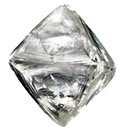
The octahedron is one of the most recognizable natural rough diamond crystal forms.
It has eight triangular faces and six vertices and can be visualized as two four-sided pyramids joined together at their bases.
Well-formed octahedral rough can provide cutters with favorable options for producing polished diamonds while preserving useful weight.
Dodecahedron
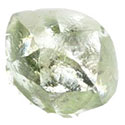
A dodecahedral rough diamond presents a more rounded appearance than a sharply defined octahedron.
The form is associated with twelve faces and may develop as natural processes modify or resorb the surfaces of an originally sharper crystal.
Because the faces are more numerous and the outline is often smoother, dodecahedral rough may appear fuller or more rounded than octahedral rough.
Cube
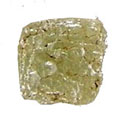
Diamonds can also occur in cubic crystal forms, reflecting diamond's underlying cubic crystal structure.
Cubic rough may have very different transparency, inclusion patterns and cutting potential from one specimen to another.
Some cubic material may be suitable for gems, while lower-quality rough can be more appropriate for industrial applications.
Other Natural Crystal Forms
Nature does not produce every diamond as a perfectly symmetrical crystal. Rough diamonds can occur in many variations and combinations of crystal forms.
These may include:
- Rhombic dodecahedral forms with twelve rhombus-shaped faces.
- Cuboctahedral forms combining characteristics of cubes and octahedrons.
- Macle crystals, which are flattened, triangular twinned diamonds.
- Broken or irregular rough created by natural growth, cleavage, breakage or resorption.
Why Rough Diamonds Differ in Shape
The original growth pattern of a diamond is only part of the story. After formation, natural processes can reshape the crystal.
A process known as resorption can gradually modify crystal surfaces and soften sharp edges. Other diamonds may experience natural cleavage or breakage before reaching the Earth's surface.
For this reason, rough diamonds recovered from the same deposit may display dramatically different shapes and surface characteristics.
How Rough Diamonds Are Evaluated
Before a rough diamond becomes a polished gemstone, professionals examine the crystal carefully to determine how it can best be used.
Shape & Size
The shape and dimensions of the rough crystal influence which polished diamond shapes can be produced and how much of the original weight may be retained.
A well-proportioned crystal can sometimes provide more efficient cutting options than highly irregular rough.
Color & Clarity
Rough diamonds are examined for their apparent color, transparency and internal features.
Inclusions, fractures and other characteristics must be considered because their position can affect the size, clarity and appearance of the finished polished diamond.
Cutting Potential
The objective of diamond planning is not simply to produce the largest possible polished stone.
Cutters consider the combination of finished weight, shape, proportions, clarity and value when deciding where a rough diamond should be sawn or otherwise divided.
Planning the Cut
Modern diamond manufacturers can examine and map a rough diamond before cutting begins. Planning technology can help locate inclusions and evaluate alternative cutting strategies.
A single piece of rough may ultimately produce one polished diamond or be divided into two or more stones, depending upon its shape, internal characteristics and the manufacturer's objectives.
From Rough to Brilliance
A rough crystal may look very different from the finished diamond it eventually becomes.
Through careful planning, cutting, faceting and polishing, the natural crystal is transformed so that light can enter, reflect within and return through its facets.
The quality of that transformation is a major factor in the beauty and value of the finished gemstone.
Every Polished Diamond Has a Rough Beginning
The natural shape, color, transparency and internal characteristics of a rough diamond provide the starting point from which a cutter must work. Understanding rough diamonds helps explain why cutting a diamond is a combination of geology, technology, craftsmanship and careful planning.