
Facts About Fancy Red Diamonds
Fancy Red Diamonds
Natural fancy red diamonds are among the rarest and most valuable colored diamonds in existence. Their scarcity is extraordinary even within the already uncommon world of fancy-color diamonds.
Unlike yellow diamonds, which commonly owe their color to nitrogen, or many blue diamonds, whose color is associated with boron, the red color in natural diamonds is linked primarily to structural defects associated with plastic deformation of the diamond crystal.
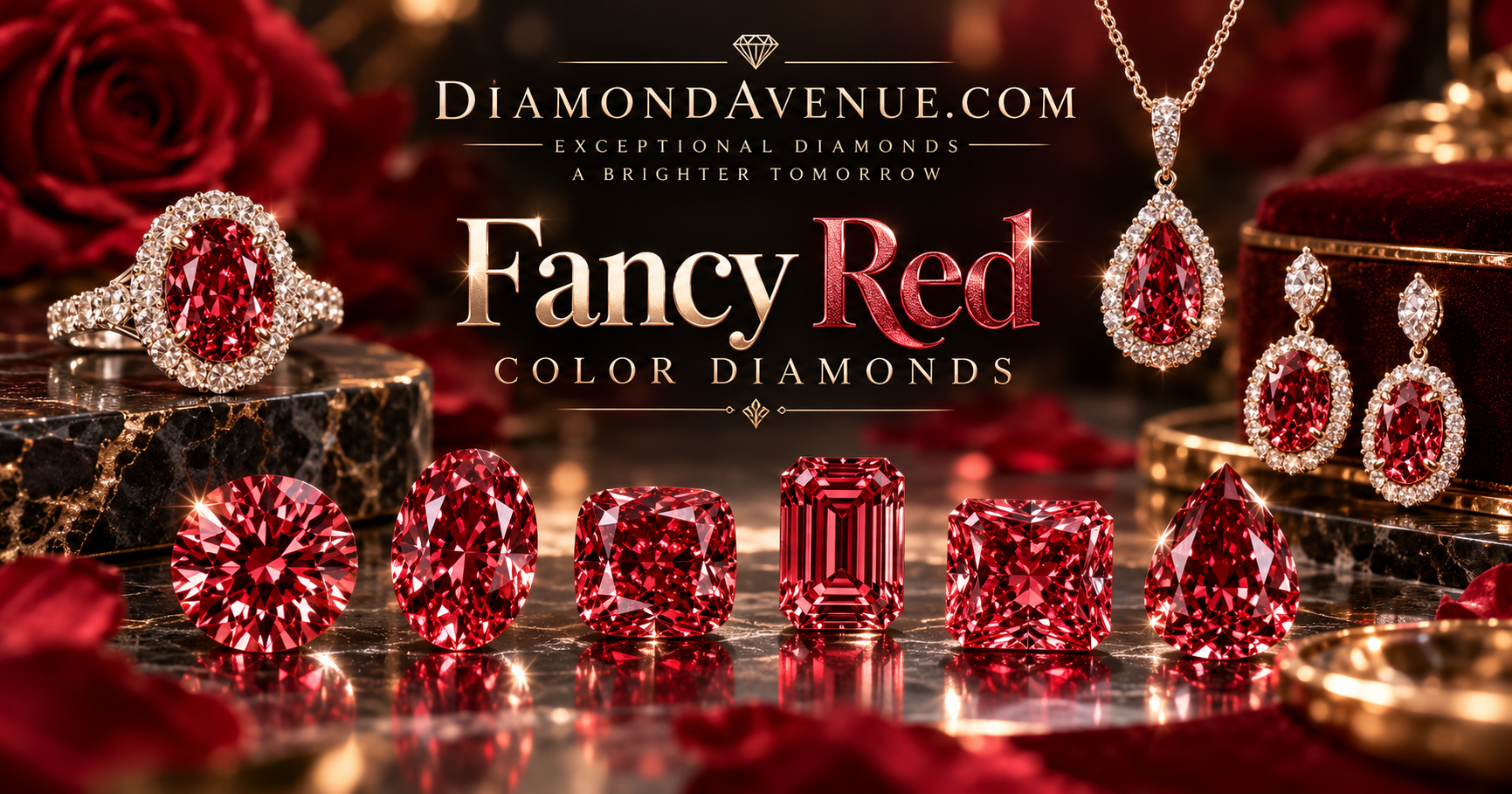
Fancy Red Diamonds
Natural red diamonds occupy an exceptionally small niche within the fancy-color diamond market. Their combination of extreme rarity, distinctive color and limited historical production has made major examples famous throughout the gem world.
What Are Fancy Red Diamonds?
Fancy red diamonds are natural diamonds whose predominant face-up color is red.
In the GIA color-grading system, a diamond is considered predominantly red only when the final word in its color description is red.
This distinction is important because diamonds containing some red coloration may instead be classified as pink, purplish pink, orangy red, purplish red or another related hue depending upon their actual appearance.
How Rare Are Red Diamonds?
Predominantly red diamonds are exceptionally rare. GIA analysis of more than one million natural fancy-color diamonds submitted for laboratory services found that predominantly red diamonds accounted for only about 0.07 percent of those fancy-color stones.
Unmodified Fancy red diamonds represented an even smaller portion of the total.
Most natural red diamonds are also relatively small. Large stones with strong predominantly red color are among the most unusual diamonds known.
What Causes the Red Color?
The red color in most natural red diamonds is closely related to the same structural processes responsible for pink coloration.
During the diamond's geological history, enormous pressure and stress can cause plastic deformation within the diamond crystal.
This deformation can create or modify atomic-scale defects within the diamond lattice. One of the most important optical features associated with natural pink and red coloration is a broad absorption band centered near 550 nanometers.
When this absorption becomes sufficiently strong, the diamond can progress visually from pink toward a much more saturated red appearance.
The exact atomic structure of the defect responsible for this absorption is still an area of scientific research. It is therefore more accurate to say that red color is associated with plastic deformation and related optical defects than to describe it simply as light being "bent" by an irregular crystal lattice.
Plastic Deformation
Plastic deformation does not mean that diamond becomes soft or plastic-like.
The term describes permanent microscopic changes in the crystal structure caused by intense geological stress.
These changes can generate and move structural defects through the diamond crystal and can create the optical conditions responsible for pink, red and sometimes brown coloration.
Red and Pink Are Closely Related
Natural pink and red diamonds are closely related gemologically.
A red diamond generally represents a rare combination of tone and saturation in which the pink-to-red color-producing defects create a sufficiently strong predominantly red appearance.
The transition between vivid pink and red can be subtle, which makes laboratory color grading particularly important.
Why Red Diamonds Have Only One Fancy Grade
Red diamonds differ from most other fancy-color diamonds in an important way.
Colors such as yellow, pink and blue may receive several different intensity descriptions, such as Fancy Light, Fancy, Fancy Intense, Fancy Vivid, Fancy Deep or Fancy Dark.
Predominantly red diamonds occupy such a narrow range of tone and saturation that GIA uses only one fancy grade: Fancy red.
Black and white diamonds are similarly described with only the Fancy designation rather than a series of intensity grades.
Red Diamonds With Modifying Colors
Not every predominantly red diamond is completely unmodified. Natural red diamonds may contain secondary hues that influence their overall appearance and laboratory color description.
Purplish Red
Purple is the most common modifier among predominantly red diamonds studied by GIA. Purplish red diamonds can display rich colors ranging toward crimson or magenta-red.
Orangy Red
Orange can modify a predominantly red diamond, producing a warmer red appearance. Naturally occurring diamonds with this combination remain extremely rare.
Brownish Red
Brown may also modify red coloration. Brownish red diamonds can display deeper or more subdued appearances than unmodified Fancy red stones.
The Last Color Named Is Dominant
In laboratory color terminology, the order of the color words is significant.
A diamond described as Fancy Purplish Red has red as its dominant color and purple as the modifying hue.
A diamond described as reddish purple, by contrast, would have purple as the dominant hue.
Unmodified Fancy Red
When a laboratory grades a diamond simply as Fancy red, the stone is predominantly red without another hue appearing in the final color description.
Such diamonds are extraordinarily uncommon and represent one of the smallest categories within natural fancy-color diamonds.
Where Have Red Diamonds Been Found?
Natural red diamonds have been associated with several diamond-producing regions of the world, including Australia, Brazil, Russia, India and parts of Africa.
Historically, one of the best-known modern sources was the Argyle Diamond Mine in Western Australia. Argyle became internationally famous for producing rare pink, red and violet diamonds.
The Argyle mine ceased production in 2020, so diamonds originating from that mine now represent a finite historical supply.
The Argyle Connection
The Argyle Diamond Mine became particularly famous for pink diamonds, but it also produced a very small number of exceptionally rare red diamonds.
Some of these stones were included in the annual Argyle Pink Diamonds Tender, where the mine's most important colored diamonds were offered to invited buyers and collectors.
Red diamonds represented only a minute fraction of Argyle's total diamond production.
Red Diamonds Are Not Exclusively Argyle
Although Argyle became strongly associated with red and pink diamonds, natural red diamonds are not exclusive to Western Australia.
Important red and predominantly red diamonds have also been associated with other geographic origins, including Brazil.
Because so few red diamonds exist, geographic origin should not be assumed solely from color.
Most Red Diamonds Are Small
Large Fancy red diamonds are exceptionally rare.
GIA research indicates that the overwhelming majority of unmodified Fancy red diamonds are relatively small, with only a very small percentage exceeding two carats.
This makes any natural Fancy red diamond of significant carat weight especially noteworthy.
Clarity Is Often Secondary to Color
Many Fancy red diamonds contain noticeable inclusions or clarity characteristics.
Because predominantly red natural color is so extraordinarily rare, collectors may place much greater emphasis on the diamond's color than on achieving an exceptionally high clarity grade.
Clarity still matters, particularly if an inclusion affects durability, transparency or overall appearance.
Cut and Fancy Red Diamonds
The cutting of a natural red diamond is influenced by two exceptionally important considerations: preserving valuable carat weight and maximizing the visible face-up color.
Fancy shapes and modified brilliant cutting styles are therefore common among Fancy red diamonds. Radiant-style rectangular and square cuts can help strengthen the appearance of color while preserving more of the original rough diamond.
Round brilliant red diamonds are comparatively uncommon because cutting a round stone can require substantial loss of rare rough material.
Famous Red Diamonds
Because so few important natural red diamonds are known, individual stones frequently become famous and acquire their own names and histories.
Moussaieff Red
The Moussaieff Red is a 5.11-carat natural Fancy red diamond and is one of the world's most famous examples of an unmodified red diamond.
De Young Red
The De Young Red is one of the best-known historic red-colored diamonds and is part of the Smithsonian Institution's National Gem Collection.
Winston Red
The Winston Red is another historically important natural Fancy red diamond. Its modern gemological study has provided researchers with valuable information about the causes and characteristics of red coloration in diamond.
Is a Red Diamond Similar to a Ruby?
A red diamond and a ruby can both display red coloration, but they are completely different gemstones.
Diamond is composed primarily of carbon and has a hardness of 10 on the Mohs scale.
Ruby is the red variety of the mineral corundum, composed primarily of aluminum oxide, and has a Mohs hardness of 9.
Gemological Identification
A trained gemologist can readily distinguish ruby from diamond using their different optical and physical properties.
Refractive index, dispersion, hardness, crystal structure, inclusions and spectroscopic properties all differ significantly between the two gems.
Similar color alone should therefore never be used to identify a gemstone.
Natural, Treated and Lab-Grown Red Diamonds
A red appearance does not by itself establish that a diamond is a naturally colored Fancy red diamond.
Diamond color can be altered through various treatment processes, and laboratory-grown diamonds can also display red, pink or related colors.
Natural Fancy red diamonds, treated natural diamonds and laboratory-grown diamonds represent very different categories and should be clearly identified.
Any important diamond represented as a natural Fancy red should be accompanied by a grading report from a respected independent gemological laboratory confirming that the diamond is natural and evaluating the origin of its color.
What Determines the Value of a Fancy Red Diamond?
The extraordinary scarcity of natural red diamonds means that each important stone must be evaluated individually. Important value factors include:
Natural Color Origin
Confirmation that the red color developed naturally is fundamental to the value of an important Fancy red diamond.
Hue and Color Purity
Whether the diamond is unmodified Fancy red or contains purple, orange or brown modifiers can significantly influence its appearance and market desirability.
Carat Weight
Because large red diamonds are extraordinarily scarce, an increase in carat weight can represent a substantial increase in rarity.
Color Distribution
Attractive and relatively even face-up color can contribute substantially to the beauty of a red diamond.
Cut
Cut affects apparent color, brilliance, weight retention and the overall face-up appearance of the finished stone.
Provenance
Historic ownership, famous names, important collections and well-documented provenance can add further interest to an already exceptional red diamond.
Buying a Fancy Red Diamond
Because natural Fancy red diamonds are among the rarest gemstones offered in the market, laboratory documentation and careful examination are particularly important.
Important considerations include:
- Obtain a grading report from a respected independent gemological laboratory.
- Confirm that the diamond is natural rather than laboratory-grown.
- Confirm that the red color is naturally occurring rather than treated.
- Review the exact laboratory color description.
- Determine whether the diamond is unmodified Fancy red or has a secondary hue.
- Examine color distribution and overall face-up appearance.
- Consider clarity characteristics that could affect transparency or durability.
- Review provenance when purchasing a historically important or named diamond.
Fancy Red Diamond Quick Facts
- Gem: Natural diamond
- Primary color: Red
- Rarity: Among the rarest natural fancy-color diamonds
- GIA intensity designation: Fancy red
- Primary color mechanism: Optical defects associated with plastic deformation of the diamond crystal
- Important absorption feature: Broad band near 550 nanometers
- Possible modifying colors: Purple, orange and brown
- Historic sources: Australia, Brazil, Russia, India and other diamond-producing regions
- Major value factors: Natural color origin, hue, color purity, carat weight, color distribution, cut, clarity and provenance
- Famous examples: Moussaieff Red, De Young Red and Winston Red
- Laboratory grading: Essential for important natural red diamonds
The Exceptional Rarity of Fancy Red Diamonds
Fancy red diamonds occupy an extraordinary position within the world of natural gemstones.
Their color develops through an unusual combination of crystal structure, geological stress and microscopic defects associated with plastic deformation. Only under exceptional circumstances does this process produce a diamond with enough saturation to be classified as predominantly red.
The result is a gemstone so uncommon that even experienced jewelers and collectors may go an entire career without handling an important natural Fancy red diamond.
Their extreme rarity, combined with the scarcity of large examples and the fame of stones such as the Moussaieff Red, explains why natural Fancy red diamonds remain among the most celebrated colored diamonds in the world.