Fancy Blue Diamonds: Natural Color, Rarity and Value
Fancy Blue Diamonds
Understanding Natural Blue Diamond Color, Rarity, Grading and Value
What Are Fancy Blue Diamonds?
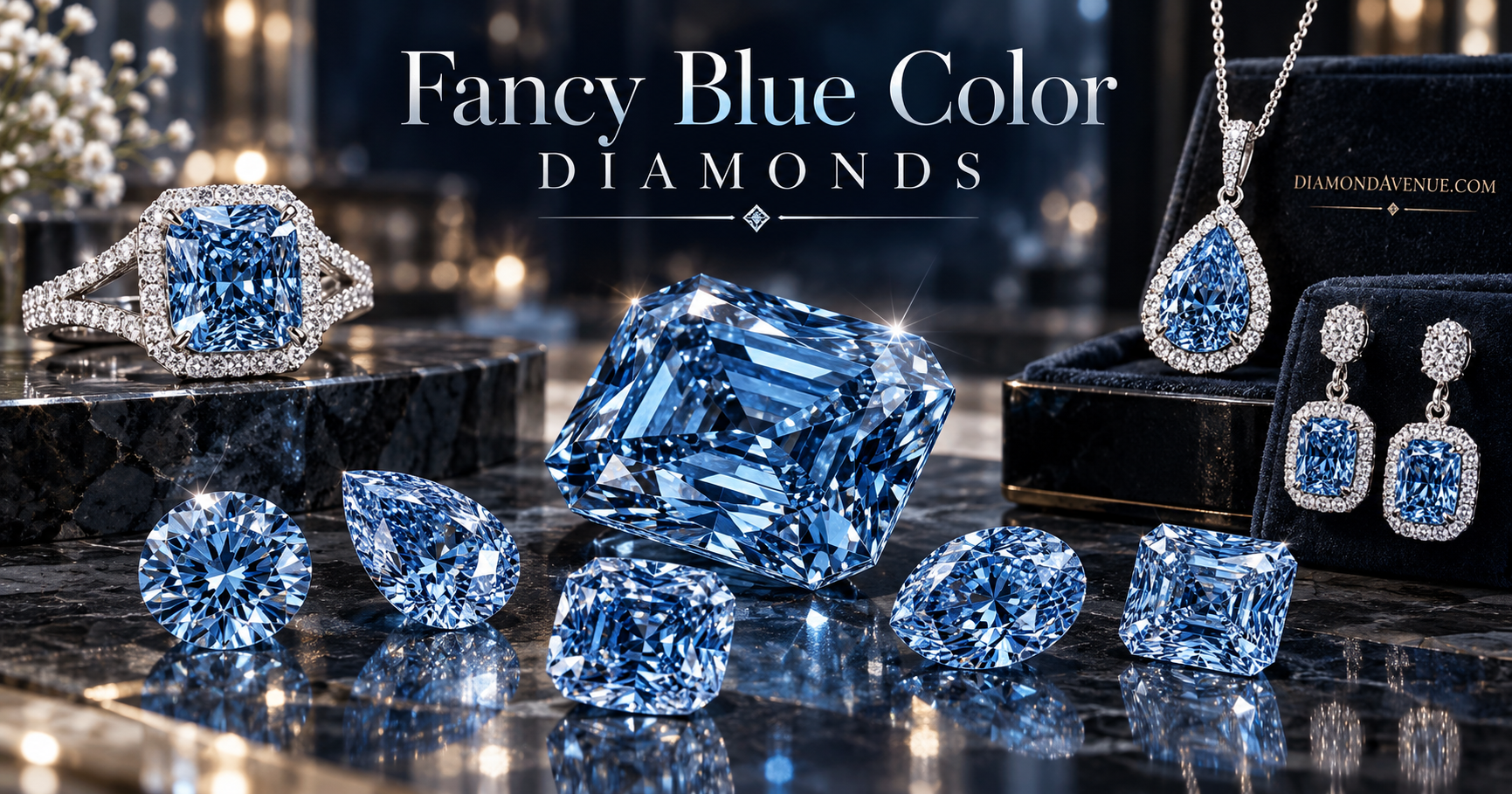
Fancy blue diamonds are natural or laboratory-grown diamonds that display a noticeable blue body color rather than falling within the traditional colorless-to-light-color D-to-Z diamond range.
Natural blue diamonds are among the rarest and most highly prized colored diamonds. Their colors can range from pale, icy blue and grayish blue to richly saturated Fancy Intense, Fancy Vivid and Fancy Deep blue.
Unlike diamonds in the D-to-Z range, where the relative absence of color is generally desirable, fancy-color diamonds are valued largely for the strength, attractiveness and rarity of their color.
D-to-Z Diamonds
The GIA D-to-Z Color Scale evaluates diamonds ranging from colorless at D through progressively more noticeable yellow, brown or gray coloration toward Z.
Within this normal color range, less visible color generally corresponds with a higher color grade.
Fancy Color Diamonds
Fancy-color diamonds are evaluated according to the presence and character of their color.
Hue, tone and saturation become the dominant considerations, and stronger attractive color can substantially increase rarity and value.
What Causes a Diamond to Be Blue?
Many natural blue diamonds receive their color from trace amounts of the element boron incorporated into the diamond's carbon crystal lattice while the diamond forms deep within the Earth.
Boron affects the way the diamond absorbs visible light. Certain wavelengths are absorbed while blue wavelengths are transmitted or returned to the observer, giving the diamond its characteristic blue appearance.
Blue diamonds associated with boron are generally classified as Type IIb diamonds.
The relationship between boron concentration, crystal structure and visible color is complex, so color strength should not be judged from boron concentration alone.
Type IIb Blue Diamonds
Most diamonds contain measurable nitrogen and are classified as Type I diamonds.
Type II diamonds contain little or no measurable nitrogen. Type IIb diamonds contain trace boron, which can produce blue or grayish-blue coloration.
Type IIb diamonds are scientifically unusual because boron also gives them electrical semiconductor properties not typically associated with most diamonds.
Hue
Hue identifies the basic visible color. A diamond may be described as blue or may include modifying colors such as greenish blue or grayish blue.
Tone
Tone describes how light or dark the blue color appears.
A diamond can have strong saturation but appear quite dark because of its tone.
Saturation
Saturation describes the strength or purity of the blue color.
Strongly saturated natural blue diamonds are exceptionally rare.
GIA Blue Diamond Color Grades
Depending on hue, tone and saturation, GIA may describe blue diamonds using color-grade terms that include:
Faint Blue | Very Light Blue | Light Blue
Fancy Light Blue | Fancy Blue | Fancy Intense Blue
Fancy Vivid Blue | Fancy Deep Blue | Fancy Dark Blue
These descriptions do more than simply represent increasing amounts of blue. Tone and saturation work together, which is why a Fancy Dark diamond is not necessarily more desirable than a Fancy Vivid diamond.
Fancy Vivid Blue
Fancy Vivid Blue diamonds display strong saturation combined with a tone that allows the blue color to remain bright and easily visible.
Fine natural Fancy Vivid Blue diamonds are exceptionally rare and are among the most sought-after colored diamonds.
Fancy Deep Blue
Fancy Deep Blue diamonds combine strong saturation with a darker tone.
Their appearance can be rich and dramatic, and naturally occurring examples are extraordinarily rare.
Secondary Colors and Modifying Hues
Not every blue diamond displays a pure blue hue.
Blue diamonds may contain modifying colors such as gray or green. A grading description might therefore include terms such as grayish blue, greenish blue or combinations of those hues.
The relative strength of the primary and modifying colors can have a major effect on appearance, rarity and market value.
Color Distribution
The distribution of blue color across the face of the diamond is another important consideration.
Even, attractive face-up color is generally desirable. Gemological reports can describe color distribution as Even or Uneven.
Cutters carefully orient and facet rare blue rough to display the strongest and most attractive color possible.
Cutting Fancy Blue Diamonds
Fancy-color diamonds are often cut with a different objective from traditional colorless diamonds.
Instead of maximizing white-light return alone, the cutter may select proportions, facet arrangements and shapes that strengthen and distribute the blue body color when the diamond is viewed face-up.
Because natural blue rough is so rare, cutters must also carefully balance color enhancement with carat-weight retention.
Popular Blue Diamond Shapes
Fancy blue diamonds can be fashioned into many shapes, including:
- Cushion
- Radiant
- Oval
- Pear
- Emerald
- Round
- Heart
- Marquise
Cushion, radiant and other modified brilliant styles are frequently selected because their facet arrangements can help intensify face-up color.
Blue Diamonds and Clarity
Clarity remains an important quality factor, but color often plays the dominant role in determining the desirability of a fancy blue diamond.
A rare natural blue diamond may remain exceptionally valuable even when inclusions are present, provided they do not significantly detract from appearance or threaten durability.
The combination of strong natural blue color, high clarity and substantial carat weight is exceptionally rare.
Carat Weight and Rarity
Natural blue diamonds are rare at virtually every size, and large strongly colored examples are particularly unusual.
As carat weight increases, the combination of size and strong natural blue color can cause value per carat to rise sharply.
Even comparatively small natural Fancy Intense or Fancy Vivid blue diamonds can therefore be important and valuable gems.
Natural Blue Diamonds
A natural blue diamond acquired its blue color through geological processes without intentional human color treatment.
Fine naturally colored blue diamonds are extremely rare and generally command substantial premiums.
Treated Blue Diamonds
Diamond color can also be changed artificially through treatments such as irradiation, annealing or other processes.
A treated blue diamond may be attractive, but it is materially different in rarity and market value from a comparable naturally colored blue diamond.
Laboratory-Grown Blue Diamonds
Blue diamonds can also be grown in laboratories using processes designed to reproduce diamond crystal growth.
Laboratory-grown diamonds have essentially the same basic crystal structure and major physical properties as natural diamonds, but their origin is different.
Natural, laboratory-grown and treated-color diamonds should therefore be clearly distinguished when evaluating rarity and value.
Why a Gemological Laboratory Report Is Important
The origin of a blue diamond's color cannot always be determined reliably by visual inspection alone.
Advanced laboratory testing can help determine whether a diamond is natural or laboratory-grown and whether its blue color is natural or the result of treatment.
A GIA Colored Diamond Grading Report can provide information including color grade, color origin, carat weight, clarity, polish, symmetry and color distribution.
Famous Blue Diamonds
Some of history's most celebrated diamonds are natural blue diamonds.
Hope Diamond
The Hope Diamond is one of the world's best-known blue diamonds and is famous for its exceptional color, size, long history and legendary provenance.
Wittelsbach-Graff Diamond
The historic Wittelsbach blue diamond passed through European royalty before later becoming known as the Wittelsbach-Graff Diamond.
Blue Moon Diamond
The Blue Moon Diamond became internationally famous because of its rare Fancy Vivid blue color, size and extraordinary auction history.
What Determines the Value of a Blue Diamond?
Fancy blue diamond value depends upon several interrelated factors:
- Natural versus treated color
- Natural versus laboratory-grown origin
- Hue
- Tone
- Saturation
- Presence and strength of modifying colors
- Color distribution
- Carat weight
- Cut and face-up appearance
- Clarity
- Laboratory documentation
- Provenance and historical importance
Fancy Blue Diamond Buying Tips
- Determine whether the diamond is natural or laboratory-grown.
- Determine whether the blue color is natural or treated.
- Examine hue, tone and saturation together.
- Pay attention to secondary colors such as gray or green.
- Examine the evenness of the face-up color.
- Consider how the cut enhances the diamond's blue color.
- Do not judge value from color-intensity terminology alone.
- Review clarity characteristics that could affect transparency or durability.
- Obtain an independent laboratory report for a significant blue diamond.
Explore Fancy Color Diamonds
Fancy Color Diamonds | Fancy Black Diamonds | Diamond Color | Diamond Clarity | Diamond Cut