
DiamondAvenue - Cut
Diamond Cut
Understanding Cut - One of the Four Cs of Diamond Quality
What Is Diamond Cut?
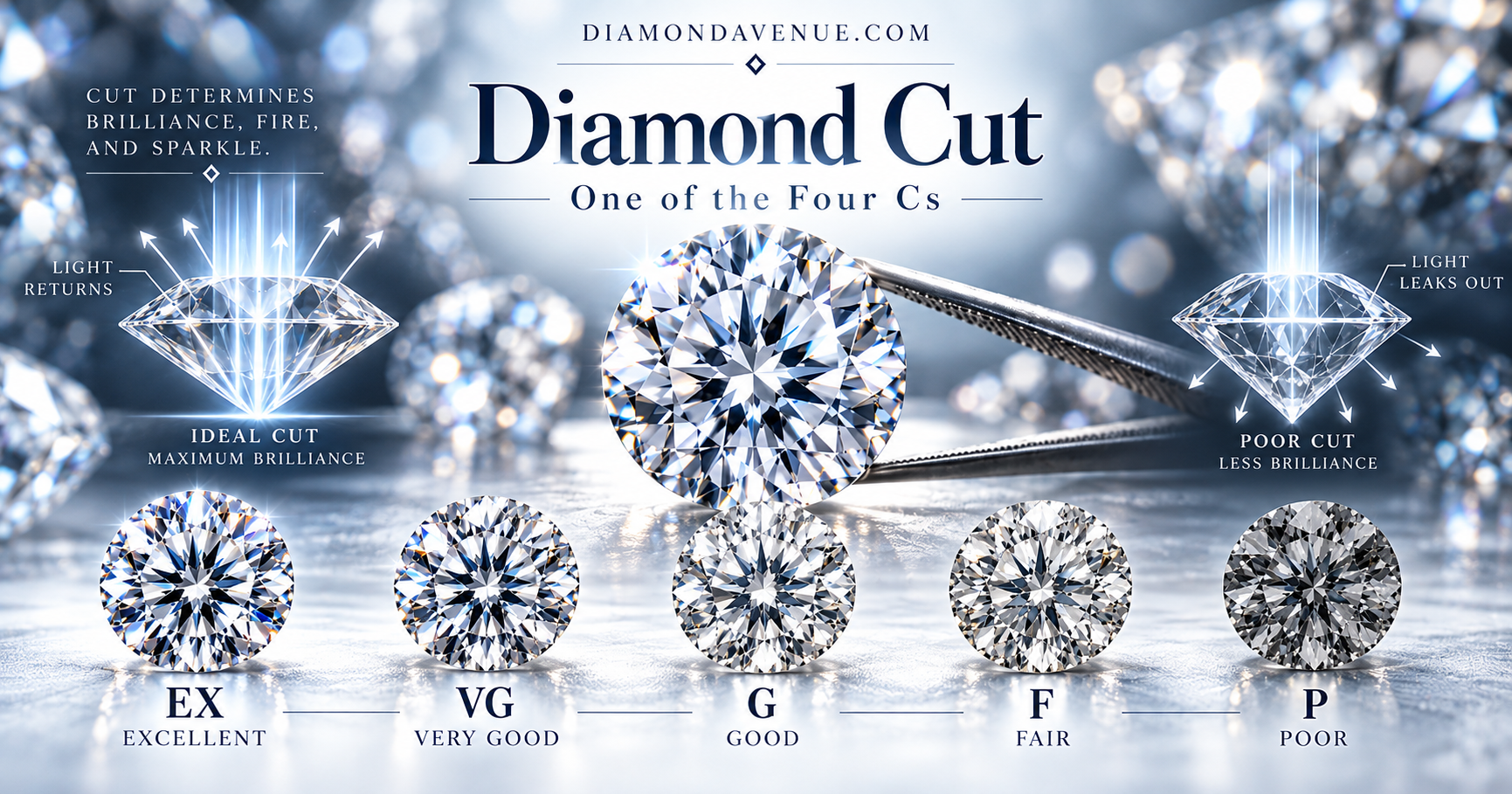
Cut is one of the Four Cs used to evaluate diamond quality. It describes how successfully a diamond's proportions, facet arrangement, symmetry and polish work together to return light to the observer.
Diamond cut has a major influence on the visual beauty of a diamond because it determines how much brightness, fire and scintillation the stone produces.
A well-cut diamond can appear lively, bright and full of sparkle. A poorly cut diamond can appear dark or lifeless even when it has excellent color and clarity.
Cut Is Not the Same as Shape
Diamond shape describes the outline of the diamond when viewed from above.
Examples include round, oval, pear, marquise, emerald, cushion and heart shapes.
Cut Describes Craftsmanship
Diamond cut quality describes the design and craftsmanship of the finished diamond.
It includes the relationship between the crown, table, girdle, pavilion and culet, as well as the precision of the facet arrangement and the quality of the polished surfaces.
Diamond Cut and Light Performance
The purpose of a well-designed diamond cut is to control how light enters the stone, reflects from its facets and returns to the viewer.
When the angles and proportions of a diamond work together effectively, light is reflected and dispersed back through the crown.
When a diamond is cut too shallow or too deep, more light may escape through the pavilion or sides of the stone instead of returning toward the viewer.
Brightness
Brightness is the combination of internal and external white-light reflections returned from a diamond.
A well-cut diamond can appear bright across much of its face-up surface.
Fire
Fire is the dispersion of white light into flashes of spectral color.
These colorful flashes may appear red, orange, yellow, green, blue or violet as the diamond or light source moves.
Scintillation
Scintillation describes the flashes of light and the pattern of light and dark areas seen as the diamond, observer or light source moves.
This changing pattern produces much of the sparkle associated with a finely cut diamond.
The Modern Round Brilliant Cut
The modern standard round brilliant diamond normally has 57 or 58 facets.
The 58th facet, when present, is the small facet at the bottom of the pavilion known as the culet.
These facets are carefully positioned to control the path of light through the diamond and to produce an attractive combination of brightness, fire, scintillation and contrast.
Crown
The crown is the upper portion of the diamond above the girdle.
It contains the table and surrounding facets that help return and disperse light.
Girdle
The girdle forms the outer edge of the diamond between the crown and pavilion.
It provides an important structural boundary and is commonly the area held by prongs or other parts of a jewelry setting.
Pavilion
The pavilion is the lower portion of the diamond below the girdle.
Pavilion angles play a major role in determining whether light is returned through the crown or lost through the bottom of the stone.
Table
The table is the large flat facet at the top of the diamond.
Table size is measured as a percentage of the diamond's average girdle diameter and is one of several measurements used when evaluating proportions.
Culet
The culet is the point or small facet at the bottom of the pavilion.
In many modern round brilliant diamonds the culet is pointed or extremely small. Larger culets may become visible through the table and can influence the diamond's appearance.
Why Diamond Proportions Matter
Diamond proportions describe the relationships among the stone's dimensions, facet sizes and facet angles.
Important proportion measurements can include:
- Table size
- Total depth
- Crown angle
- Crown height
- Pavilion angle
- Pavilion depth
- Girdle thickness
- Culet size
- Star facet length
- Lower-half facet length
These measurements must work together. A single measurement by itself does not determine whether a diamond is well cut.
Marcel Tolkowsky and the Ideal Cut
In 1919, mathematician and diamond cutter Marcel Tolkowsky published influential calculations describing proportions intended to maximize brilliance and fire in the round brilliant diamond.
His work became historically important in the development of the modern round brilliant cut and helped popularize the concept of an "ideal" diamond proportion set.
Modern research has shown, however, that there is not one single proportion combination capable of producing an attractive diamond. Different combinations of crown angle, pavilion angle, table size and other measurements can produce excellent light performance.
Too Shallow
When pavilion proportions are too shallow, a significant amount of light can escape instead of returning toward the viewer.
This can create darker or less lively areas and reduce the diamond's visual impact.
Well Proportioned
A well-proportioned diamond efficiently balances brightness, fire and scintillation while maintaining attractive face-up size and durability.
Too Deep
Excessive depth can allow light to escape through the pavilion and can also hide excess carat weight where it does not contribute to the face-up diameter of the diamond.
The GIA Diamond Cut Grade Scale
For standard round brilliant diamonds in the D-to-Z color range, the GIA cut grading system uses five grades:
Excellent | Very Good | Good | Fair | Poor
The grade represents how successfully the diamond's face-up appearance, design and craftsmanship work together.
Excellent
An Excellent cut diamond demonstrates a highly successful combination of brightness, fire, scintillation, design and craftsmanship within the GIA cut grading system.
Very Good
A Very Good cut diamond can still display strong brightness, fire and scintillation, but one or more cut characteristics fall outside the Excellent range.
Good
Good cut diamonds may display attractive light return but generally show more noticeable compromises in proportions, appearance or craftsmanship.
Fair
Fair cut diamonds may show reduced brightness, fire or scintillation because of less efficient proportions or craftsmanship.
Poor
Poor cut diamonds can lose a substantial amount of light and may appear noticeably darker or less lively than better-cut diamonds.
Seven Factors Used to Evaluate Cut
GIA evaluates seven major components when determining the cut quality of a standard round brilliant diamond:
Face-Up Appearance
The three face-up appearance factors are:
- Brightness
- Fire
- Scintillation
Design
Design considers:
- Weight ratio
- Durability
Craftsmanship
Craftsmanship considers:
- Polish
- Symmetry
Diamond Polish
Polish describes the condition and finish of a diamond's facet surfaces.
Fine polish allows light to pass through and reflect from facets without unnecessary surface interference.
Poorer polish may leave lines, abrasions or other surface features that can reduce the quality of the finish.
Diamond Symmetry
Symmetry describes the exactness of the diamond's shape and the alignment and placement of its facets.
Good symmetry helps create balanced patterns of brightness, darkness, fire and scintillation.
Poor symmetry can interfere with the intended optical pattern of the diamond.
Carat Weight Versus Face-Up Size
Two diamonds can have the same carat weight but different visible diameters.
A diamond that is cut excessively deep may carry extra weight beneath the girdle where it cannot be seen when the diamond is viewed face-up.
Cut evaluation therefore considers weight ratio - the relationship between a diamond's weight and its diameter.
Cut and Diamond Durability
Diamond is extremely hard, but its proportions still need to protect vulnerable areas from damage.
A girdle that is excessively thin may create a greater risk of chipping during setting or wear.
Excessively thick girdles, on the other hand, can add weight without contributing significantly to the visible size of the diamond.
Cut Grades and Fancy-Shaped Diamonds
GIA's overall Excellent-to-Poor cut grade currently applies to standard round brilliant diamonds in the D-to-Z color range.
Fancy-shaped diamonds, such as oval, pear, marquise, cushion, emerald and heart shapes, are evaluated for important characteristics including polish, symmetry, proportions and overall appearance, but they do not receive the same GIA overall cut grade used for standard round brilliants.
How Diamond Cut Affects Value
Cut quality can have a substantial effect on both the beauty and market value of a diamond.
Well-cut diamonds generally command higher prices because more of the rough diamond may need to be sacrificed to achieve attractive proportions, symmetry and light performance.
Poorly cut diamonds may retain extra carat weight but can appear smaller, darker or less lively when viewed face-up.
For this reason, cut quality should be considered together with carat weight, color and clarity rather than selecting a diamond on weight alone.
Diamond Cut Buying Tips
- Give substantial consideration to cut quality because it has a direct effect on brightness, fire and scintillation.
- Compare diamonds face-up under similar lighting conditions.
- Review the overall cut grade on a reputable laboratory grading report when buying a round brilliant diamond.
- Review polish and symmetry grades in addition to the overall cut grade.
- Consider table percentage, total depth, crown angle and pavilion angle together rather than relying on a single measurement.
- Compare visible diameter as well as carat weight because excessively deep diamonds can carry hidden weight.
- Look for an attractive balance of brightness, fire, scintillation and contrast that appeals to you personally.
- Remember that no single proportion measurement guarantees an attractive diamond.