
DiamondAvenue.com

Diamond CCCC


Diamond Characteristics: Carat, Clarity, Color and Cut (Shape)


The Four Cs of Diamonds

Diamonds have been treasured as gemstones for centuries and today remain among the most widely recognized and valued gems used in fine jewelry.

To make diamond quality easier to describe and compare, gemologists developed standardized methods of evaluating the characteristics that most strongly influence a diamond's appearance and value.

Four characteristics became especially important and are now commonly known as the Four Cs of Diamonds: Carat Weight, Color, Clarity and Cut.

Each C evaluates a different aspect of a diamond. No single characteristic tells the whole story. The beauty and value of a diamond result from the way all four characteristics work together.

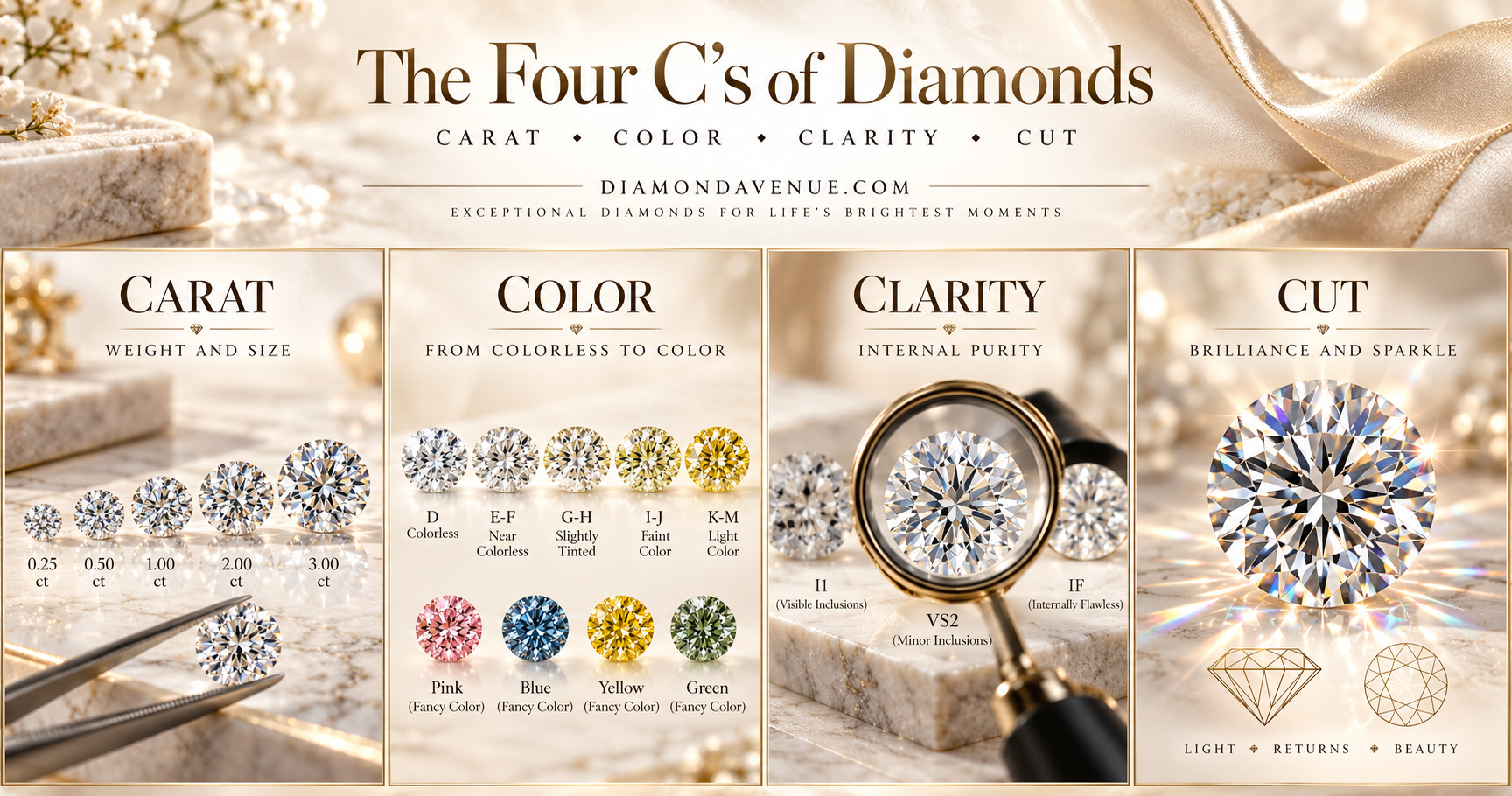
Carat • Color • Clarity • Cut

The Four Cs of diamonds montage illustrating carat weight, color, clarity and cut

The Four Cs provide a practical framework for comparing diamonds. Carat describes weight, color evaluates body color, clarity considers internal and external characteristics, and cut examines how effectively a diamond has been fashioned to interact with light.

Why the Four Cs Matter

Two diamonds that appear similar at first glance can differ substantially in quality and price.

The Four Cs help describe those differences in a systematic way.

They allow consumers, jewelers and gemologists to compare diamonds according to measurable and observable characteristics rather than relying only on general appearance.

The Four Cs also make it easier to understand why two diamonds of the same carat weight may have very different prices.

The Four Cs Work Together

Diamond quality should not be judged by any one C alone.

For example, a large diamond with poor cut proportions may appear less brilliant than a smaller, exceptionally well-cut diamond.

Likewise, a diamond with very high clarity may not be visually superior if its cut does not return light effectively.

The best comparison considers all four characteristics along with the diamond's shape, measurements and overall visual appeal.

1. Carat Weight

Carat measures a diamond's weight, not its physical diameter.

One metric carat equals:

1.00 carat = 200 milligrams = 0.20 gram

Each carat is divided into 100 points.

For example:

  • 0.25 carat = 25 points
  • 0.50 carat = 50 points
  • 0.75 carat = 75 points
  • 1.00 carat = 100 points

Carat Weight and Apparent Size

Two diamonds of equal carat weight can look different in size because the weight may be distributed differently.

Factors affecting face-up appearance include:

  • Diamond shape
  • Depth
  • Table size
  • Girdle thickness
  • Overall proportions

A heavier diamond is therefore not necessarily a larger-looking diamond.

Learn more about Diamond Carat Weight

2. Diamond Color

For most traditional white diamonds, the Color grade measures the absence of noticeable body color.

Diamonds can range from exceptionally colorless to stones showing increasing amounts of yellow or brown.

Color is commonly evaluated using a letter scale that begins with D for colorless diamonds and continues through progressively more noticeable color.

Subtle differences between neighboring color grades can be difficult to detect without controlled lighting and comparison stones.

Fancy Color Diamonds

Not every diamond is evaluated according to the colorless-to-yellow system.

Diamonds with sufficiently strong natural color may be classified as fancy-color diamonds.

Fancy colors can include:

  • Yellow
  • Pink
  • Blue
  • Green
  • Orange
  • Purple
  • Red
  • Brown

Learn more about Diamond Color

3. Diamond Clarity

Clarity evaluates internal and external characteristics that developed during formation or were produced during cutting and handling.

Internal characteristics are generally called inclusions, while external characteristics are generally called blemishes.

Clarity grading considers characteristics such as:

  • Size
  • Number
  • Position
  • Nature
  • Relief or visibility

The Clarity Scale

Common clarity categories range from diamonds with no inclusions visible under standard grading conditions to diamonds containing obvious inclusions.

Common grade categories include:

  • Flawless - FL
  • Internally Flawless - IF
  • Very Very Slightly Included - VVS
  • Very Slightly Included - VS
  • Slightly Included - SI
  • Included - I

Many inclusions cannot be seen with the unaided eye, especially in higher clarity grades.

Learn more about Diamond Clarity

4. Diamond Cut

Cut describes how well a diamond has been fashioned and how effectively its proportions and facets interact with light.

Cut should not be confused with shape.

Shape describes the outline of the diamond, such as round, oval, pear, princess or emerald.

Cut quality relates to factors such as:

  • Proportions
  • Facet arrangement
  • Symmetry
  • Polish
  • Light return

Cut and Diamond Brilliance

Cut has a major influence on how lively and brilliant a diamond appears.

A well-cut diamond can return a substantial amount of light through the top of the stone, creating:

  • Brightness - white light returned from the diamond
  • Fire - flashes of spectral color
  • Scintillation - flashes of light and dark seen as the diamond moves

A poorly proportioned diamond may allow more light to escape through the sides or bottom, reducing its visual performance.

Learn more about Diamond Cut

The Four Cs at a Glance

Characteristic What It Measures Why It Matters
Carat Diamond weight Influences rarity, size perception and price
Color Degree of body color Affects visual appearance and rarity
Clarity Internal and external characteristics Helps describe purity and visibility of inclusions
Cut Proportions, symmetry, polish and light performance Strongly influences brilliance, fire and scintillation

Which of the Four Cs Is Most Important?

There is no universal answer because different buyers value different characteristics.

However, cut deserves particular attention because it strongly influences how a diamond interacts with light and therefore how brilliant and lively it appears.

A balanced approach is generally more useful than attempting to maximize every grade.

For example, a buyer might prefer a slightly lower clarity grade that appears clean to the unaided eye and allocate more of the budget toward superior cut quality or greater carat weight.

Diamond Fluorescence

Diamond fluorescence is the visible glow that some diamonds produce when exposed to ultraviolet (UV) radiation.

Blue is the most commonly observed fluorescence color, although yellow, orange, green and other colors can occur.

Gemological laboratories may describe fluorescence by its strength, using terms such as:

  • None
  • Faint
  • Medium
  • Strong
  • Very Strong

Fluorescence is not one of the Four Cs and does not automatically make a diamond better or worse.

Its effect should be considered together with the diamond's color, clarity and overall appearance.

Fluorescence strength and color may also be listed on a diamond grading report.

Learn more about Diamond Fluorescence

Diamond Grading Reports

Independent gemological laboratories evaluate diamonds and issue reports describing characteristics such as carat weight, color, clarity, proportions, polish, symmetry and fluorescence.

A grading report provides an independent description of the examined diamond and can help buyers compare stones more accurately.

Diamond Grading Reports

Independent gemological laboratories examine diamonds and issue grading reports describing important characteristics of the stone.

These reports may include:

  • Carat weight
  • Color grade
  • Clarity grade
  • Cut grade where applicable
  • Measurements
  • Proportions
  • Polish
  • Symmetry
  • Fluorescence
  • Identifying characteristics
  • Treatment or origin information where applicable

A grading report describes the laboratory's findings about a particular diamond and provides an independent reference for comparison.

GIA

The Gemological Institute of America is one of the world's best-known gemological education and research organizations.

GIA played an important role in developing the modern terminology and grading systems used to describe diamonds, including the familiar D-to-Z color scale and modern clarity terminology.

GIA laboratories issue diamond grading and identification reports used throughout the international jewelry trade.

AGS

The American Gem Society has played an important role in promoting professional standards and consumer education within the jewelry industry.

AGS has also contributed substantially to the study and evaluation of diamond cut quality.

Historical AGS grading terminology and research remain influential in discussions of diamond proportions and light performance.

HRD Antwerp

HRD Antwerp is a European diamond grading organization associated historically with Antwerp, Belgium, one of the world's major diamond trading centers.

Its laboratories provide diamond grading and identification services and its reports are widely encountered in European and international diamond markets.

Grading Report or "Certificate"?

Consumers frequently refer to a laboratory document as a diamond "certificate."

In professional gemology, however, grading report or diamond report is often the more precise terminology.

The report records the laboratory's observations and grading conclusions for the diamond examined. It should not be confused with an appraisal, guarantee or statement of monetary value.

How the Four Cs Affect Diamond Price

Diamond pricing is complex because all four quality factors interact.

In general:

  • Larger diamonds tend to become progressively rarer as carat weight increases.
  • Diamonds with less noticeable body color may command higher prices within the traditional colorless range.
  • Diamonds with fewer or less visible inclusions may command higher prices.
  • Better cut quality can increase desirability because of improved light performance.

Shape, fluorescence, proportions, rarity, origin, treatments and market conditions can also influence price.

Using the Four Cs When Buying a Diamond

The Four Cs are most useful when they are treated as comparison tools rather than as a requirement to obtain the highest possible grade in every category.

When comparing diamonds:

  • Look at the diamond in addition to reading its grades.
  • Give careful consideration to cut quality.
  • Compare actual millimeter measurements as well as carat weight.
  • Consider whether inclusions are visible without magnification.
  • Compare color under similar lighting conditions.
  • Review an independent grading report.
  • Consider the diamond's shape and setting.
  • Balance the Four Cs according to your priorities and budget.

Explore the Four Cs in Detail

Carat Weight   |   Color   |   Clarity   |   Cut

Diamond Shapes   |   Diamond Types

Back to Index