
De Beers Millennium Star
History of the De Beers Millennium Star Diamond
The De Beers Millennium Star is one of the most celebrated large colorless diamonds of the modern era.

Weighing 203.04 carats, the pear-shaped diamond became the centerpiece of the De Beers Millennium Jewels, a collection assembled to celebrate the arrival of the year 2000.
Its story combines an extraordinary 777-carat rough diamond, years of planning and precision cutting, elite gemological grades and one of the most dramatic attempted jewel robberies of modern times.
The De Beers Millennium Star at a Glance
Name: De Beers Millennium Star
Finished Weight: 203.04 carats
Original Rough Weight: 777 carats
Shape: Pear-shaped brilliant
Facets: 54
Color Grade: D
Clarity Grade: Flawless
Polish: Excellent
Symmetry: Excellent
Measurements: Approximately 50.06 × 36.56 × 18.54 mm
Origin of Rough: Mbuji-Mayi district, Zaire, now the Democratic Republic of the Congo
Discovery of the 777-Carat Rough Diamond
The history of the Millennium Star begins in the early 1990s, when an unnamed miner working an alluvial diamond deposit in the Mbuji-Mayi district of Zaire, now the Democratic Republic of the Congo, discovered an enormous piece of gem-quality rough diamond.
The rough diamond weighed approximately 777 carats.
According to the Gemological Institute of America, the stone was considered the sixth-largest known colorless gem-quality rough diamond at the time.
De Beers subsequently purchased the remarkable crystal fragment on the open market.
Years of Study Before Cutting
Transforming a rough diamond of such exceptional size and quality into a finished gemstone required extensive planning.
The Steinmetz Group spent approximately three years studying, planning and working on the rough crystal across three continents.
Every decision had to balance several objectives: preserving as much weight as possible, avoiding internal stress and imperfections, achieving outstanding optical performance and producing a stone worthy of the historic rough crystal.
Dividing the Rough Diamond
After extensive examination, the 777-carat rough diamond was divided into three separate pieces.
The largest portion became the stone from which the De Beers Millennium Star would ultimately be fashioned.
The process illustrates one of the central challenges of cutting extraordinary rough diamonds: the largest possible polished stone is not always the best result.
Cutters must instead determine the form that provides the strongest combination of weight, beauty, symmetry and clarity.
Creating the Millennium Star
The cutting and polishing project was undertaken by specialists associated with the Steinmetz Group.
Numerous models and extensive calculations were used to determine how the largest portion of the rough diamond should be fashioned.
The eventual choice was a pear-shaped brilliant containing 54 facets.
When completed, the diamond weighed 203.04 carats and measured approximately 50.06 × 36.56 × 18.54 millimeters.
Although hundreds of carats were lost during the transformation from rough crystal to polished diamond, the finished stone achieved exceptional proportions and gemological quality.
D Color
In 1997, the Gemological Institute of America examined the De Beers Millennium Star.
GIA assigned the diamond a D color grade, the highest grade on the standard D-to-Z diamond color scale.
A D-color diamond is considered essentially colorless under standardized grading conditions.
Achieving this degree of colorlessness in a diamond weighing more than 200 carats makes the Millennium Star particularly remarkable.
Flawless Clarity
GIA also graded the Millennium Star Flawless.
During grading, no internal or surface clarity characteristics were visible using a binocular microscope and a fully corrected 10× loupe.
GIA further recorded excellent polish and excellent symmetry.
The diamond showed no fluorescent reaction when exposed to long-wave ultraviolet radiation.
Why Its Quality Is So Extraordinary
Large diamonds frequently contain mineral inclusions, internal fractures or structural irregularities that become increasingly apparent as the size of the stone increases.
The Millennium Star combines three characteristics that are exceptionally difficult to find together: enormous size, the highest color grade and Flawless clarity.
Its finished size of 203.04 carats makes those characteristics particularly noteworthy.
The diamond's combination of size and purity helped make it the natural centerpiece for De Beers' celebration of the new millennium.
The De Beers Millennium Jewels
De Beers assembled a special collection of important diamonds to mark the passing of the twentieth century and the arrival of the new millennium.
Known as the De Beers Millennium Jewels, the collection included a group of exceptional diamonds, among them several rare blue stones.
The 203.04-carat Millennium Star served as the centerpiece of the collection.
De Beers formally welcomed the new millennium with the Millennium Star in 2000, making the diamond both a gemological achievement and a symbol of a historic change of era.
Exhibition at the Millennium Dome
In late 1999, the De Beers Millennium Jewels were unveiled at the Millennium Dome in London.
The exhibition was created as part of Britain's celebration of the arrival of the year 2000.
At the center of the display was the Millennium Star, whose name directly reflected the occasion for which the collection had been assembled.
A Symbol of the New Millennium
The Millennium Star was intended to embody permanence, rarity and exceptional craftsmanship at the moment the world entered a new millennium.
Its extraordinary size and purity made it an ideal centerpiece for the De Beers exhibition.
The diamond quickly became one of the most recognizable large diamonds of the late twentieth and early twenty-first centuries.
The Millennium Dome Diamond Robbery Attempt
The Millennium Star later became the target of one of the most dramatic attempted jewel robberies of modern times.
In November 2000, a criminal gang attempted to steal the De Beers Millennium Jewels from their exhibition at the Millennium Dome.
The plan involved breaking into the secure display and escaping from the site after taking the diamonds.
British police had learned of the plot and mounted an extensive undercover operation.
The attempted robbery was stopped and the Millennium Star and the other diamonds remained secure.
The extraordinary episode added another chapter to the history of a diamond that had already attracted international attention because of its size and quality.
The Splendor of Diamonds
In the summer of 2003, the De Beers Millennium Star traveled to Washington, D.C., for a major exhibition at the Smithsonian National Museum of Natural History.
The exhibition, titled The Splendor of Diamonds, brought together some of the world's most remarkable diamonds for public display.
The Smithsonian exhibition ran from June 27 through September 30, 2003.
A Gathering of Rare Diamonds
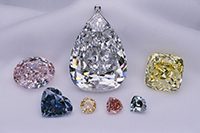
The exhibition brought together diamonds of remarkable size and color, allowing visitors to compare some of the world's rarest gemstones in one setting.
Among the World's Rarest Diamonds
The Millennium Star was displayed alongside several other celebrated diamonds at the Smithsonian.
These included the Allnatt Diamond, Steinmetz Pink, Heart of Eternity, Pumpkin Diamond, Ocean Dream and Moussaieff Red.
Together, the stones demonstrated the extraordinary range of sizes and natural colors that diamonds can display.
The Smithsonian identified the Millennium Star as a 203.04-carat colorless diamond and one of the largest colorless diamonds represented in the exhibition.
203.04 Carats
Its enormous finished weight places the Millennium Star among the great faceted colorless diamonds of modern history.
D Color & Flawless
The combination of GIA D color and Flawless clarity is particularly remarkable in a diamond exceeding 200 carats.
Historic Exhibitions
Its appearances at London's Millennium Dome and the Smithsonian helped introduce the diamond to millions of people around the world.
Legacy of the De Beers Millennium Star
The De Beers Millennium Star represents an unusual combination of natural rarity and human craftsmanship.
Its journey began as a 777-carat rough diamond recovered from an alluvial deposit in Central Africa and continued through years of scientific study, cutting and polishing before becoming a 203.04-carat pear-shaped brilliant.
Its exceptional D color, Flawless clarity, excellent polish and excellent symmetry made it one of the most impressive large polished diamonds examined by GIA.
Its role as the centerpiece of the De Beers Millennium Jewels linked the diamond permanently with the arrival of the year 2000.
The attempted Millennium Dome robbery and its later appearance at the Smithsonian added further chapters to its remarkable modern history.
Today, the Millennium Star remains one of the clearest examples of how an extraordinary natural diamond can become both a gemological achievement and a cultural symbol.