
De Young Red Diamond
History of the De Young Red Diamond
The De Young Red Diamond is one of the most unusual colored diamonds in the Smithsonian's National Gem Collection. Its remarkable story began not in a famous diamond mine or auction house, but as an unidentified reddish stone mounted in an old piece of estate jewelry.
The De Young Red Diamond
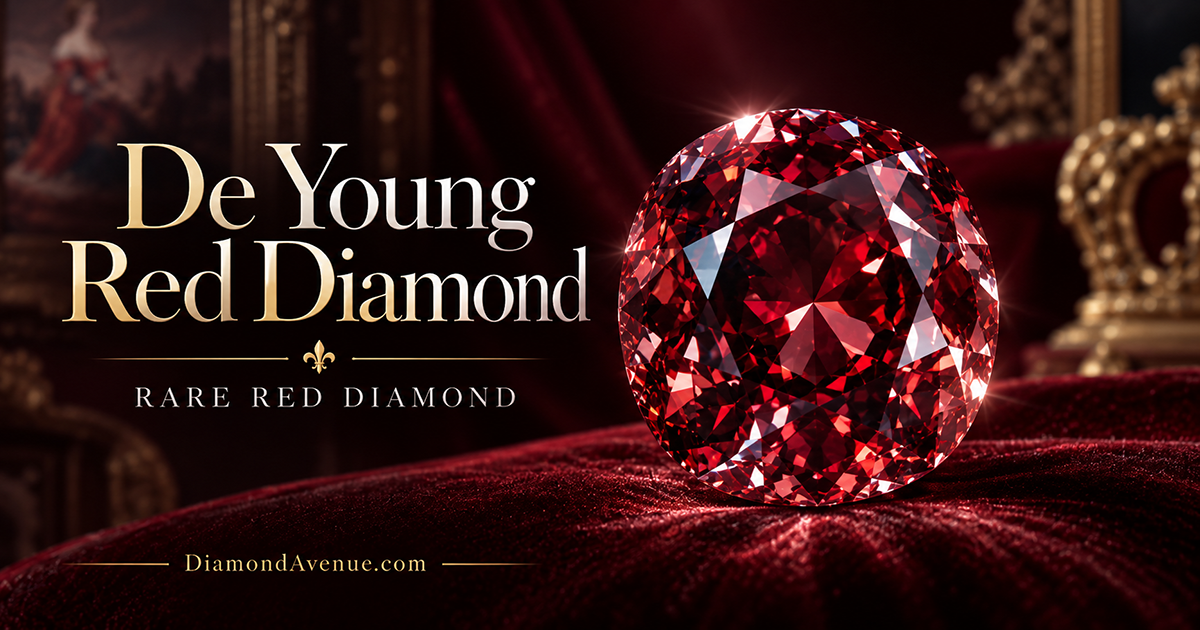
The 5.03-carat De Young Red Diamond is one of the most historically significant natural diamonds displaying a strong reddish coloration and is preserved in the Smithsonian's National Gem Collection.
An Unexpected Discovery
The De Young Red Diamond entered the collection of Boston jeweler S. Sydney DeYoung during the late 1930s or early 1940s.
Mistaken for a Garnet
The diamond was acquired by Boston jeweler S. Sydney DeYoung while it was mounted in an estate scarf pin. Because of its dark brownish-red appearance, the stone was believed to be a garnet.
Red garnets were commonly used in antique jewelry, so there was little reason at first to suspect that this particular stone was something dramatically more rare.
DeYoung eventually examined the stone more carefully and recognized characteristics that did not seem consistent with garnet. Further examination established that the mysterious reddish gemstone was, in fact, a natural diamond.
S. Sydney DeYoung Recognizes Its Importance
Once DeYoung understood what he had discovered, the stone took on an entirely different significance. Natural diamonds displaying a predominantly red or reddish body color are among the rarest varieties of colored diamonds.
Rather than immediately offering the extraordinary stone for sale, DeYoung removed it from its jewelry setting and kept it securely in his vault.
The diamond eventually became known as the De Young Red Diamond in recognition of the Boston jeweler who discovered its true identity and preserved it for future generations.
S. Sydney DeYoung
S. Sydney DeYoung was a Boston jeweler whose careful examination transformed what appeared to be an ordinary antique red gemstone into an important gemological discovery.
Gemological Characteristics
Today, the Smithsonian records the De Young Red Diamond as a 5.03-carat natural diamond with a modified round brilliant cut and a clarity grade of VS2.
5.03 Carats
At 5.03 carats, the De Young is exceptionally large for a natural diamond displaying such an intense reddish coloration.
Modified Round Brilliant
The Smithsonian identifies the stone as a modified round brilliant-cut diamond, designed to return light through a generally circular arrangement of facets.
VS2 Clarity
The Gemological Institute of America graded the diamond VS2 in clarity, an impressive clarity grade for a historic natural colored diamond.
The De Young's Extraordinary Color
The De Young has traditionally been called the De Young Red Diamond, although modern gemological terminology provides a more precise description of its color.
The Smithsonian describes its GIA color grade as natural Fancy Dark reddish brown. Its appearance is therefore considerably darker and more brownish than the vivid red coloration seen in some other celebrated red diamonds.
This distinction is important because modern GIA grading standards reserve particular terminology for diamonds whose predominant body color meets specific requirements. Nevertheless, the De Young remains one of the world's most historically significant large natural diamonds with a strong red component.
The origin of red coloration in natural diamonds is especially interesting to gemologists. Rather than simply resulting from a chemical coloring element, red coloration is believed to be associated largely with structural changes or deformation within the diamond crystal lattice.
Preserved Rather Than Sold
One of the most unusual aspects of the De Young story is what happened after its identity became known.
Instead of treating the diamond simply as valuable merchandise, DeYoung retained it. According to the Smithsonian, he kept the stone in a vault and never offered it for sale.
That decision ultimately helped preserve an important gemstone for scientific study and public exhibition.
A Gift for Future Generations
DeYoung ultimately decided that the extraordinary diamond should become part of the Smithsonian Institution's National Gem Collection.
The stone was given to the Smithsonian through DeYoung's estate and was formally accessioned into the National Gem Collection in December 1987.
Its Smithsonian catalog number is NMNH G9871.
The Smithsonian Collection
From Estate Jewelry to the National Gem Collection
The journey of the De Young Red Diamond is remarkable: a dark reddish stone once mistaken for garnet became one of the most important colored diamonds preserved by the Smithsonian Institution.
It is now part of the National Gem Collection at the Smithsonian's National Museum of Natural History in Washington, D.C., where it can be studied alongside some of the world's most significant diamonds, gemstones and mineral specimens.
The Smithsonian continues to classify the De Young as one of the largest known natural diamonds displaying this exceptionally rare reddish coloration.
Why the De Young Red Diamond Is Famous
The De Young Red Diamond is famous not simply because of its size. Its importance comes from the combination of several extraordinary characteristics.
It is a large natural colored diamond displaying an extremely uncommon reddish body color; it has an unusually high VS2 clarity grade; its discovery story began with a gemstone mistakenly identified as garnet; and its owner chose preservation and public legacy instead of selling the stone commercially.
The result is a gem whose story connects the worlds of antique jewelry, gemological discovery, diamond science and museum preservation.
What once appeared to be an ordinary reddish stone in an old piece of jewelry has become an enduring part of America's National Gem Collection.
Weight
5.03 Carats
Color
Natural Fancy Dark
Reddish Brown
Clarity
VS2
Cut
Modified Round Brilliant
Smithsonian Catalog
NMNH G9871
Smithsonian Acquisition
1987