
DiamondAvenue.com - Color
Diamond Color
Understanding Color - One of the Four Cs of Diamond Quality
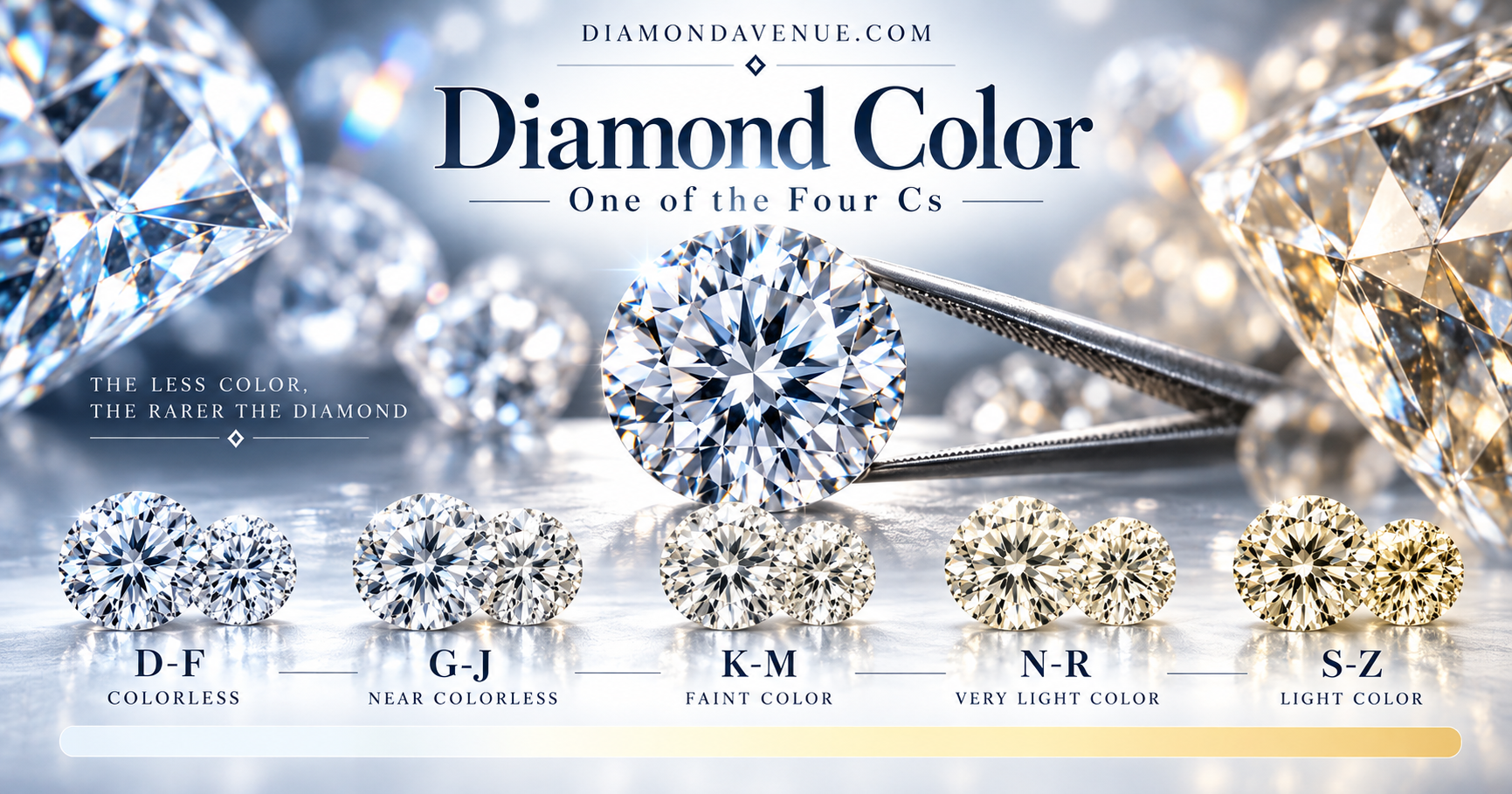
What Is Diamond Color?
Diamond color is one of the Four Cs used to describe and evaluate diamond quality. In most diamonds within the normal color range, color grading actually measures the relative absence of visible color.
A chemically pure and structurally perfect diamond would be colorless. Natural diamonds, however, may contain trace elements or structural characteristics that produce subtle yellow, brown, gray or other color appearances.
Within the traditional D-to-Z diamond color range, diamonds that show less body color are generally considered rarer. When other quality factors are comparable, diamonds with higher color grades usually command higher prices.
Diamond color can be extremely subtle. Differences between neighboring color grades may be difficult for an untrained observer to recognize, especially once a diamond is mounted in jewelry.
Why Does the Diamond Color Scale Start at D?
The GIA diamond color scale begins with the letter D, which represents the highest color grade. The scale continues alphabetically through Z.
Earlier diamond grading systems used a variety of letters, numbers and descriptive terms. When the Gemological Institute of America developed its standardized system, it began with D to distinguish the new grading scale from earlier systems.
Therefore, there are no GIA diamond color grades of A, B or C.
How Diamond Color Is Graded
Diamond color grading is performed under carefully controlled lighting conditions. The diamond is compared against a set of reference diamonds, commonly called masterstones, whose color grades are already established.
During grading, a diamond is generally examined table-down because this position helps reduce the visual influence of brilliance and makes subtle differences in body color easier to compare.
Each letter grade represents a narrow range of color. Neighboring grades may appear extremely similar, but the distinction can influence rarity and market value.
The GIA D-to-Z Diamond Color Scale
The GIA D-to-Z scale groups diamonds into five broad categories: Colorless, Near Colorless, Faint, Very Light and Light.
D-F - Colorless
Diamonds graded D, E and F fall within the Colorless range.
These diamonds contain very little visible body color. Differences among D, E and F can be extremely subtle and may require comparison under controlled grading conditions.
D represents the highest color grade on the GIA D-to-Z scale.
G-J - Near Colorless
Diamonds graded G through J are classified as Near Colorless.
These diamonds may contain a slight trace of warmth that can be difficult for an untrained observer to detect, particularly when the diamond is viewed face-up or mounted in jewelry.
Near-colorless diamonds are popular because they can provide an attractive balance between a bright appearance and cost.
K-M - Faint
Diamonds graded K through M are classified as Faint.
A noticeable warm tint may begin to appear, particularly in larger diamonds or diamonds viewed from the side.
N-R - Very Light
Diamonds graded N through R are classified as Very Light.
Yellow, brown or gray body color becomes more apparent and can often be seen without specialized grading equipment.
S-Z - Light
Diamonds graded S through Z are classified as Light.
Body color is readily noticeable, although these diamonds remain within the standard D-to-Z grading system rather than the fancy-color grading system.
What Causes Color in Diamonds?
Diamond color can result from trace elements within the crystal structure, structural distortions, radiation exposure during geological formation, or combinations of these factors.
Nitrogen is one of the most common causes of yellow or brown coloration in natural diamonds. Boron can contribute to blue color in certain diamonds.
Other natural colors, including pink, red, green, orange and violet, can be associated with different atomic or structural conditions within the diamond.
How Jewelry Metal Affects Color Appearance
The metal surrounding a diamond can influence how its color is perceived.
White metals such as platinum and white gold provide a bright, neutral background that may make subtle warmth in a diamond easier to notice.
Yellow or rose gold can visually blend with warmer diamond colors, allowing some near-colorless or faint-color diamonds to appear whiter when viewed face-up.
Diamond Shape and Color
Diamond shape and faceting style can also affect the way body color is perceived.
Some brilliant-cut shapes can help disguise subtle warmth because their numerous facets create strong patterns of light return.
Other shapes may retain or emphasize body color differently, so two diamonds with the same laboratory color grade may not appear identical when viewed face-up.
Fancy Color Diamonds
Diamonds with color outside the normal D-to-Z range are generally evaluated under a separate fancy-color grading system.
Yellow and brown diamonds that display more color than a Z grade can enter the fancy-color range. Diamonds showing colors such as blue, green, pink or red are also evaluated as colored diamonds rather than under the ordinary D-to-Z scale.
Unlike D-to-Z diamonds, where less color usually increases rarity and value, fancy-color diamonds are often valued more highly as the color becomes stronger, more saturated and more visually appealing.
Fancy Color Intensity Grades
Fancy-color diamonds may receive descriptions indicating the strength and depth of their color.
Depending on the diamond, grading terminology can include:
- Faint
- Very Light
- Light
- Fancy Light
- Fancy
- Fancy Intense
- Fancy Vivid
- Fancy Dark
- Fancy Deep
Strong, attractive and rare colors can command extraordinary prices, particularly in large natural diamonds.
Famous Fancy Color Diamonds
Some of the world's most famous diamonds are prized specifically because of their extraordinary natural color.
The Hope Diamond, for example, is renowned for its deep blue color and historic provenance.
Other celebrated colored diamonds include the Dresden Green, the Tiffany Diamond, the Graff Pink and the Moussaieff Red.
Their fame demonstrates an important distinction in diamond grading: within the standard D-to-Z range, less color is generally preferred, while exceptional natural color can make a fancy-color diamond extraordinarily rare and valuable.
Diamond Fluorescence
Fluorescence is visible light emitted by some diamonds when they are exposed to ultraviolet radiation. Blue is the most common fluorescence color observed in gem diamonds.
Diamond grading reports may describe fluorescence using terms such as None, Faint, Medium, Strong or Very Strong.
Fluorescence does not automatically improve or reduce the quality of a diamond. Its effect on appearance depends upon the individual stone, the strength and color of the fluorescence, and the lighting environment.
Blue Fluorescence and Warmer Diamonds
Because blue and yellow are complementary colors, blue fluorescence can sometimes make a diamond with a noticeable yellow tint appear somewhat whiter in lighting that contains sufficient ultraviolet energy.
This effect is most noticeable in diamonds with stronger blue fluorescence and warmer body color.
Does Fluorescence Cause Haziness?
Fluorescence alone does not normally make a diamond cloudy or hazy.
In uncommon cases, strong fluorescence combined with certain light-scattering structural characteristics may contribute to a hazy or oily appearance. Each diamond should therefore be evaluated individually.
How Diamond Color Affects Value
For diamonds within the normal D-to-Z range, higher color grades are generally rarer and command higher prices when carat weight, cut and clarity are comparable.
However, the visual difference between neighboring color grades can be subtle. A diamond should therefore be evaluated as a whole rather than purchased solely on the basis of a letter grade.
Cut quality, setting metal, diamond shape, size and lighting can all influence how color is perceived.
Diamond Color Buying Tips
- Compare diamonds under similar lighting whenever possible.
- Consider how the diamond will look once mounted in the intended jewelry metal.
- Compare neighboring color grades in person when practical.
- Remember that subtle grade differences may be difficult to detect without direct comparison.
- Evaluate cut quality along with color, since superior light return can strongly influence overall appearance.
- Consider fluorescence as an individual characteristic rather than automatically treating it as positive or negative.
- Review an independent laboratory grading report when buying a significant diamond.