
Diamond History
History of the Dresden Green Diamond
The Dresden Green Diamond is one of the world's most celebrated natural-color diamonds. Weighing approximately 41 carats, its extraordinary green color, exceptional purity and more than three centuries of documented history have made it one of the great treasures of European royal jewelry.
The Dresden Green Diamond
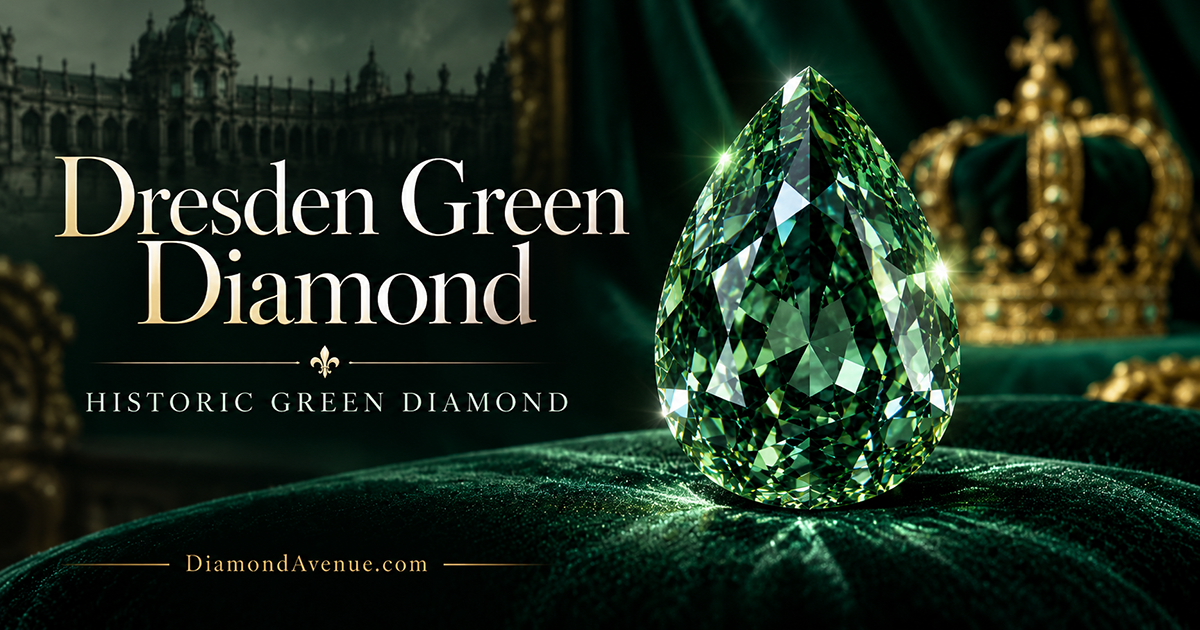
The Dresden Green is an approximately 41-carat natural green diamond whose remarkable color and royal history have made it one of the best-known colored diamonds in the world.
An Indian Origin
The Dresden Green is generally believed to have originated in India, most likely from the historic diamond-producing region commonly associated with the Golconda mines.
The exact mine and circumstances of its discovery are not documented with certainty. Earlier accounts have sometimes associated the diamond specifically with the Kollur Mine, one of the famous diamond sources of southern India.
What is certain is that the diamond was already known in Europe by the early eighteenth century, long before modern laboratory irradiation of diamonds was possible.
Earliest Recorded Appearance
One of the earliest known references to the diamond appeared in the London news-sheet The Post Boy in October 1722.
The report described diamond merchant Marcus Moses, recently arrived from India, presenting King George I with an unusually large diamond of an intense emerald-green appearance.
The newspaper account establishes that a remarkable green diamond fitting the Dresden Green's description was already attracting royal attention in London by 1722.
The Origin of Its Rare Green Color
Natural green diamonds are exceptionally rare. Their color commonly results from exposure to naturally occurring radiation during the diamond's long residence within the earth.
Radiation can alter defects within the diamond's crystal lattice and create absorption features that produce a green appearance. In many natural green diamonds, this coloration is concentrated near the surface.
The Dresden Green is particularly unusual because its green coloration is distributed broadly and relatively evenly throughout the gem rather than existing merely as a thin surface layer.
Its documented history, extending to the early eighteenth century, is also important scientifically because it proves that the stone's green color predates experiments involving artificial irradiation of diamonds.
Gemological Characteristics
When Gemological Institute of America researchers examined the Dresden Green in 1988, they found it to be an exceptionally rare Type IIa diamond, one of the chemically purest categories of natural diamond.
Approximately 41 Carats
The Dresden Green weighs approximately 41 carats, making it exceptionally large for a natural green diamond.
Fancy Green
GIA researchers described the diamond as Fancy green, with a medium tone and slightly grayish saturation.
Type IIa
The Dresden Green belongs to the rare Type IIa category of diamonds, noted for exceptionally low concentrations of certain impurities.
Modified Pear-Shaped Brilliant
GIA researchers described the Dresden Green as a modified pear-shaped brilliant, producing its distinctive elongated outline.
Exceptional Quality
Because the diamond remained mounted when GIA examined it, researchers did not issue a conventional grading report, but they described the stone as being of extraordinary gemological quality.
Acquired by the Saxon Royal Court
By the early 1740s, the green diamond had reached the great European gem market at Leipzig.
The stone was acquired for the Saxon royal collection during the reign of Friedrich August II, Elector of Saxony, who was also Augustus III, King of Poland.
Historical accounts associate the transaction with a Dutch diamond merchant named Delles. Sources differ slightly over whether the purchase occurred in 1741 or 1742, but by this period the Dresden Green had become part of one of Europe's richest royal collections.
Its acquisition reflected the Saxon court's extraordinary interest in gemstones, jewelry, precious metals and elaborate works of decorative art.
Augustus III of Poland
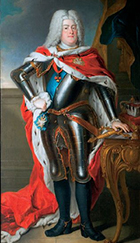
Augustus III of Poland and Elector of Saxony expanded the royal collection that would make Dresden famous for its jewels and precious works of art.
The Historic Hat Ornament
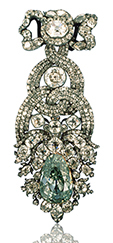
From the Golden Fleece to a Royal Hat Ornament
During the eighteenth century, the Dresden Green became part of elaborate royal jewelry associated with the Saxon court.
The diamond was at one stage incorporated into an insignia connected with the Order of the Golden Fleece, one of Europe's most prestigious chivalric orders.
In 1768, Prague jeweler Diessbach created the magnificent hat ornament in which the Dresden Green remains mounted.
The spectacular jewel surrounds the green diamond with hundreds of colorless diamonds. Part of the ornament incorporated an earlier jeweled element created in the eighteenth century for the Saxon court.
The preservation of this historic setting greatly enhances the Dresden Green's significance because both the gemstone and an important part of its eighteenth-century royal presentation have survived together.
The Green Vault of Dresden
The diamond ultimately became one of the most celebrated treasures associated with Dresden's Green Vault.
The Green Vault traces its origins to the extraordinary royal treasure chambers created by Augustus the Strong in the Dresden Royal Palace between 1723 and 1730.
These rooms were designed to display the wealth and artistic sophistication of the Saxon court through collections of jewels, precious metals, ivory, rock crystal and other masterpieces.
Over time, the Dresden Green became one of the collection's best-known individual gemstones and eventually took the name by which it is now known around the world.
Protected During Times of War
The Dresden royal treasures have repeatedly been moved for protection during periods of military conflict.
During the Seven Years' War, valuable objects from the collection were removed from Dresden for safekeeping.
The collection again faced extraordinary danger during the Second World War. Before Dresden suffered devastating Allied bombing in February 1945, many of its most valuable treasures had been evacuated from the city.
The Dresden Green and other important treasures were protected at Königstein Fortress, a massive hilltop stronghold overlooking the Elbe River southeast of Dresden.
Königstein Fortress

Königstein Fortress served as a secure wartime refuge for important treasures from Dresden's royal collections.
After World War II
Following the end of the Second World War, the royal treasures were taken to the Soviet Union along with numerous other German art objects.
They were eventually returned to Dresden, allowing the Dresden Green once again to become part of the city's public museum collections.
Its survival through eighteenth-century wars, nineteenth-century political upheaval and the destruction of Dresden during World War II adds another remarkable chapter to the diamond's long history.
The 1988 GIA Examination
In November 1988, senior gemologists from the Gemological Institute of America were given an unusual opportunity to examine the Dresden Green in Dresden.
The examination was especially important because green diamonds present one of gemology's most difficult color identification challenges. Both natural radiation and laboratory irradiation can produce green coloration.
Because the Dresden Green's history had been documented for centuries before artificial diamond irradiation became possible, researchers could study it as an important reference example of natural green coloration.
GIA researchers confirmed that the stone was an exceptionally rare Type IIa diamond and described its natural green color as distributed throughout the gem.
A Rare International Traveler
Although closely associated with Dresden, the diamond has occasionally traveled abroad for important exhibitions.
In 2000, it was exhibited in the United States and was shown at the Smithsonian Institution alongside the famous Hope Diamond, bringing together two of the world's most celebrated natural-color diamonds.
It has also appeared in later international exhibitions, allowing audiences outside Germany rare opportunities to view the historic gemstone.
Home in Dresden
Today, the Dresden Green remains part of the collections of the Staatliche Kunstsammlungen Dresden and is associated with the New Green Vault in Dresden's Royal Palace.
The restored Royal Palace now houses both the Historic Green Vault and the New Green Vault, continuing the centuries-old tradition of displaying Saxony's royal treasures in Dresden.
Why the Dresden Green Diamond Is Famous
Few diamonds combine so many extraordinary qualities in a single gemstone.
The Dresden Green is famous for its large size, naturally occurring green coloration, exceptional chemical purity, centuries of documented history, royal ownership and survival in its historic eighteenth-century ornament.
It is also important to gemological science because its early recorded history provides compelling evidence that its green coloration developed naturally rather than through human treatment.
From the diamond markets of eighteenth-century Europe to the royal courts of Saxony and the modern laboratories of gemologists, the Dresden Green has remained one of the most distinctive and historically important colored diamonds known.
Weight
Approximately 41 Carats
Color
Natural Fancy Green
Diamond Type
Type IIa
Cut
Modified Pear-Shaped Brilliant
Earliest Record
1722
Present Collection
Green Vault
Dresden, Germany