
Diamond History
History of the Eureka Diamond
The Eureka Diamond occupies a special place in the history of gemstones. Although modest in size when compared with many famous diamonds, its discovery helped reveal the extraordinary diamond wealth of southern Africa and contributed to the birth of the modern South African diamond industry.
The Eureka Diamond
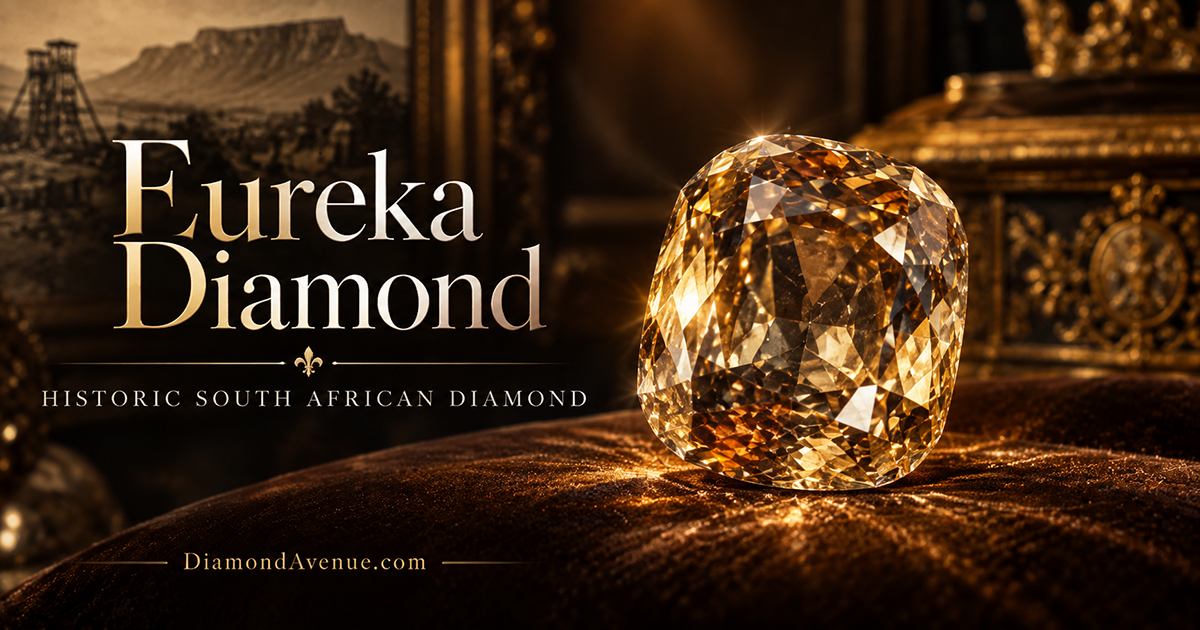
The Eureka began as a 21.25-carat rough diamond found near the Orange River in South Africa. After cutting, the historic stone weighed approximately 10.73 carats.
A Shiny Pebble on the Orange River
The story of the Eureka Diamond begins in 1866 on the Jacobs family farm, De Kalk, near Hopetown on the Orange River in what is now South Africa's Northern Cape.
Fifteen-year-old Erasmus Stephanus Jacobs was collecting attractive stones near the river when he found an unusually bright pebble.
At the time, there was no established diamond-mining industry in the region and little reason for the Jacobs family to suspect that the stone was anything extraordinary.
Erasmus Jacobs
Erasmus Jacobs is generally credited with finding the diamond that later became known as the Eureka.
Accounts of the discovery vary in some details, but a later affidavit from Jacobs stated that he picked up the bright pebble on his father's farm when he was about fifteen years old.
The stone eventually attracted the attention of neighboring farmer Schalk van Niekerk, who suspected that the unusual pebble might be valuable.
Identifying the Stone as a Diamond
Van Niekerk passed the stone to traveling trader John O'Reilly, who carried it to Colesberg in an effort to determine its identity.
The stone was examined by local officials and was eventually sent to Dr. William Guybon Atherstone, a physician and geologist in Grahamstown who had experience identifying minerals and gemstones.
Atherstone confirmed that the pebble was a genuine diamond weighing approximately 21.25 carats.
The confirmation was historically significant. A large diamond had now been verified from a region that was not yet recognized internationally as a major diamond source.
A Discovery That Changed South Africa
The Eureka did not immediately trigger the enormous diamond rush that would soon transform the region, but it provided compelling evidence that diamonds existed naturally in South Africa.
The discovery received widespread attention and encouraged prospectors, traders and geologists to take reports of South African diamonds seriously.
Only a few years later, the discovery of the much larger Star of South Africa intensified interest dramatically and helped ignite the great diamond rushes that led to the development of Kimberley.
GIA identifies the Eureka as the first significant South African diamond and credits discoveries such as the Eureka with helping establish the foundations of the modern diamond industry.
Why "Eureka"?
The name Eureka comes from the Greek expression commonly translated as "I have found it."
The name proved particularly appropriate for a gemstone whose discovery helped reveal one of the world's most important diamond-producing regions.
The Rough Diamond
Before cutting, the Eureka weighed approximately 21.25 carats.
Historical descriptions characterize the rough diamond as having a yellow to brownish-yellow appearance.
International Attention at the Paris Exhibition
Soon after its identification, the Eureka became an international curiosity.
The diamond was associated with the Paris Exposition of 1867, one of the great international exhibitions of the nineteenth century.
Historical accounts differ over whether the actual diamond or a replica was continuously displayed in Paris, but the event helped introduce the South African discovery to an international audience.
What had begun as an unusual pebble in river gravel had become evidence that an entirely new diamond-producing region might exist.
Sir Philip Wodehouse and the Eureka
The diamond was eventually acquired by Sir Philip Wodehouse, Governor of the Cape Colony.
Wodehouse subsequently took the diamond to Britain, where it remained for many years.
During its time in Europe, the rough stone was cut and polished, transforming it from a 21.25-carat rough crystal into the considerably smaller finished gemstone known today.
21.25 Carats in the Rough
The original Eureka weighed approximately 21.25 carats before cutting.
10.73 Carats After Cutting
After being fashioned into a polished gem, the Eureka weighed approximately 10.73 carats.
Historical descriptions generally identify the finished stone as a cushion-shaped or modified brilliant-cut yellowish diamond.
A Century in Britain
Following its departure from South Africa, the Eureka remained in Britain for much of the next century and passed through private ownership.
It appeared periodically in important diamond exhibitions, including the Ageless Diamond Exhibition held in London in 1959.
Although the Eureka is neither among the world's largest nor most valuable diamonds, its historic significance increasingly outweighed its physical size.
Purchased by De Beers
Roughly a century after the diamond's discovery, De Beers acquired the Eureka.
Its return to South African ownership was symbolically important because the stone represented the beginning of the diamond discoveries that ultimately transformed the country's economy and mining industry.
Presented to South Africa
De Beers subsequently presented the historic diamond to the people of South Africa.
GIA reported in 1984 that the 10.73-carat Eureka had been placed on permanent loan at the De Beers Mine Museum in Kimberley.
The Eureka Diamond Today
Today, the Eureka is displayed at the Kimberley Mine Museum at the historic Big Hole complex in Kimberley, Northern Cape.
Visitors can see the gemstone near the very region whose diamond discoveries transformed Kimberley from a remote settlement into one of the most famous mining centers in the world.
South African tourism authorities describe the Eureka as one of the most historically important gemstones in the country's mining history.
The Eureka and the South African Diamond Rush
The discovery of the Eureka demonstrated that diamonds could be found in the river gravels of the Orange River region.
Other discoveries soon followed. The 1869 discovery of the 83.5-carat rough diamond later known as the Star of South Africa created far greater excitement and helped trigger large-scale prospecting.
Prospectors poured into the Northern Cape, first searching river deposits and later discovering diamond-bearing volcanic pipes near what became Kimberley.
These events eventually led to massive mining operations, the development of the Big Hole, the rise of companies such as De Beers, and the emergence of South Africa as one of the world's most important diamond-producing nations.
Why the Eureka Diamond Is Famous
The Eureka Diamond is not famous because of exceptional size, flawless clarity or extraordinary color.
Its importance comes primarily from its historical significance.
The Eureka was the first major diamond discovery to draw international attention to South Africa's diamond resources. Its identification demonstrated that the region possessed genuine diamond deposits and helped encourage the exploration that followed.
In that sense, the small yellow diamond found by a fifteen-year-old boy helped set in motion events that transformed the global diamond industry.
Discovery
1866
Discoverer
Erasmus Jacobs
Location
Near Hopetown
Orange River, South Africa
Rough Weight
21.25 Carats
Finished Weight
10.73 Carats
Present Location
Kimberley Mine Museum
South Africa
Legacy of the Eureka Diamond
Few famous diamonds illustrate so clearly how the historical importance of a gemstone can exceed its monetary or physical value.
The Eureka's discovery connected a simple river pebble with one of the most dramatic mining booms of the nineteenth century.
From Erasmus Jacobs' discovery near the Orange River to the diamond fields of Kimberley and the emergence of the modern global diamond trade, the Eureka remains an enduring symbol of the beginning of South Africa's diamond era.