
Diamond History
History of the Florentine Diamond
The Florentine Diamond is one of the great historic diamonds of Europe. Weighing approximately 137.27 carats, the pale yellow diamond passed through the collections of the Medici and Habsburg dynasties and became one of the most celebrated jewels of the former Austrian imperial house.
For more than a century the Florentine was believed to have disappeared following the collapse of the Austro-Hungarian Empire. In 2025, however, members of the Habsburg family revealed that the diamond had survived and had been preserved for decades in Canada.
The Florentine Diamond
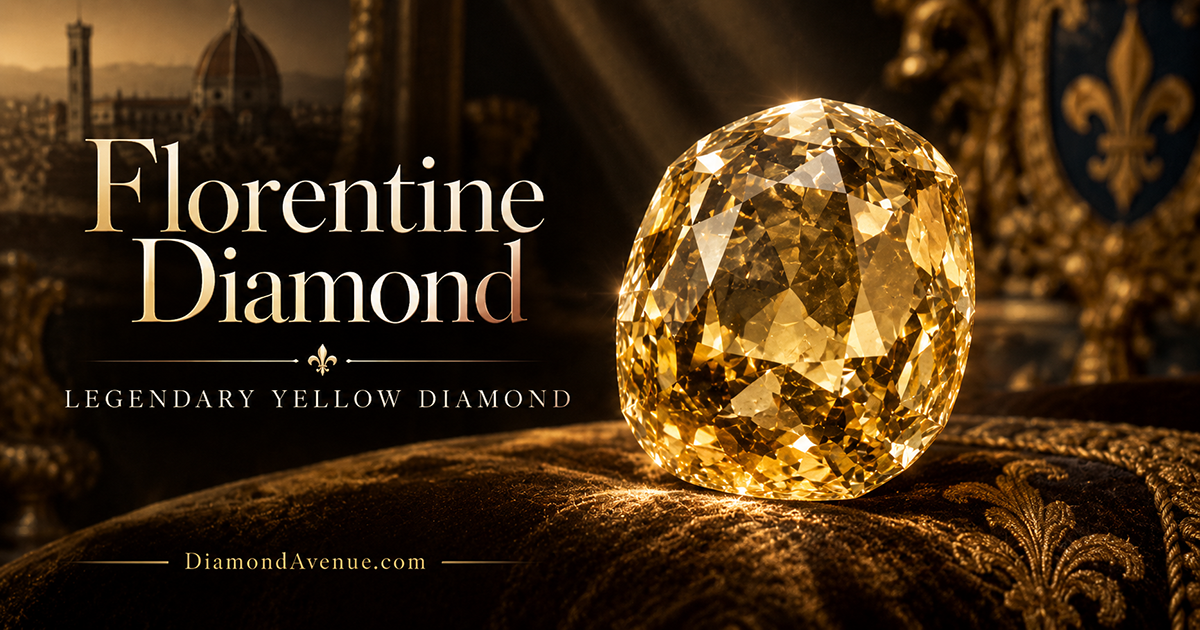
The Florentine is a historic 137.27-carat light-yellow diamond fashioned in an unusual double rose cut and associated for centuries with some of Europe's most powerful royal families.
An Extraordinary Historic Diamond
The Florentine is remarkable not only because of its size and history, but also because of its distinctive antique cutting style.
Historical descriptions characterize the stone as light yellow, sometimes with a subtle greenish or citron appearance. Its unusual shape and large number of facets give the diamond an appearance unlike that of modern brilliant-cut diamonds.
137.27 Carats
The Florentine weighs approximately 137.27 carats, placing it among the great historic diamonds of Europe.
Light Yellow
The diamond is historically described as light yellow, with older descriptions sometimes noting a slight greenish or citron tone.
126 Facets
Historical descriptions attribute 126 facets to the Florentine, contributing to the remarkable flashes of color observed from the stone.
Double Rose Cut
The Florentine is commonly described as a double rose-cut diamond. Rose cuts belong to an early tradition of diamond cutting that predates the modern brilliant cut.
Its irregular, somewhat pear-shaped outline and numerous facets reflect the craftsmanship and cutting techniques used for important diamonds centuries ago.
Legend and the Early History of the Florentine
Like many famous diamonds, the Florentine accumulated a colorful history in which legend and documented fact became intertwined.
One famous story claimed that the diamond belonged to Charles the Bold, Duke of Burgundy, and that he carried it at the Battle of Nancy in 1477, where he was killed.
According to later versions of the tale, the diamond was found on or near the battlefield by someone who mistook the stone for an ordinary piece of glass and sold it for a trivial amount.
The story has been repeated for generations, but careful diamond historians have questioned whether the stone owned by Charles the Bold was actually the diamond that later became known as the Florentine.
For that reason, the Burgundy story is best regarded as part of the diamond's legend rather than as an established chapter in its documented history.
A Probable Indian Origin
The Florentine is generally believed to have originated in India, the principal source of the world's great diamonds before major deposits were discovered in Brazil and later South Africa.
Historical accounts differ over precisely how and when the rough diamond reached Europe. One tradition links the stone with Portuguese activity in India before it eventually entered the possession of the powerful Medici family of Florence.
Although parts of this early history remain uncertain, the diamond's association with the Medici dynasty is far better documented.
The Medici of Florence
By the seventeenth century, the diamond was firmly associated with the Medici family, the extraordinary banking and ruling dynasty that helped make Florence one of the great artistic and cultural centers of Renaissance Europe.
The Medici accumulated magnificent collections of paintings, sculpture, gemstones, jewelry and other precious objects as symbols of wealth, culture and political power.
The great yellow diamond became one of the most important jewels associated with the Grand Dukes of Tuscany.
The Grand Duke of Tuscany Diamond
Because of its association with the Medici rulers of Tuscany, the stone became known by several names, including the Grand Duke of Tuscany Diamond and the Tuscan Diamond.
Its later association with Florence ultimately produced the name by which it is best known today: the Florentine Diamond.
Jean-Baptiste Tavernier and the Florentine
One of the most important figures in the history of famous diamonds was the seventeenth-century French traveler, gem merchant and writer Jean-Baptiste Tavernier.
Tavernier traveled extensively through Europe and Asia and personally examined many of the great diamonds owned by rulers and royal courts.
During the seventeenth century he recorded the large yellow diamond associated with the Grand Duke of Tuscany. His account provides an important historical connection between the stone and the Medici collection.
Tavernier's writings and drawings became important historical records of major diamonds long before photography made precise visual documentation possible.
The End of the Medici Dynasty
The Medici dynasty came to an end during the eighteenth century. When Grand Duke Gian Gastone de' Medici died without an heir in 1737, rule of Tuscany passed to Francis Stephen of Lorraine.
Francis Stephen was the husband of Maria Theresa of Austria and later became Holy Roman Emperor.
Through this dynastic transition, the famous yellow diamond became associated with the House of Habsburg-Lorraine.
From this period forward, the Florentine became closely connected with the Austrian imperial family and was sometimes called the Austrian Yellow Diamond.
A Jewel of the Habsburg Imperial Family
For generations, the Florentine formed part of the magnificent jewelry associated with the Habsburg court in Vienna.
It was incorporated into different forms of imperial jewelry over time and became one of the best-known gemstones associated with the Austrian ruling house.
The diamond's great size, distinctive yellow coloration and historic connection with both the Medici and Habsburg dynasties gave it importance far beyond its monetary value.
Carefully Documented
During the nineteenth century, the Florentine was studied and documented as part of the Austrian imperial collections.
Its unusual cutting style, dimensions, color and weight were recorded, and replicas were produced so that the extraordinary gem could be studied without risking the original.
Other Historic Names
Over the centuries, the diamond has been known by several names:
Florentine Diamond
Grand Duke of Tuscany Diamond
Tuscan Diamond
Austrian Yellow Diamond
Each name reflects a different chapter in the diamond's long European history.
World War I and the Fall of the Habsburg Empire
The First World War brought an end to centuries of Habsburg rule in Central Europe.
In 1918, Austria-Hungary collapsed and Emperor Charles I, the last emperor of Austria, relinquished participation in the affairs of state.
As the imperial family left Austria, important family jewels, including the Florentine, were taken to Switzerland for safekeeping.
The diamond then disappeared from public view.
The Great Mystery of the Florentine
For more than a century, the fate of the Florentine Diamond became one of the great mysteries of the gemstone world.
Because the diamond was no longer publicly seen after the fall of the Habsburg monarchy, numerous theories developed concerning its fate.
Some believed that it had been stolen. Others suggested that the enormous historic diamond had been secretly sold and recut into smaller stones so that its identity could never be recognized.
Still other accounts claimed that it had passed anonymously through the international diamond trade.
None of these theories could be conclusively established, and for decades the Florentine was routinely described as one of the world's great lost diamonds.
Empress Zita Protects the Imperial Jewels
The true story was considerably different.
Emperor Charles I and his wife, Empress Zita of Bourbon-Parma, had succeeded in preserving the Florentine and other important family jewels.
After the collapse of the empire, the family lived first in Switzerland. Charles later died on the Portuguese island of Madeira in 1922.
Zita subsequently lived with her children in several countries as political circumstances repeatedly forced the former imperial family to relocate.
The Florentine Comes to Canada
During the Second World War, Empress Zita and members of her family eventually found refuge in North America and spent part of the war years in Quebec, Canada.
The historic Habsburg jewels traveled with the family. The Florentine and other heirlooms were ultimately placed in secure storage in Canada.
Zita later returned to Europe, but the jewels remained safely protected in Canada.
Only a very small number of family members knew the location of the Florentine.
A Century of Secrecy
Empress Zita wanted the location of the jewels kept secret as a matter of security.
The family maintained that secrecy for generations. Knowledge of the Florentine's location was passed privately among only a few descendants.
As decades passed without a public sighting, speculation that the diamond had been lost, stolen or recut became accepted by many writers and gem historians.
In reality, the famous diamond had survived intact.
The Florentine Diamond Resurfaces in 2025
In 2025, descendants of the Habsburg family publicly revealed that the Florentine Diamond had not disappeared after World War I.
The historic diamond had instead remained in family custody and had been protected for decades in a Canadian bank vault.
The revelation resolved one of the longest-running mysteries surrounding any famous diamond.
More than a century after the collapse of the Austro-Hungarian Empire, the Florentine was shown intact and still displaying the distinctive form recorded in historic descriptions and replicas.
Preserved by the Habsburg Family
Members of the Habsburg family have stated that the diamond and associated family treasures should be preserved rather than dispersed.
The family's stewardship helped ensure that the Florentine survived intact through political upheaval, exile and two world wars.
Possible Public Exhibition
Habsburg descendants have expressed an intention to make the Florentine available for public exhibition in Canada.
Such an exhibition would give the public a rare opportunity to see a diamond that spent more than a century hidden from view.
Why the Florentine Diamond Is Famous
The Florentine's fame rests on much more than its impressive 137.27-carat weight.
Its unusual light-yellow color, historic double rose cut, extraordinary 126-facet arrangement and association with two of Europe's greatest dynasties make it an exceptional survivor from the age of royal jewels.
Its history links Renaissance Florence, the Medici grand dukes, the Habsburg imperial court, the fall of Austria-Hungary, royal exile and eventually Canada.
The mystery surrounding its supposed disappearance added another dimension to its fame. For generations, historians believed the great diamond might have been lost forever.
The 2025 disclosure that the Florentine had survived intact transformed the story once again, turning one of history's most famous lost diamonds into one of its most remarkable rediscoveries.
Weight
137.27 Carats
Color
Light Yellow
Cut
Double Rose Cut
Facets
126
Historic Owners
Medici Dynasty
Habsburg-Lorraine Dynasty
Redisclosed
2025
Historic Names of the Florentine
Florentine Diamond • Grand Duke of Tuscany Diamond • Tuscan Diamond • Austrian Yellow Diamond
Legacy of the Florentine Diamond
Few diamonds have traveled through so many chapters of European history while retaining such an aura of mystery.
The Florentine survived dynastic change, the end of the Medici line, centuries of Habsburg rule, the collapse of an empire, royal exile and the upheavals of the twentieth century.
For more than one hundred years it was widely considered lost. Its survival demonstrates how easily the history of a famous jewel can disappear from public view while the object itself continues to exist.
Today, the Florentine remains one of the most historically significant yellow diamonds in existence and an extraordinary physical link between Renaissance Florence, imperial Vienna and the surviving descendants of the Habsburg dynasty.