
Diamond History
History of the Graff Pink Diamond
The Graff Pink is one of the most celebrated natural pink diamonds of the modern era. Its combination of exceptional size, extraordinary color, Type IIa classification and remarkable auction history has made it one of the best-known colored diamonds in the world.
When the diamond appeared at Sotheby's Geneva in 2010, it weighed 24.78 carats. After its purchase by jeweler Laurence Graff, the stone was carefully repolished and transformed into the 23.88-carat Fancy Vivid Pink, Internally Flawless diamond known today as the Graff Pink.
The Graff Pink Diamond
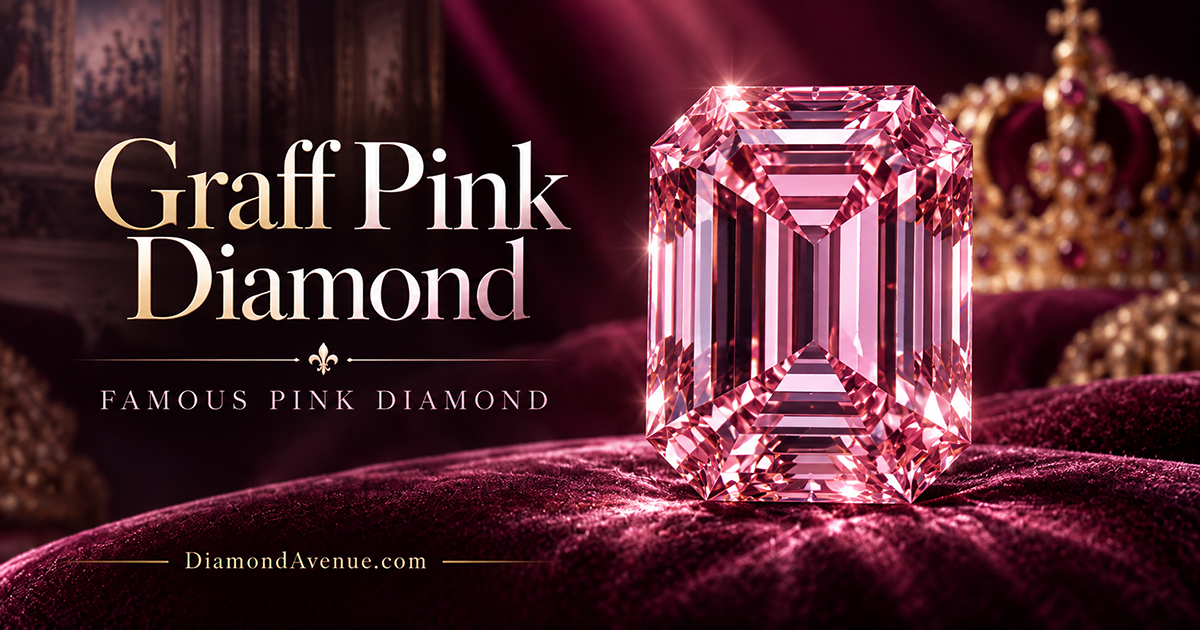
The Graff Pink is a 23.88-carat natural Fancy Vivid Pink diamond with an Internally Flawless clarity grade. It is also classified as a rare Type IIa diamond.
An Origin Shrouded in Mystery
Unlike many other famous diamonds, the precise mine from which the Graff Pink originated has not been publicly documented.
Its original rough weight, the identity of its first cutter and the circumstances surrounding its earliest history are also uncertain.
What is known is that the diamond emerged during the twentieth century as an exceptionally large natural pink diamond and was eventually associated with one of America's most famous jewelers.
Harry Winston and the Pink Diamond
The diamond was once owned by legendary American jeweler Harry Winston, whose name is associated with many of the world's most important diamonds and gemstones.
According to the provenance supplied when the stone appeared at Sotheby's in 2010, it had been purchased from Harry Winston by a private collector approximately sixty-five years earlier.
The diamond remained in private hands for decades and was not seen on the open market for more than half a century.
A Private Treasure
For roughly six decades, the great pink diamond remained largely outside public view.
Its long absence from the market added greatly to the excitement when Sotheby's announced that the stone would be offered for sale in Geneva in 2010.
The Diamond Returns to the Public Eye
In 2010, Sotheby's announced that the extraordinary pink diamond would be offered at its Magnificent Jewels sale in Geneva, Switzerland.
Prior to the auction, the stone was exhibited internationally, generating considerable interest among collectors, jewelers and the jewelry press.
The appearance was especially significant because the diamond had not been offered publicly for approximately sixty years.
The Graff Pink Before Repolishing
At the time of the Sotheby's auction, the diamond weighed 24.78 carats and was described as a round-cornered rectangular step-cut diamond.
The Gemological Institute of America graded its color Fancy Intense Pink with no secondary color modifier.
The diamond was also classified as Type IIa, placing it among a rare category of diamonds known for exceptional chemical purity.
Type IIa Diamond
Type IIa diamonds contain extremely low levels of measurable nitrogen and are among the chemically purest natural diamonds.
Only a small percentage of natural diamonds fall into this category.
Exceptionally Rare Pink Color
Natural pink diamonds are themselves extremely rare. Large pink diamonds with strong saturation and high clarity are rarer still.
The unusual combination of size, color and Type IIa chemistry made the stone particularly important to collectors.
A Classic Platinum Ring
When the diamond was offered at Sotheby's, it was mounted in a platinum ring.
The large central pink diamond was flanked by shield-shaped colorless diamonds, a classic design that emphasized the color and exceptional size of the pink center stone.
The restrained setting allowed the diamond itself to remain the dominant visual element.
The Record-Setting 2010 Sotheby's Auction
On November 16, 2010, the diamond was offered at Sotheby's Geneva.
Intense bidding drove the final price to approximately $46.2 million.
At the time, the result established an auction record for a jewel and an auction record for a pink diamond.
The buyer was London jeweler and diamond dealer Laurence Graff.
Laurence Graff
Laurence Graff has built an international reputation for acquiring, cutting and transforming some of the world's rarest diamonds.
Graff immediately recognized that the 24.78-carat pink diamond possessed characteristics that might allow experienced cutters to improve both its clarity and color.
Purchasing such an important historic diamond and then deciding to recut it involved substantial risk. Any error could permanently reduce the value of the stone or damage an irreplaceable natural gem.
Laurence Graff

Laurence Graff purchased the diamond at Sotheby's Geneva in 2010 and subsequently gave the gemstone the name by which it is known today.
The Decision to Repolish the Diamond
After acquiring the stone, Graff's master cutters began the delicate process of repolishing the diamond.
According to Graff, approximately 25 inclusions located near the surface were carefully polished away.
The goal was not simply to improve clarity. The cutters also sought to enhance the apparent saturation of the diamond's remarkable natural pink color.
Every alteration required removing some of the diamond's original weight, making the process a careful balance between size, clarity, proportions and color.
Before Repolishing
24.78 Carats
Fancy Intense Pink
Type IIa
After Repolishing
23.88 Carats
Fancy Vivid Pink
Internally Flawless
From Fancy Intense to Fancy Vivid Pink
The repolishing produced a remarkable result.
The diamond's weight was reduced by less than one carat, from 24.78 to 23.88 carats, but its color grade improved from Fancy Intense Pink to Fancy Vivid Pink.
Fancy Vivid is among the highest saturation classifications used by GIA for naturally colored diamonds.
The diamond also achieved an Internally Flawless clarity grade, greatly enhancing an already exceptional gemstone.
The Graff Pink
After its acquisition and transformation, Laurence Graff named the diamond The Graff Pink.
The name permanently connected the gemstone with one of the best-known jewelers and diamond houses of the modern era.
What Makes a Diamond Pink?
Pink diamonds are unusual because their color generally is not attributed to the same types of trace elements responsible for colors in many other diamonds.
Current research associates the pink coloration of many natural diamonds with structural distortions within the diamond crystal lattice caused by extreme geological forces during formation.
These structural changes affect the way light passes through the diamond, producing the extraordinary pink coloration prized by collectors.
A Historic Auction Record
The approximately $46.2 million paid for the Graff Pink in 2010 was extraordinary for its time.
The sale established new auction benchmarks for both pink diamonds and jewelry.
The Graff Pink retained the auction record for a pink diamond until 2017, when the substantially larger Pink Star sold for a higher price.
The 2010 result nevertheless remains one of the landmark auction sales in colored-diamond history.
Why the Graff Pink Diamond Is Famous
The Graff Pink is famous because several exceptional qualities come together in a single gemstone.
It is an unusually large natural pink diamond, belongs to the rare Type IIa category and displays exceptionally strong color without a secondary color modifier.
Its provenance includes Harry Winston and Laurence Graff, two of the most important names in twentieth- and twenty-first-century diamond jewelry.
Its record-setting 2010 Sotheby's sale made headlines around the world, while the successful repolishing demonstrated how sophisticated diamond cutting could improve both the color and clarity of an already extraordinary stone.
Current Weight
23.88 Carats
Current Color
Fancy Vivid Pink
Current Clarity
Internally Flawless
Diamond Type
Type IIa
2010 Auction Weight
24.78 Carats
2010 Sale Price
Approximately $46.2 Million
Former Owner
Harry Winston
Purchased By
Laurence Graff
Auction
Sotheby's Geneva
November 16, 2010
Legacy of the Graff Pink
The Graff Pink represents an unusual combination of natural rarity, historical provenance, auction drama and modern cutting expertise.
When it returned to the market in 2010, it was already one of the world's most important natural pink diamonds. Laurence Graff's decision to repolish such a valuable gemstone was a considerable technical and financial risk.
The successful transformation from a 24.78-carat Fancy Intense Pink diamond into a 23.88-carat Fancy Vivid Pink, Internally Flawless diamond further enhanced its place in modern gemological history.
Today, the Graff Pink remains a benchmark against which other exceptional natural pink diamonds are compared.