
Diamond History
History of the Heart of Eternity Diamond
The Heart of Eternity Diamond is one of the most important natural blue diamonds of the modern era. Weighing 27.64 carats, the rare heart-shaped diamond is distinguished by its Fancy Vivid Blue color, VS2 clarity and rare Type IIb classification.
Its history is closely connected with South Africa's famous Cullinan Mine, the De Beers Millennium Jewels, the opening of London's Millennium Dome and one of the most dramatic attempted jewel robberies in modern history.
The Heart of Eternity Diamond
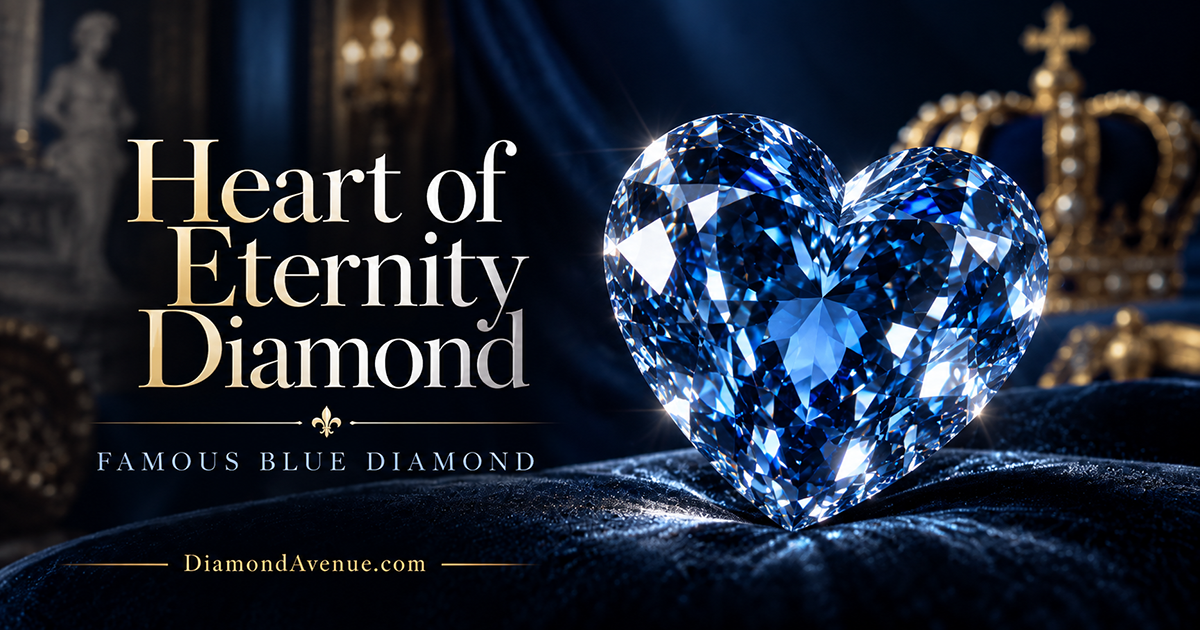
The Heart of Eternity is a 27.64-carat natural blue diamond fashioned into a heart-shaped modified brilliant and graded by GIA as Fancy Vivid Blue, VS2 clarity.
Born at the Premier Mine
The Heart of Eternity originated at South Africa's historic Premier Mine, now known as the Cullinan Mine.
This mine has produced an extraordinary number of important diamonds, including the great Cullinan Diamond, the Golden Jubilee, the Blue Heart and many other large and rare colored diamonds.
The mine is particularly famous for producing exceptional blue diamonds, including stones belonging to the rare Type IIb category.
A Rare Natural Blue Diamond
Natural blue diamonds are among the rarest colored diamonds found in nature.
The Heart of Eternity is especially important because of the combination of its large size, unusually intense blue color and exceptional gemological characteristics.
GIA classified the diamond as Type IIb, a rare category associated with natural blue diamonds containing trace amounts of boron.
What Gives the Diamond Its Blue Color?
The blue color of most natural Type IIb diamonds is associated with minute quantities of boron incorporated into the diamond crystal structure during formation deep within the earth.
Boron affects the way light is absorbed by the diamond, allowing blue wavelengths to dominate the color seen by the eye.
Type IIb diamonds are also unusual because they can conduct electricity, a property not normally associated with most natural diamonds.
Gemological Characteristics
The Gemological Institute of America graded the Heart of Eternity in 1999.
GIA recorded the stone as a 27.64-carat heart-shaped modified brilliant with a color grade of Fancy Vivid Blue and clarity grade of VS2.
Weight
27.64 Carats
Color
Fancy Vivid Blue
Clarity
VS2
Cut
Heart-Shaped Modified Brilliant
Diamond Type
Type IIb
Cut by the Steinmetz Group
The Heart of Eternity was manufactured by the Steinmetz Group, which was responsible for cutting a remarkable group of blue diamonds created for De Beers at the end of the twentieth century.
Designing a heart-shaped diamond of this size and color required balancing weight retention, symmetry, brilliance and color intensity.
The resulting heart-shaped modified brilliant became the largest and most prominent blue diamond in the collection.
The De Beers Millennium Jewels
As the year 2000 approached, De Beers assembled a spectacular collection of rare diamonds for a major international exhibition.
The collection became known as the De Beers Millennium Jewels.
Its centerpiece was the large colorless De Beers Millennium Star, accompanied by an extraordinary group of rare natural blue diamonds.
Together, the jewels were intended to showcase some of the finest diamonds available at the beginning of the new millennium.
The Midnight Collection
De Beers assembled 11 exceptional blue diamonds with a combined weight of approximately 118 carats.
This group became known as the Midnight Collection.
All 11 blue diamonds were recovered from the Premier Mine in South Africa and were manufactured by the Steinmetz Group.
At 27.64 carats, the Heart of Eternity was the largest diamond in the Midnight Collection.
Displayed at London's Millennium Dome
The Millennium Jewels became one of the major attractions at the Millennium Dome in Greenwich, London, during the year 2000.
Visitors were able to view the Heart of Eternity alongside the Millennium Star and the other rare blue diamonds in a specially designed high-security exhibition vault.
The exhibition drew enormous public interest because many of the diamonds had never before been displayed together.
Extraordinary Security
The value and rarity of the Millennium Jewels required extraordinary security.
The diamonds were displayed inside a specially reinforced concrete vault and protected by extensive surveillance and security systems.
Despite these precautions, the collection became the target of one of Britain's most audacious attempted robberies.
A Target for Jewel Thieves
During 2000, British police learned that a criminal gang was planning to steal the Millennium Jewels.
Scotland Yard began an extensive undercover surveillance operation and carefully monitored the suspects as they prepared their attack.
The Millennium Dome Diamond Raid
On the morning of November 7, 2000, members of the gang launched their attack on the Millennium Dome.
Using a stolen earthmover, the thieves smashed through security barriers and drove toward the vault containing the De Beers diamonds.
The raiders used smoke bombs and carried equipment intended to break through the protective display surrounding the jewels.
Their plan was to seize the diamonds and escape across the River Thames in a waiting speedboat.
Scotland Yard Was Waiting
Unknown to the thieves, Scotland Yard had been tracking the plot for months.
More than 100 police officers were involved in the operation, including members of the Flying Squad and armed officers positioned around the Dome.
Some officers were disguised as Dome employees and maintenance workers so that the gang would not realize police were waiting for them.
When the thieves reached the vault, officers moved in and arrested them before they could escape.
The Diamonds Had Already Been Replaced
The most remarkable part of the police operation was that the real diamonds had already been removed.
Before the raid, police and De Beers secretly replaced the Millennium Jewels with crystal replicas.
Even if the thieves had successfully broken into the display, they would not have escaped with the genuine Heart of Eternity or the other priceless diamonds.
After the Failed Robbery
The attempted theft became international news and dramatically increased public awareness of the Millennium Jewels.
The gang members were later prosecuted and several received lengthy prison sentences.
The real diamonds survived the attempted robbery unharmed, and the Heart of Eternity remained one of the most memorable jewels associated with the Millennium Dome exhibition.
An Important Gemological Reference Diamond
The Heart of Eternity is also important to gemologists.
Its unusual combination of substantial size and strongly saturated natural blue color provides an important example of the properties of Type IIb diamonds.
When GIA documented the stone, it was one of the largest Fancy Vivid Blue diamonds the laboratory had examined.
Its study contributed to the scientific understanding of natural blue diamonds and the role of boron in producing their distinctive color.
Part of the Cullinan Mine's Blue Diamond Legacy
The Heart of Eternity is part of a remarkable tradition of blue diamonds produced by the Cullinan Mine.
Other famous blue diamonds from the same mine include the Blue Heart and the rough diamond that later became the Blue Moon of Josephine.
The mine's ability to produce large Type IIb blue diamonds has made it one of the most important sources of rare blue diamonds in the world.
Why the Heart of Eternity Diamond Is Famous
The Heart of Eternity is famous because it combines several exceptionally rare characteristics.
At 27.64 carats, it is unusually large for a natural blue diamond. Its Fancy Vivid Blue color represents an exceptionally strong level of saturation, while its Type IIb classification places it within one of the rarest categories of natural diamonds.
Its romantic heart shape gives the stone a distinctive visual identity, while its association with the De Beers Millennium Jewels connects it with one of the most celebrated diamond exhibitions of modern times.
Finally, its presence at the center of the attempted Millennium Dome robbery added an extraordinary chapter to the diamond's modern history.
Weight
27.64 Carats
Color
Fancy Vivid Blue
Clarity
VS2
Cut
Heart-Shaped
Modified Brilliant
Diamond Type
Type IIb
Origin
Premier / Cullinan Mine
South Africa
GIA Graded
1999
Millennium Display
Millennium Dome
London, 2000
Famous Event
Millennium Dome
Robbery Attempt
Legacy of the Heart of Eternity
The Heart of Eternity represents an extraordinary intersection of geology, gemology, diamond cutting and modern history.
Its natural blue color began with trace boron deep within the earth. Its discovery at the famous Cullinan Mine connected it with one of history's greatest diamond sources.
Its transformation into a precisely shaped heart, inclusion in the De Beers Millennium Jewels and survival of the attempted Millennium Dome robbery turned an already exceptional gemstone into a modern diamond legend.
Today, the Heart of Eternity remains one of the most recognizable and historically significant natural blue diamonds of its generation.