
Diamond - History
History of the Hope Diamond
The Hope Diamond is one of the most famous gemstones in the world. Its extraordinary deep blue color, remarkable size and more than three centuries of documented history have made it one of the most recognizable diamonds ever discovered.
The diamond's story reaches from the diamond mines of India to the court of King Louis XIV of France, through the upheaval of the French Revolution, nineteenth-century Britain, American high society and finally the Smithsonian Institution in Washington, D.C.
The Hope Diamond
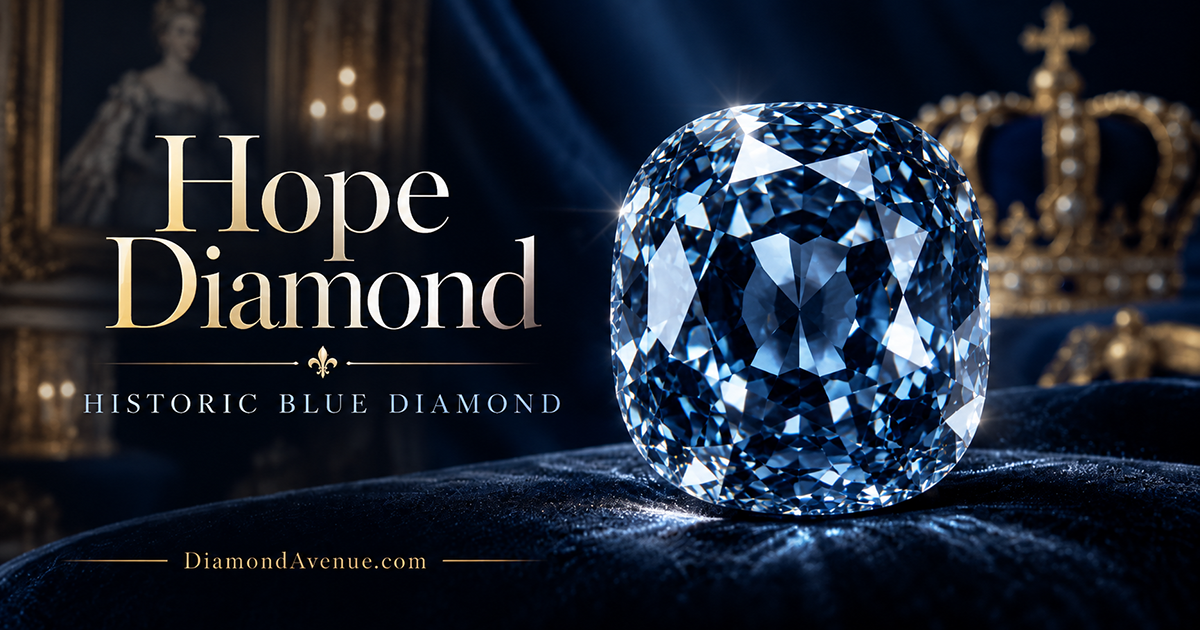
The Hope Diamond weighs 45.52 carats and is graded Fancy Deep grayish blue with VS1 clarity. It belongs to the rare Type IIb category of natural diamonds.
Origins in India
The Hope Diamond began its recorded history as a much larger blue diamond obtained in India during the seventeenth century.
French gem merchant and traveler Jean-Baptiste Tavernier returned from India with an unusually large blue diamond weighing approximately 115 modern metric carats.
The precise mine from which Tavernier obtained the diamond is not documented with certainty. It is often associated with the historic Kollur Mine in the Golconda region, although the Smithsonian notes that this attribution remains circumstantial.
What is certain is that the diamond originated in India, which at that time was the world's principal commercial source of diamonds.
Jean-Baptiste Tavernier
Jean-Baptiste Tavernier was one of the seventeenth century's most important gem merchants and travelers.
He made six major journeys through Persia and India and recorded extensive information about Asian trade, gemstones and diamond mining.
Tavernier's writings provide one of the earliest surviving visual records of the large blue diamond that eventually became the Hope Diamond.
The Tavernier Blue
The original stone is commonly called the Tavernier Blue.
It weighed approximately 115 modern metric carats and had an irregular, somewhat triangular form typical of diamonds cut in India to preserve as much weight as possible.
Sold to King Louis XIV
In 1668, Tavernier presented his collection of diamonds to King Louis XIV of France.
In February 1669, Louis XIV purchased Tavernier's group of diamonds, including the large blue stone, for approximately 220,000 livres.
The spectacular blue diamond became part of the French Crown Jewels and began its long association with European royalty.
Creation of the French Blue
Louis XIV wanted the stone recut according to European tastes, which favored greater symmetry and brilliance.
Court jeweler Jean Pittan the Younger supervised the transformation of the approximately 115-carat Tavernier diamond.
The cutting process took about two years.
When completed, the stone weighed approximately 69 carats and had been transformed into a dramatic heart-like blue diamond.
Royal inventories referred to it as the "great violet diamond of His Majesty." It later became known to history as the French Blue.
The Order of the Golden Fleece
During the reign of King Louis XV, the French Blue was incorporated into one of the most spectacular pieces of French royal jewelry.
In 1749, Parisian jeweler Pierre-André Jacqumin created an elaborate insignia of the Order of the Golden Fleece containing the French Blue and other important gemstones.
The setting became one of the great jeweled treasures of the French monarchy.
The French Revolution
The French Revolution placed the Crown Jewels in extraordinary danger.
Following the fall of the monarchy, the royal jewels were stored in the Garde-Meuble in Paris.
In September 1792, during a period of political chaos, thieves broke into the repository and looted many of the French Crown Jewels.
The French Blue disappeared.
Twenty Years of Mystery
For nearly twenty years after the theft, the French Blue vanished from the historical record.
Historians now believe the large diamond was recut during this period in an attempt to disguise its identity and prevent its recovery by France.
The recutting reduced the stone from approximately 69 carats to the form that would eventually become the 45.52-carat Hope Diamond.
The Diamond Reappears in London
In 1812, a large deep-blue diamond suddenly appeared in London in the possession of diamond merchant Daniel Eliason.
London jeweler John Francillon examined the stone and produced a detailed drawing and description.
Francillon described a beautiful deep-blue diamond with exceptional color and clarity.
The timing was intriguing: the stone was documented only days after the expiration of a twenty-year statute of limitations associated with crimes committed during the French Revolution.
Was the Hope Cut from the French Blue?
For generations, historians suspected that the diamond appearing in London in 1812 was the missing French Blue in a new form.
In 2007, researchers discovered a lead cast of the French Blue in the collection of France's Muséum National d'Histoire Naturelle.
Computer modeling of the cast demonstrated that the modern Hope Diamond could fit inside the French Blue, providing strong physical evidence that the Hope was indeed cut from the stolen French Crown Jewel.
Henry Philip Hope
By 1839, the blue diamond was documented in the collection of wealthy British banker and gem collector Henry Philip Hope.
His remarkable gem collection included diamonds, colored gemstones and other important treasures.
The Hope Diamond Gets Its Name
The diamond eventually became associated so strongly with the Hope family that it became known as the Hope Diamond.
The name endured long after the stone left the family's possession.
The Great Exhibition of 1851
The Hope Diamond was publicly displayed at the Great Exhibition of 1851 at the Crystal Palace in London.
The exhibition brought together extraordinary examples of art, industry, science and luxury from around the world.
Display there helped establish the Hope Diamond as one of the great famous gemstones of the nineteenth century.
Lord Francis Hope
The diamond eventually passed through the Hope family to Francis Hope.
Financial difficulties ultimately led him to seek permission to sell the famous family heirloom.
After legal proceedings, the diamond was eventually sold and began moving through the international jewelry trade.
Pierre Cartier and the Hope Diamond
By the early twentieth century, the Hope Diamond had passed through several dealers and eventually came into the hands of Pierre Cartier of the famous Cartier jewelry family.
Cartier recognized that the stone's fascinating history could make it especially appealing to wealthy American clients.
He also helped popularize stories about a supposed curse associated with the diamond.
Evalyn Walsh McLean
In 1912, Pierre Cartier sold the Hope Diamond to wealthy Washington socialites Ned and Evalyn Walsh McLean.
The reported price was approximately $180,000.
Cartier had the diamond mounted in a new setting surrounded by colorless diamonds, creating the basic necklace presentation associated with the Hope today.
Evalyn McLean frequently wore the diamond at social events and became one of its most famous owners.
The Legend of the Hope Diamond Curse
Few gemstones have accumulated as many legends as the Hope Diamond.
Stories claimed that owners of the diamond suffered financial ruin, personal tragedy or premature death.
However, historians have found that many of these stories were exaggerated, embellished or invented long after the events supposedly occurred.
Newspaper writers, jewel dealers and other storytellers helped popularize the idea of a curse because the sensational stories attracted public attention.
Pierre Cartier is believed to have made use of these legends while attempting to interest Evalyn Walsh McLean in purchasing the diamond.
Harry Winston Acquires the Hope
Evalyn Walsh McLean died in 1947.
In 1949, legendary American jeweler Harry Winston purchased the Hope Diamond along with the rest of McLean's jewelry collection.
Winston soon made the Hope a centerpiece of his traveling Court of Jewels exhibition.
From 1949 through the early 1950s, the exhibition traveled around the United States, educating the public about important gemstones while helping raise money for charitable organizations.
Harry Winston Gives the Hope Diamond to America
Harry Winston believed that the United States should have a major national gemstone collection.
He believed that the Hope Diamond could become the centerpiece of such a collection and encourage other important donations to the Smithsonian Institution.
In 1958, Winston donated the Hope Diamond to the Smithsonian's National Gem Collection.
Delivered by Registered Mail
One of the most famous episodes in the Hope Diamond's history occurred when Harry Winston sent the priceless gemstone to the Smithsonian.
Rather than using an armored vehicle or private courier, the diamond was placed in a plain brown package and sent through the United States Postal Service by registered mail.
The package was insured for $1 million.
The Hope Diamond officially arrived at the Smithsonian on November 10, 1958.
The Smithsonian's Most Famous Gem
The Hope Diamond quickly became one of the most popular attractions at the Smithsonian's National Museum of Natural History.
More than 100 million visitors have viewed the diamond since Harry Winston donated it in 1958.
Today, it remains part of the National Gem Collection in Washington, D.C.
Its Smithsonian catalog number is NMNH G3551.
Return to France
In 1962, the Hope Diamond temporarily returned to France for the exhibition Ten Centuries of French Jewels at the Louvre Museum in Paris.
The exhibition reunited the famous diamond with the country where its predecessor, the French Blue, had once formed part of the French Crown Jewels.
Precisely Weighed in 1975
For many years, published estimates of the Hope Diamond's weight varied.
On November 13, 1975, the diamond was removed from its setting and accurately weighed.
The measurement established its modern accepted weight at exactly 45.52 carats.
Gemological Examination
Gemologists from the Gemological Institute of America examined the Hope Diamond at the Smithsonian in 1988.
They recorded a clarity grade of VS1 and documented its unusual blue coloration and exceptionally strong phosphorescence.
When the diamond was examined again in 1996, GIA described its color using updated terminology as natural Fancy Deep grayish blue.
Type IIb Diamond
The Hope belongs to the rare Type IIb category of natural diamonds.
These diamonds contain trace amounts of boron, which contributes to their characteristic blue color.
Type IIb diamonds can also conduct electricity, making them unusual among natural diamonds.
Red Phosphorescence
The Hope Diamond displays another fascinating phenomenon.
After exposure to ultraviolet light, the diamond produces a distinctive orange-red phosphorescent glow.
This glow can continue briefly even after the ultraviolet light source has been removed.
Weight
45.52 Carats
Color
Fancy Deep
Grayish Blue
Clarity
VS1
Cut
Modified Antique
Cushion
Diamond Type
Type IIb
Origin
India
Tavernier Diamond
Approximately 115 Carats
French Blue
Approximately 69 Carats
Hope Diamond
45.52 Carats
Why the Hope Diamond Is Famous
Few diamonds combine so many extraordinary qualities.
The Hope is exceptionally large for a natural blue diamond and displays a deep, highly distinctive color produced by trace boron within its crystal structure.
Its documented history links the stone with Jean-Baptiste Tavernier, Louis XIV, the French Crown Jewels, the French Revolution, the Hope family, Pierre Cartier, Evalyn Walsh McLean and Harry Winston.
Its disappearance during the French Revolution, reappearance in nineteenth-century London and later identification as the recut French Blue give it one of the most dramatic provenances of any gemstone.
Added to that history are the legends of a curse, Harry Winston's remarkable decision to send the diamond to the Smithsonian by registered mail and decades of scientific research into its unusual color and phosphorescence.
Legacy of the Hope Diamond
The Hope Diamond is far more than a famous piece of jewelry. It is an important historical object, scientific specimen and cultural icon.
Its journey from India to seventeenth-century France, through revolution and disappearance, into British and American collections and finally to the Smithsonian spans more than three centuries.
Scientific research has revealed the physical characteristics responsible for its extraordinary blue color, while historical research has clarified the relationship between the Tavernier Diamond, the French Blue and the modern Hope.
Today, the Hope Diamond remains one of the Smithsonian's most famous treasures and one of the best-known gemstones in the world.