
Diamond History
History of the Hortensia Diamond
A historic pink diamond of the French Crown Jewels, the Hortensia Diamond has survived royal ownership, revolution, theft and recovery to become one of France's most celebrated historic gemstones.
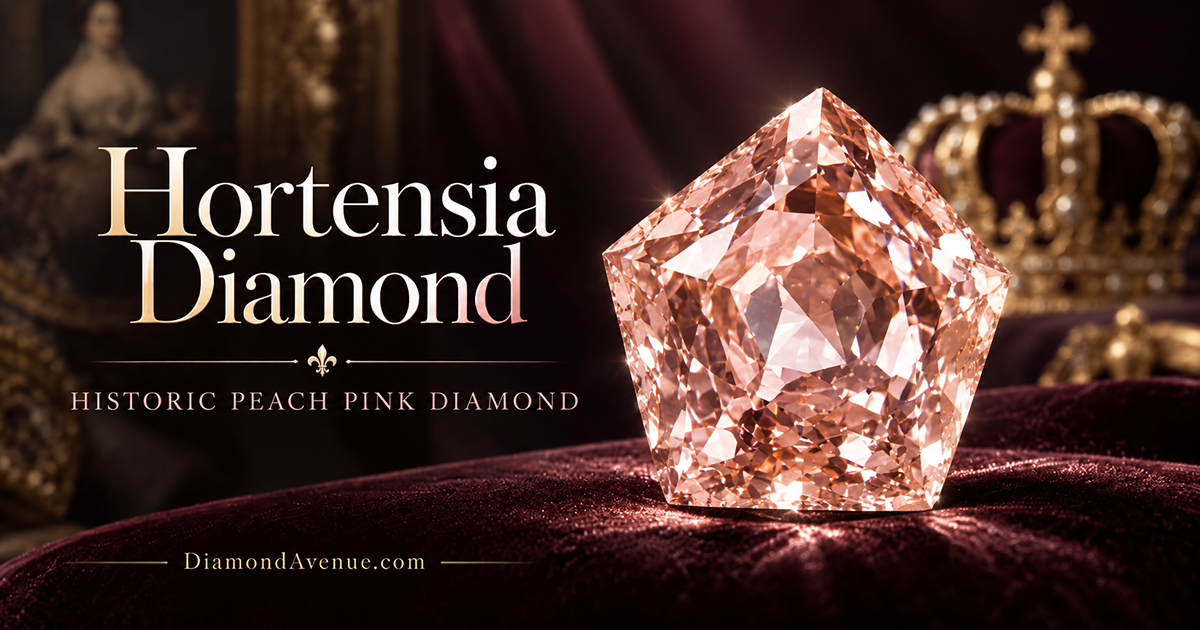
The Hortensia Diamond
The Hortensia Diamond is one of the historic colored diamonds associated with the French Crown Jewels. Weighing approximately 20.53 carats, it is especially notable for its unusual pink color, which has been described as having a subtle brownish-orange tint.
Unlike many famous diamonds known principally for extraordinary size, the Hortensia is distinguished by a combination of rare color, royal provenance and dramatic history.
Its centuries-long association with the French monarchy places it among a select group of gemstones whose importance extends far beyond their monetary value.
Diamond at a Glance
Name:
Hortensia Diamond
Weight:
Approximately 20.53 carats
Color:
Pink with a slight brownish-orange tint
Shape:
Historic shield-like, five-sided cut
Historic Collection:
French Crown Jewels
Present Collection:
Musée du Louvre, Paris
A Diamond of Louis XIV
The documented history of the Hortensia Diamond reaches back to the reign of King Louis XIV of France, the "Sun King," whose long reign helped transform the French royal collection into one of Europe's most important treasuries of precious gems.
The diamond is first recorded in the 1691 inventory of the French Crown Jewels. At that time it was mounted as part of a diamond ornament belonging to the king.
The Louvre notes that the stone may possibly have been brought to France by Jean Pitan the Younger, a royal jeweler and keeper of the king's gemstones who made several journeys to the Netherlands during the 1670s to acquire diamonds for the Crown.
Although the diamond's history before its appearance in the French royal inventory is uncertain, its documented connection with Louis XIV establishes more than three centuries of recorded European provenance.
A Rare Historic Pink Diamond
Natural pink diamonds are among the most unusual colored diamonds, and large historic examples are particularly uncommon.
The Hortensia is described by the Louvre as a pink diamond with a slight brown-orange tint. Its subdued historic coloration differs from the strongly saturated pink hues associated with some modern fancy-color diamonds.
Its color, combined with its size and exceptionally long documented history, has made the Hortensia an important reference point in discussions of famous natural pink diamonds.
Its Unusual Shape
The Hortensia does not have the highly symmetrical appearance associated with modern round brilliant diamonds.
The Louvre describes the gemstone as a five-sided pink diamond, while gemological references commonly characterize its overall form as a shield shape.
Its historic cutting style reflects an era when diamonds were fashioned primarily to preserve valuable rough material and display color and brilliance under candlelight rather than to conform to modern standardized proportions.
The French Revolution and the Great Crown Jewel Theft
One of the most dramatic episodes in the history of the Hortensia Diamond occurred during the French Revolution.
In September 1792, amid the political upheaval that accompanied the collapse of the French monarchy, thieves broke into the Garde-Meuble de la Couronne, the royal storehouse in Paris where many of the Crown Jewels were kept.
During a series of thefts between September 11 and September 17, 1792, a large portion of the French royal jewel collection disappeared. The Hortensia Diamond was among the stones taken.
Some of the stolen gems vanished permanently, while others eventually resurfaced. The Hortensia was one of the fortunate survivors.
The Diamond Is Recovered
The Hortensia did not remain missing for long. According to the Louvre's historical record, the diamond was recovered the following month.
A man named François Dupeyron, suspected of involvement in the theft and condemned to death, revealed the location where some of the stolen jewels had been hidden shortly before his execution.
The discovery returned the Hortensia to French possession and preserved a gemstone that might otherwise have disappeared permanently into the private diamond trade.
Survival Through Political Change
France subsequently passed through extraordinary political transformations: revolution, republic, empire, restored monarchy and additional changes of government.
Through those upheavals, the Hortensia remained associated with the historic collection of French Crown Diamonds.
Its survival is especially significant because many royal jewels were altered, sold, dispersed or lost as successive governments reconsidered the fate of the former royal treasury.
Why Is It Called the Hortensia Diamond?
The name Hortensia has traditionally been associated with Hortense de Beauharnais, Queen of Holland and the daughter of Joséphine de Beauharnais, who became Empress of the French after marrying Napoleon Bonaparte.
However, the diamond itself predates Hortense by many decades. It was already documented in the French Crown Jewels in 1691, while Hortense de Beauharnais was born in 1783.
For that reason, the name should not be interpreted as evidence that the diamond originally belonged to her. The precise circumstances under which the gemstone acquired the name "Hortensia" are less securely documented than its earlier history in the French royal collection.
The Hortensia and the Louvre
The Hortensia Diamond eventually became part of France's national museum collections.
The Louvre records the diamond as having been assigned to the museum in 1889. It remains the property of the French state and is administered by the Musée du Louvre.
Its preservation in a national collection gives the Hortensia unusual historical continuity. Rather than passing permanently into private ownership, it survives as part of the material heritage of France.
More Than a Famous Gemstone
The significance of the Hortensia Diamond comes from more than carat weight alone.
It is simultaneously a rare natural pink diamond, a relic of the court of Louis XIV, a survivor of one of the most famous jewel thefts in European history and an artifact of the French Revolution.
Few gemstones combine gemological rarity with such an extensive documented connection to major events in European history.
Hortensia Diamond Historical Timeline
1670s
Royal jeweler Jean Pitan the Younger travels to the
Netherlands to acquire diamonds for Louis XIV.
The Louvre considers it possible that the Hortensia
was among stones obtained through these activities.
1691
The diamond appears in an inventory of the French
Crown Jewels, mounted in a diamond ornament belonging
to Louis XIV.
September 1792
The Hortensia is stolen during the looting of the
French Crown Jewels at the Garde-Meuble in Paris.
October 1792
The diamond is recovered after François Dupeyron
reveals the hiding place of stolen jewels.
19th Century
The Hortensia survives successive changes in French
government and remains associated with the historic
Crown Diamond collection.
1889
The diamond is assigned to the Musée du Louvre.
Today
The Hortensia remains part of the French national
collection and one of the historically important
surviving diamonds of the former French Crown Jewels.
Why the Hortensia Diamond Is Famous
The Hortensia Diamond is famous because it combines several characteristics rarely found together in a single gemstone:
- It is a large historic natural pink diamond.
- It weighs approximately 20.53 carats.
- Its documented royal history reaches back to Louis XIV.
- It was part of the French Crown Jewels.
- It survived the famous 1792 theft of the Crown Jewels.
- It was recovered shortly after the theft rather than disappearing permanently.
- It survives today as part of the French national collection at the Louvre.
Together, its color, size, royal provenance and extraordinary survival through the French Revolution make the Hortensia one of the historically important diamonds of Europe.