
Diamond History
History of the Incomparable Diamond
From the chance discovery of an enormous rough diamond in Central Africa to its transformation into one of the world's largest internally flawless polished diamonds, the Incomparable Diamond has one of the most remarkable histories of any famous diamond.
The Incomparable Diamond
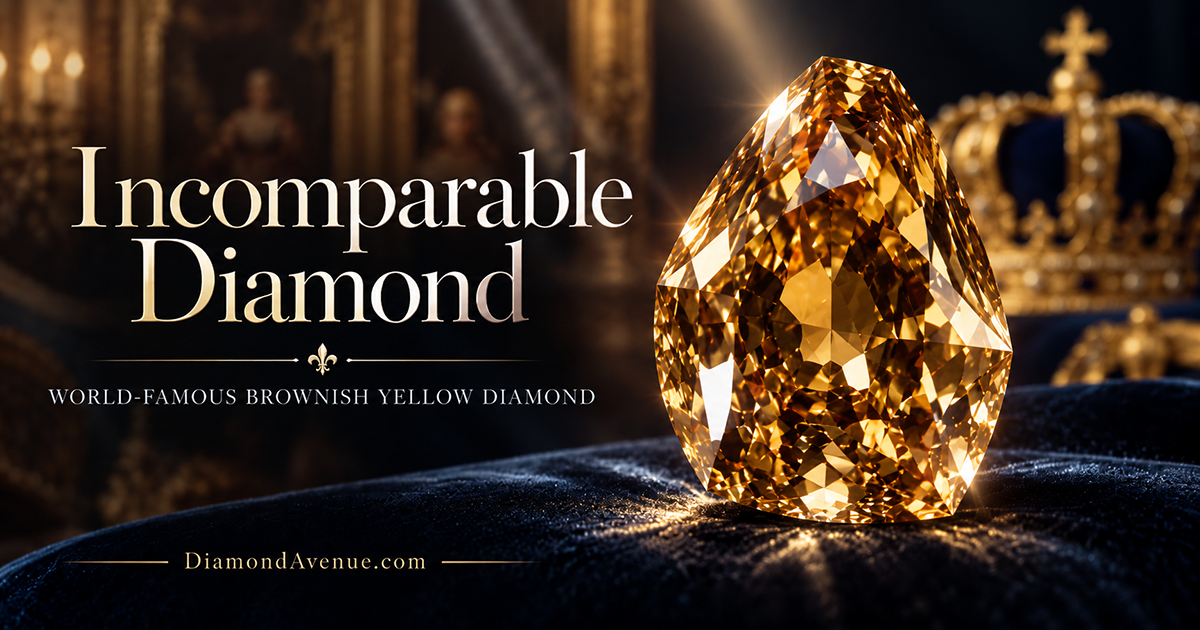
The Incomparable Diamond was one of the largest and most celebrated polished yellow diamonds in the world.
In its famous polished form, the diamond weighed 407.48 carats and was fashioned into an unusual shield-shaped step cut.
The Gemological Institute of America graded it Fancy Deep brownish yellow in color and Internally Flawless in clarity.
Its extraordinary size, unusual color, exceptional clarity and fascinating discovery story made the Incomparable one of the most recognizable large colored diamonds of the modern era.
Diamond at a Glance
Historic Name:
Incomparable Diamond
Original Rough Weight:
Approximately 890 carats
Incomparable Weight:
407.48 carats
Color:
Fancy Deep brownish yellow
Clarity:
Internally Flawless
Historic Cut:
Shield-shaped step cut
Origin:
Democratic Republic of the Congo
Later Name:
Golden Canary
Current Recut Weight:
303.10 carats
An Extraordinary Chance Discovery
The story of the Incomparable Diamond began in the early 1980s in what is now the Democratic Republic of the Congo.
According to accounts cited by the Gemological Institute of America, an enormous rough diamond was discovered by a young girl near her uncle's house. The stone was found in a pile of discarded mining rubble.
The material reportedly had not been processed for diamonds because the pieces were considered too large or unsuitable for normal screening.
Hidden among that rejected material was an extraordinary rough diamond weighing approximately 890 carats.
The discovery immediately placed the crystal among the largest gem-quality rough diamonds known at the time and began a lengthy process of examination, planning and cutting.
An 890-Carat Rough Diamond
Cutting an exceptionally large rough diamond requires considerably more planning than cutting an ordinary gemstone.
Every possible cutting direction must be studied to determine how the crystal can yield the greatest combination of size, color, clarity and beauty.
With a rough diamond approaching 900 carats, a single incorrect cutting decision could potentially destroy hundreds of carats of valuable material.
The massive Congo rough was therefore studied extensively before polishing began.
Fifteen Finished Diamonds
The rough eventually produced a number of polished diamonds rather than a single finished gemstone.
GIA reports that 15 finished stones were fashioned from the original rough.
By far the largest of those finished diamonds was the stone that became known as the Incomparable Diamond.
Its finished weight of 407.48 carats represented an extraordinary achievement in preserving both size and gem quality from the original crystal.
Creation of the 407.48-Carat Incomparable
The principal polished stone was fashioned into an unusual shield-shaped step cut.
Rather than forcing the massive rough into a conventional round, oval or rectangular shape, the cutters followed the natural form of the crystal to preserve as much weight as practical while producing an attractive finished diamond.
The resulting gemstone weighed 407.48 carats.
GIA graded the Incomparable Fancy Deep brownish yellow with an extraordinary clarity grade of Internally Flawless.
A diamond of more than 400 carats with this level of clarity is exceptionally unusual. For years, the Incomparable was recognized as the largest internally flawless diamond graded by GIA.
Its Remarkable Yellow Color
The Incomparable belonged to the important family of naturally colored yellow diamonds.
GIA classified its color as Fancy Deep brownish yellow. The word "Fancy" distinguishes naturally colored diamonds whose color falls outside the traditional D-to-Z color-grading scale used primarily for colorless and near-colorless diamonds.
Its deep yellow appearance, modified slightly by a brown component, helped give the enormous diamond a distinctive warm golden appearance.
Internally Flawless Clarity
The diamond's clarity was nearly as exceptional as its size.
An Internally Flawless clarity grade means that no internal inclusions are visible to a skilled grader under standard 10× magnification, although minor surface characteristics may be present.
Achieving such a clarity grade in a diamond weighing hundreds of carats made the Incomparable particularly remarkable.
The Incomparable Becomes Famous
The finished Incomparable was publicly revealed in the 1980s and quickly attracted international attention because of its size and unusual appearance.
GIA records that the polished diamond was displayed at the Smithsonian Institution's National Museum of Natural History and subsequently appeared in other museum exhibitions.
These public displays helped transform the stone from an extraordinary gemological specimen into one of the world's recognized famous diamonds.
L'Incomparable Necklace
The Incomparable later became the centerpiece of one of the most extraordinary diamond necklaces ever created.
Jewelry house Mouawad incorporated the 407.48-carat diamond into an elaborate necklace known as L'Incomparable.
The huge yellow diamond was suspended within an asymmetrical arrangement of additional diamonds, creating a necklace with a total diamond weight of approximately 637 carats.
A Record-Setting Jewel
When publicized in 2013, the L'Incomparable necklace was valued at approximately $55 million.
It was recognized by Guinness World Records as the world's most expensive necklace at that time.
The centerpiece remained the immense 407.48-carat Incomparable Diamond, making the necklace as much a showcase for the individual gemstone as an example of high jewelry design.
The Incomparable Is Recut
The story of the Incomparable took an unexpected turn decades after the diamond first became famous.
The owners elected to recut the enormous 407.48-carat shield-shaped stone.
Recutting such an important diamond meant deliberately sacrificing more than 100 carats of weight, but the goal was to improve the diamond's overall shape, proportions, brilliance and presentation of color.
The transformation produced a 303.10-carat pear-shaped diamond.
With the new cut came a new name: the Golden Canary.
The 303.10-Carat Golden Canary
Despite the dramatic reduction in weight, the newly fashioned Golden Canary retained the exceptional gemological qualities that had made the Incomparable famous.
GIA graded the 303.10-carat pear-shaped diamond Fancy Deep brownish yellow and Internally Flawless.
At the time of its grading, GIA described it as the largest flawless or internally flawless diamond and the largest pear-shaped diamond it had graded.
Why Recut Such a Famous Diamond?
Recutting a historic gemstone may seem surprising, particularly when more than 100 carats must be removed.
However, carat weight is only one measure of a diamond's appearance and desirability.
A carefully planned recut can improve symmetry, brilliance, visual balance and the distribution of color throughout a gemstone.
In the case of the Incomparable, the transformation created a more conventionally elegant pear shape while retaining an extraordinary finished weight of more than 300 carats.
The Golden Canary at Auction
In December 2022, the Golden Canary was offered at auction by Sotheby's in New York.
The 303.10-carat diamond sold for approximately $12 million.
The sale opened a new chapter in the history of a gemstone that had already experienced one of the most extraordinary transformations in the world of famous diamonds.
Although the name and cut had changed, the Golden Canary remained the same historic diamond material originally discovered in the Congo and made famous as the Incomparable.
One Diamond — Two Famous Identities
The relationship between the Incomparable Diamond and the Golden Canary is important when discussing the stone's history.
They are not two unrelated diamonds.
The Golden Canary is the present recut form of the diamond formerly known as the Incomparable.
Its progression can therefore be summarized as:
Approximately 890-Carat Rough Diamond
↓
407.48-Carat Incomparable Diamond
↓
L'Incomparable Necklace
↓
303.10-Carat Golden Canary
This unusual evolution makes the diamond especially interesting because both of its major polished forms have achieved fame in their own right.
Incomparable Diamond Historical Timeline
Early 1980s
An approximately 890-carat rough diamond is
discovered in discarded mining rubble in the
Democratic Republic of the Congo.
1980s
The rough is carefully studied and cut into
15 finished diamonds.
1984
The principal 407.48-carat polished diamond becomes
publicly known as the Incomparable.
Following Years
The diamond is exhibited at the Smithsonian
Institution's National Museum of Natural History and
other venues.
2013
The 407.48-carat Incomparable becomes the centerpiece
of Mouawad's L'Incomparable necklace, valued at
approximately $55 million.
2022
The Incomparable is recut into a
303.10-carat pear-shaped diamond and renamed the
Golden Canary.
December 2022
The Golden Canary is sold at Sotheby's New York for
approximately $12 million.
Why the Incomparable Diamond Is Famous
The Incomparable occupies a special place among the world's famous diamonds because its story combines exceptional size, rarity, craftsmanship and an extraordinary discovery.
- It originated from an approximately 890-carat rough diamond.
- The rough was reportedly discovered by a young girl in discarded mining rubble.
- Its principal polished stone weighed 407.48 carats.
- GIA graded it Fancy Deep brownish yellow.
- It received the exceptional clarity grade of Internally Flawless.
- It became the centerpiece of the famous L'Incomparable necklace.
- It was later transformed into the 303.10-carat Golden Canary.
- Both its Incomparable and Golden Canary forms rank among the most significant large polished colored diamonds documented by GIA.
Legacy of the Incomparable
The Incomparable Diamond demonstrates how the identity of a famous gemstone can evolve over time.
It began as an extraordinary natural crystal overlooked in discarded mining material, became an immense shield-shaped diamond, appeared in museum exhibitions, served as the centerpiece of a record-setting necklace and was ultimately recut into another world-famous gemstone.
Today, the name Incomparable Diamond remains historically important even though the 407.48-carat version of the gemstone no longer exists in that form.
Its descendant, the 303.10-carat Golden Canary, preserves the remarkable natural diamond that began its journey in the Congo more than four decades ago.