
Diamond History
History of the Koh-i-Noor Diamond
Few diamonds have accumulated as much history, symbolism and controversy as the Koh-i-Noor. For centuries, the stone passed among powerful rulers of South and Central Asia before becoming part of the British Crown Jewels.
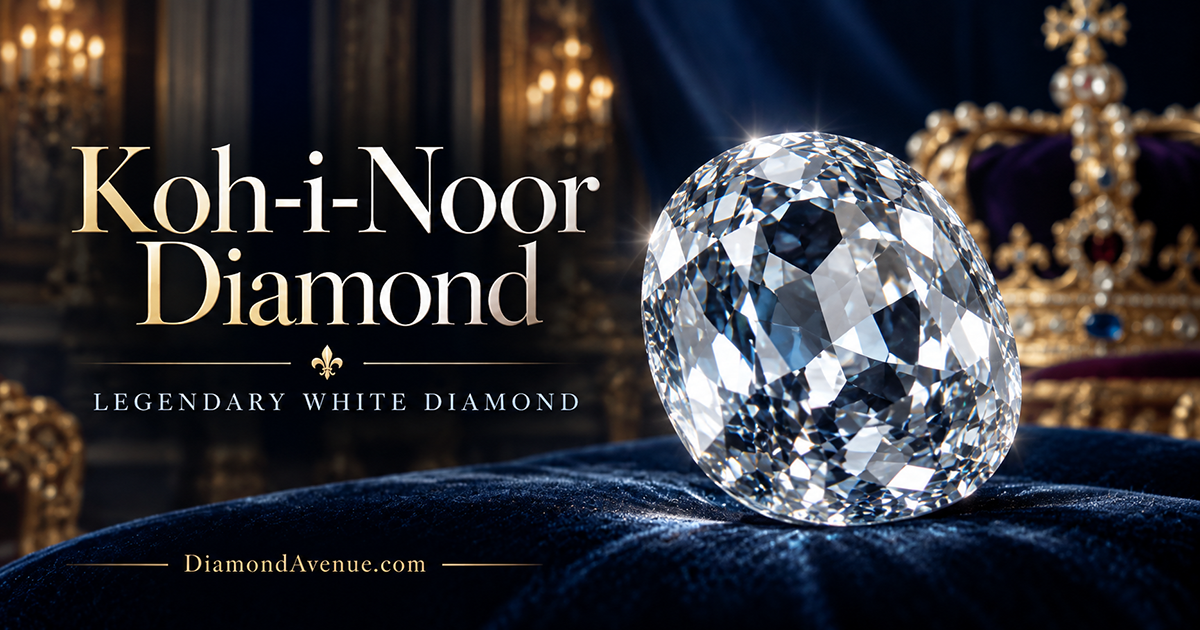
The Koh-i-Noor Diamond
The Koh-i-Noor is one of the world's most famous historic diamonds.
Its name is generally translated from Persian as "Mountain of Light."
The diamond is believed to have originated in India, probably from the famous Golconda diamond-producing region of central southern India.
Over several centuries it passed through the hands of Mughal emperors, Persian rulers, Afghan rulers and Sikh maharajas before entering British possession in the middle of the nineteenth century.
Diamond at a Glance
Name:
Koh-i-Noor Diamond
Name Meaning:
"Mountain of Light"
Probable Origin:
India
Historic Weight Before Recutting:
Approximately 186 old carats
Present Weight:
105.60 carats
Present Cut:
Oval modified brilliant
Present Setting:
Crown of Queen Elizabeth the Queen Mother
Present Location:
Crown Jewels, Tower of London
An Ancient History Surrounded by Legend
The earliest history of the Koh-i-Noor is difficult to establish with certainty.
Over the centuries, legends have attempted to trace the diamond back thousands of years and associate it with various famous stones mentioned in Indian traditions.
Modern historical and gemological research is more cautious. The Gemological Institute of America notes that the precise history of the Koh-i-Noor before approximately the sixteenth century remains uncertain.
What is much better documented is the diamond's later history as a prized possession of successive dynasties and conquering rulers.
Probable Indian Origin
The Koh-i-Noor is generally believed to have originated in India, most likely from the historic Golconda diamond fields.
Before major diamond discoveries in Brazil and later South Africa, India was the world's most important known source of diamonds.
The Golconda region became associated with some of history's most celebrated gemstones and with exceptionally pure diamonds.
A Symbol of Sovereignty
The Koh-i-Noor was never merely a valuable gemstone. It became a visible symbol of royal authority, military conquest and dynastic legitimacy.
Possession of the diamond often followed the rise and fall of empires.
This connection with political power explains much of the fascination surrounding the Koh-i-Noor and distinguishes it from diamonds known primarily for their size or beauty.
The Koh-i-Noor and the Mughal Empire
By the early modern period, the diamond had become associated with the rulers of the Mughal Empire.
The Mughal court possessed one of the greatest treasuries of jewels in the world, including exceptional diamonds, emeralds, rubies, spinels and pearls.
Gems were more than personal ornaments at the Mughal court. They represented imperial wealth, diplomatic influence and royal authority.
The diamond that would later become known as the Koh-i-Noor formed part of this extraordinary royal tradition.
Nader Shah and the Persian Conquest
In 1739, Persian ruler Nader Shah invaded northern India and captured Delhi.
The campaign resulted in the seizure of an enormous quantity of Mughal treasure, including important gemstones.
The Koh-i-Noor passed into Persian possession during this period and became associated with Nader Shah's treasury.
"Mountain of Light"
Tradition credits Nader Shah with giving the diamond the name by which it is now famous: Koh-i-Noor, commonly translated as "Mountain of Light."
Whether every detail of the naming story can be verified is uncertain, but the Persian name became permanently associated with the gemstone.
From Persia to Afghanistan
After Nader Shah was assassinated in 1747, control of his vast treasury fragmented.
The Koh-i-Noor subsequently came into the possession of Ahmad Shah Durrani, founder of the Durrani Empire in Afghanistan.
The diamond remained associated with Afghan rulers for several generations.
Its movement from Mughal India to Persia and then Afghanistan illustrates how closely the stone's ownership followed military and political power.
Maharaja Ranjit Singh
In the early nineteenth century, the Koh-i-Noor entered the treasury of Maharaja Ranjit Singh, founder of the Sikh Empire.
Ranjit Singh, often called the "Lion of the Punjab," built a powerful Sikh state centered in Lahore.
Under his rule, the Koh-i-Noor once again became a prominent symbol of sovereignty and royal power.
The Sikh Treasury
The diamond remained within the Sikh royal treasury following Ranjit Singh's death in 1839.
A period of political instability followed, with several rapid changes in leadership.
Eventually Ranjit Singh's young son, Maharaja Duleep Singh, became the ruler of the Punjab while still a child.
Maharaja Duleep Singh and the Treaty of Lahore
Following the Anglo-Sikh Wars, the British East India Company took control of the Punjab.
In 1849, Maharaja Duleep Singh was only ten years old when the settlement known as the Treaty of Lahore formally ended Sikh sovereignty.
One provision of the treaty specifically required the Koh-i-Noor Diamond to be surrendered to Queen Victoria.
Historic Royal Palaces describes the East India Company's acquisition of the stone as part of the forced surrender imposed upon the young maharaja.
This transfer remains one of the most discussed and contested chapters in the diamond's history.
The Diamond Travels to Britain
After being surrendered under the Treaty of Lahore, the Koh-i-Noor was transported from India to Britain.
The diamond was formally presented to Queen Victoria in 1850.
Its arrival attracted enormous public interest, partly because British newspapers and officials had already promoted the diamond as an extraordinary symbol of imperial power.
The Great Exhibition of 1851
The Koh-i-Noor was placed on public display at the Great Exhibition of 1851 in London's Crystal Palace.
Enormous crowds came to see the famous Indian diamond.
Yet many visitors were reportedly disappointed by its appearance. Its older style of cutting produced less sparkle under contemporary exhibition lighting than the brilliant-cut diamonds Europeans had come to expect.
The Great Recutting of 1852
Following the Great Exhibition, a decision was made to recut the Koh-i-Noor to increase its brilliance and give it an appearance more consistent with contemporary European cutting styles.
The operation was entrusted to Garrard & Co., the Crown jewelers.
Master diamond cutters from Amsterdam were brought to London, and specialized equipment was installed for the operation.
Cutting began in July 1852. The Duke of Wellington ceremonially participated in the beginning of the process.
Over approximately 38 days, the historic stone was transformed into a more brilliant oval-shaped diamond.
From About 186 Carats to 105.60
The recutting dramatically changed the Koh-i-Noor.
Before the operation, the stone weighed approximately 186 old carats.
After recutting, its finished weight was reduced to 105.60 modern carats.
Nearly half of the diamond's historic weight was sacrificed in the effort to improve its brilliance and remove imperfections.
A New Oval Brilliant
The newly fashioned Koh-i-Noor emerged as an oval modified brilliant-cut diamond.
The transformation greatly increased the number and arrangement of facets capable of returning light to the viewer.
The operation also permanently erased much of the diamond's distinctive historic form.
Queen Victoria and the Koh-i-Noor
After recutting, Queen Victoria wore the Koh-i-Noor on a number of important occasions.
The diamond appeared in different forms of royal jewelry, including a brooch and ceremonial settings.
Queen Victoria's ownership established the stone as a major component of the British royal jewel collection.
Later generations would increasingly associate the Koh-i-Noor with the crowns of British queens and queen consorts.
Queen Alexandra and Queen Mary
During the twentieth century, the Koh-i-Noor was incorporated into crowns made for British queens.
It appeared in the crown created for Queen Alexandra for the coronation of King Edward VII in 1902.
The diamond was later transferred to the crown of Queen Mary for the 1911 coronation of King George V.
Crown of Queen Elizabeth the Queen Mother
In 1937, the Koh-i-Noor was set into a new crown created for Queen Elizabeth, wife of King George VI and later known as Queen Elizabeth the Queen Mother.
The 105.60-carat diamond occupies a prominent position at the front of the crown.
It remains in this setting today as part of the British Crown Jewels.
The Koh-i-Noor Today
The Koh-i-Noor remains mounted in the Crown of Queen Elizabeth the Queen Mother.
The crown forms part of the British Crown Jewels collection maintained at the Tower of London.
Historic Royal Palaces presents the stone's history as part of the Crown Jewels exhibition, including its role as a symbol of conquest and its successive ownership by Mughal, Persian, Afghan, Sikh and British rulers.
A Continuing Debate Over Ownership
The Koh-i-Noor remains the subject of international debate because its history is inseparable from conquest, warfare and colonial expansion.
The diamond passed among several rulers and states through military victories and political upheaval long before it reached Britain.
Its transfer to British possession in 1849 is particularly controversial because the Treaty of Lahore required the surrender of the diamond by ten-year-old Maharaja Duleep Singh following the British East India Company's defeat of the Sikh Empire.
Various governments and groups in South Asia have at different times called for the return of the diamond.
The British Crown retains the Koh-i-Noor as part of the Crown Jewels, while debate over its historical ownership and possible restitution continues.
Legends of Good and Bad Fortune
Like many exceptionally famous gemstones, the Koh-i-Noor accumulated legends concerning luck, misfortune and royal power.
One later tradition held that the stone would bring misfortune to a male wearer but could safely be worn by a woman.
Such stories form part of the folklore surrounding the diamond rather than scientifically or historically demonstrable properties of the stone.
Worn Primarily by Queens
Since entering British possession, the Koh-i-Noor has indeed been prominently associated with female members of the royal family.
It has been worn or incorporated into jewelry and crowns associated with Queen Victoria, Queen Alexandra, Queen Mary and Queen Elizabeth the Queen Mother.
This historical pattern helped reinforce the popular legend concerning male wearers.
Koh-i-Noor Diamond Historical Timeline
Before the 1500s
The diamond's precise early history is uncertain,
although it is generally believed to have originated
in India.
Mughal Period
The stone becomes associated with the treasury of
the Mughal rulers of India.
1739
Persian ruler Nader Shah captures Delhi and obtains
treasures of the Mughal court, including the stone
that becomes known as the Koh-i-Noor.
1747 and After
Following Nader Shah's death, the diamond passes
into the possession of Afghan rulers.
Early 19th Century
The Koh-i-Noor enters the treasury of Maharaja
Ranjit Singh and the Sikh Empire.
1849
Following the Second Anglo-Sikh War, the Treaty of
Lahore requires ten-year-old Maharaja Duleep Singh
to surrender the Koh-i-Noor to Queen Victoria.
1850
The diamond arrives in Britain and is presented to
Queen Victoria.
1851
The Koh-i-Noor is exhibited at the Great Exhibition
in London's Crystal Palace.
1852
The diamond is recut from approximately 186 old
carats to its present 105.60-carat oval form.
1902
It is incorporated into the coronation crown of
Queen Alexandra.
1911
The diamond is transferred to the crown made for
Queen Mary.
1937
It is set in the Crown of Queen Elizabeth the
Queen Mother.
Today
The Koh-i-Noor remains part of the British Crown
Jewels and is displayed at the Tower of London.
Why the Koh-i-Noor Diamond Is Famous
The Koh-i-Noor is famous not simply because of its size, but because few gemstones have been connected with so many dynasties, empires and major historical events.
- It is one of the world's best-known historic diamonds.
- It probably originated in the historic diamond fields of India.
- Its owners included Mughal emperors.
- It passed to Persian and Afghan rulers.
- It became part of the treasury of the Sikh Empire.
- Its surrender was specifically required by the 1849 Treaty of Lahore.
- It was displayed at the Great Exhibition of 1851.
- Its controversial 1852 recutting reduced it to 105.60 carats.
- It has been associated with several generations of British queens.
- It remains part of the British Crown Jewels.
Legacy of the Koh-i-Noor
The Koh-i-Noor is far more than a large polished diamond.
Its history reflects centuries of South Asian and Central Asian political change, the rise and fall of empires, the expansion of the British East India Company and the development of the modern British Crown Jewels.
Its physical appearance has also changed dramatically. The gemstone seen today is only a little more than half the weight of the historic stone that arrived in Britain in 1850.
Yet its greatest significance lies in its remarkable provenance. Few gemstones can document so clearly the intersection of diamonds, royalty, conquest and world history.