
Diamond History
History of the Wittelsbach Diamond
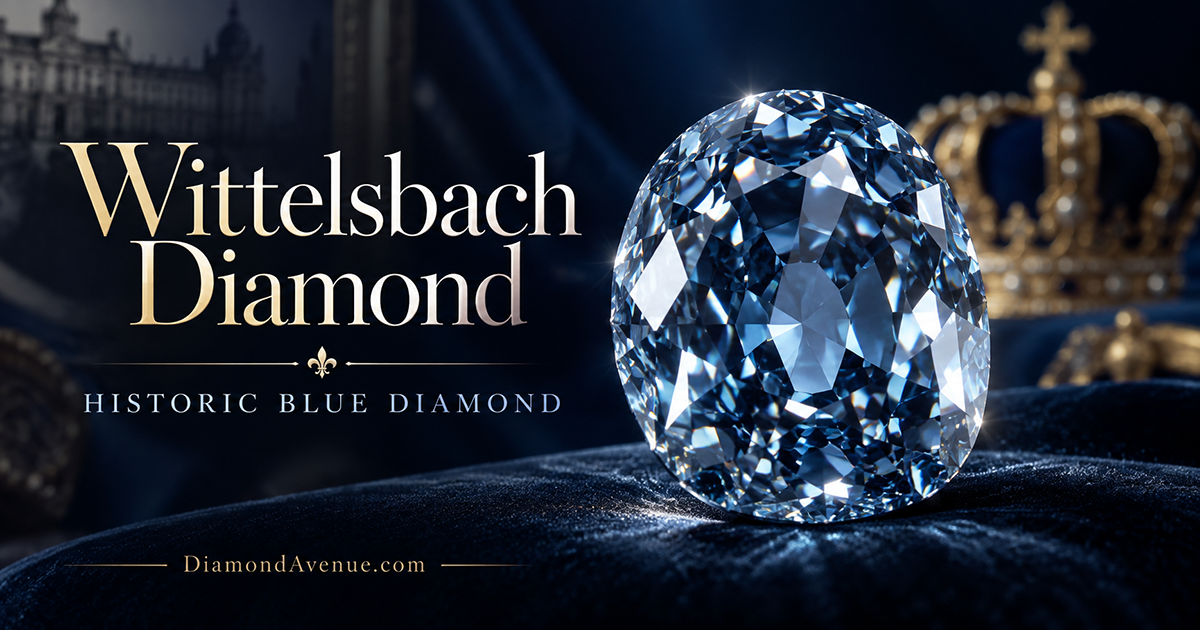
The Wittelsbach Diamond, also known historically as the Wittelsbach Blue, is one of the world's most celebrated historic blue diamonds.
Its remarkable history connects the royal houses of Spain, Austria and Bavaria and spans more than three centuries of European history.
Originally weighing 35.56 carats, the extraordinary blue diamond was purchased in 2008 by jeweler Laurence Graff and subsequently recut. The resulting 31.06-carat gemstone became known as the Wittelsbach-Graff Diamond.
Origins in India
The precise circumstances surrounding the discovery of the Wittelsbach Diamond are uncertain.
The stone is generally believed to have originated in India, most likely from the historic diamond-producing region associated with the legendary Golconda diamonds.
India was the world's principal source of important diamonds before the major discoveries in Brazil and South Africa.
1666 — A Royal Marriage
The documented European history of the diamond is associated with Infanta Margarita Teresa of Spain.
In 1666, Margarita Teresa married Leopold I, Holy Roman Emperor.
The blue diamond became associated with the Habsburg imperial family and is traditionally connected with the jewels that accompanied the Spanish princess into the Austrian royal house.
The Habsburg Connection
Through Margarita Teresa, the remarkable blue diamond became part of one of Europe's most powerful royal dynasties.
It remained connected to the Habsburg family before eventually passing through another royal marriage into the Bavarian House of Wittelsbach.
These dynastic connections gave the diamond a royal provenance rivaled by few other historic gemstones.
1722 — The House of Wittelsbach
The diamond entered the Bavarian royal family in 1722 through the marriage of Archduchess Maria Amalia of Austria to Charles Albert of Bavaria.
Charles Albert later became Holy Roman Emperor Charles VII.
From this association with Bavaria's ruling dynasty, the great blue gemstone eventually became known as the Wittelsbach Diamond.
A Bavarian Royal Treasure
For generations, the Wittelsbach Diamond formed part of the treasures of Bavaria's royal family.
During its long residence in the Bavarian royal collection, the diamond was mounted as the centerpiece of an elaborate jewel associated with the Order of the Golden Fleece.
The stone's extraordinary color, size and royal history made it one of the most important jewels belonging to the House of Wittelsbach.
The Bavarian Crown Jewels
Following the establishment of the Kingdom of Bavaria in the early nineteenth century, the Wittelsbach Diamond continued to occupy an important place among the royal treasures.
It was displayed for many years with the treasures of the Bavarian royal house at the Munich Residence.
Its long association with European royalty became an essential part of the diamond's identity and historical importance.
1931 — Offered at Auction
In 1931, members of the former Bavarian royal family offered a selection of royal jewels for sale at Christie's in London.
The Wittelsbach Diamond was included in the auction, but bidding failed to reach the required reserve price.
The diamond therefore remained unsold at the public auction and subsequently disappeared from public view.
Decades Out of Public View
For decades following the 1931 auction, the whereabouts of the Wittelsbach Diamond were largely unknown to the public.
According to historical accounts later documented by gemological researchers, the stone was secretly sold during the postwar period.
It briefly appeared anonymously at the 1958 Brussels World's Fair, although its identity was not widely recognized at the time.
Rediscovery
The famous blue diamond was recognized again in the early 1960s when it came to the attention of members of the European diamond trade.
A Belgian diamond dealer reportedly recognized the historic stone after being approached about recutting it. Rather than alter the diamond, he acquired it.
The Wittelsbach was subsequently sold to a private owner and once again disappeared from public view for several decades.
2008 — A Historic Auction
After decades in private ownership, the Wittelsbach Diamond returned dramatically to the international jewelry world in 2008.
Christie's offered the 35.56-carat historic blue diamond at auction in London on December 10, 2008.
At the time, the diamond was graded Fancy Deep grayish blue with VS2 clarity.
Laurence Graff Acquires the Diamond
London jeweler Laurence Graff purchased the Wittelsbach Diamond for £16,393,250, approximately $24.3 million at the time.
The sale established a then-record auction price for a diamond.
Graff subsequently renamed the gemstone the Wittelsbach-Graff Diamond.
The Historic Diamond Is Recut
After acquiring the diamond, Graff made the consequential decision to have the centuries-old gemstone carefully recut and repolished.
The work removed chips around the girdle, reduced the size of the large culet and was intended to enhance the diamond's appearance and color.
The recutting reduced the diamond from 35.56 carats to 31.06 carats.
Fancy Deep Blue & Internally Flawless
Following the recutting, the Gemological Institute of America (GIA) graded the Wittelsbach-Graff Diamond Fancy Deep blue.
Its clarity improved from VS2 to Internally Flawless.
The finished gemstone weighs 31.06 carats and remains one of the world's most significant natural blue diamonds.
A Rare Type IIb Blue Diamond
The Wittelsbach-Graff belongs to the exceptionally rare Type IIb category of diamonds.
Natural blue diamonds of this type commonly owe their color to trace amounts of boron within their crystal structure.
Like the famous Hope Diamond, the Wittelsbach-Graff displays unusual red phosphorescence after exposure to ultraviolet light.
Connection to the Hope Diamond
Because the Wittelsbach and Hope diamonds share several unusual characteristics, historians and gemologists long wondered whether the two stones might have been cut from the same original diamond crystal.
Both are rare Type IIb blue diamonds believed to have originated in India, and both exhibit red phosphorescence.
Scientific testing by GIA researchers ultimately found that the two famous diamonds did not originate from the same parent crystal.
2010 — The Wittelsbach-Graff Meets the Hope Diamond
From January through September 2010, the Wittelsbach-Graff Diamond was displayed alongside the Hope Diamond at the Smithsonian Institution's National Museum of Natural History in Washington, D.C.
It was the first time the two legendary blue diamonds had been displayed together, giving gemologists a rare opportunity to study and compare them directly.
Original Historic Weight
35.56 Carats
Weight of the historic Wittelsbach Blue before the Graff recutting.
Current Weight
31.06 Carats
Weight after the diamond was recut and repolished following its 2008 acquisition.
Current GIA Grade
Fancy Deep Blue
Internally Flawless
The grading achieved following the recutting of the historic stone.
From the Wittelsbach Diamond to the Wittelsbach-Graff
The gemstone's two principal names reflect two distinct chapters in its extraordinary history.
Wittelsbach Diamond or Wittelsbach Blue refers primarily to the historic 35.56-carat diamond associated for generations with the Bavarian royal family.
Wittelsbach-Graff Diamond refers to the 31.06-carat gemstone created after Laurence Graff purchased and recut the historic diamond following the 2008 Christie's auction.
Although its weight and gemological grading changed, the extraordinary blue diamond retains a direct physical and historical connection to one of Europe's most famous royal jewels.
Legacy of the Wittelsbach Diamond
Few diamonds combine exceptional color, rarity and royal provenance as dramatically as the Wittelsbach.
Its journey from India to the royal courts of Spain, Austria and Bavaria, its disappearance from public view, its rediscovery and its transformation into the Wittelsbach-Graff Diamond make it one of the most fascinating gemstones in diamond history.
Today, the name Wittelsbach remains inseparably linked with centuries of European royal history and with one of the world's most extraordinary natural blue diamonds.